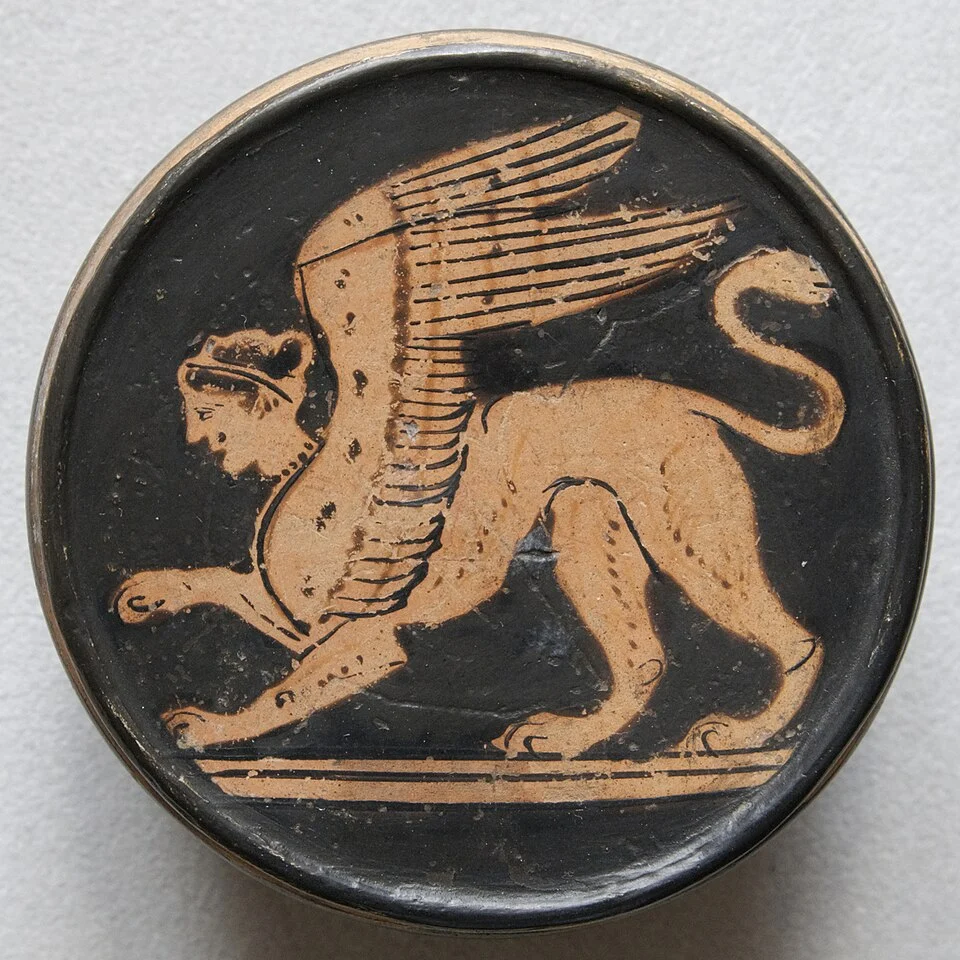
Sphinx (Egyptian)
Image associated with the exact linked encyclopedia article; consult credited file description for its interpretation.
Overview
The Greek Sphinx is best known as the destructive riddle-setter defeated by Oedipus at Thebes. Ancient literary witnesses also give her differing parents and reinterpret her as a human raider or royal claimant. Surviving Greek sphinx sculptures include funerary guardians, so the broader artistic figure cannot be reduced to one episode or treated as interchangeable with Egyptian royal imagery.
In the inspected Evelyn-White translation of Hesiod’s Theogony, the Sphinx appears in the monster genealogy following the Chimaera. The translation names Echidna and Orthus as her parents and associates the Nemean lion with the same union. Her brief identification concerns destruction among the Cadmeans, the people of Thebes. This poetic notice does not narrate Oedipus’s question-and-answer encounter. Its parentage also differs from the later Library, which names Typhon as her father.
Library III.5.8 says Hera sent the Sphinx during Creon’s rule. Echidna and Typhon’s daughter has a woman’s face, a lion’s breast, feet and tail, and a bird’s wings. The Muses teach her a riddle, which she poses from Mount Phicium. The Thebans repeatedly debate it, but failed answers cost lives, finally including Creon’s son Haemon. Creon promises both kingship and Laius’s widow to the successful solver. Oedipus explains the changing count of supports through human life: crawling on four limbs, walking on two legs, then relying on a staff in old age. The Sphinx throws herself from the citadel. Oedipus gains the kingdom and unknowingly marries his mother. The surrounding narrative makes victory part of the chain leading into the family’s catastrophe.
Sophocles’s Oedipus the King begins after the Sphinx’s defeat, during a new crisis. The priest recalls Oedipus’s rescue of the city as a reason to trust him again. Creon explains that the Sphinx’s immediate threat had prevented investigation of Laius’s murder. Later, Oedipus uses his success against her to attack Teiresias’s authority, asserting that his own intelligence solved what the prophet had not. The final chorus recalls the famed riddle-solver while confronting his ruin. In these selected speeches the earlier monster encounter supplies political legitimacy, a disputed claim to knowledge and a painful contrast with the king’s discovery of his identity. It is not a newly staged confrontation with the Sphinx.
Pausanias IX.26.2–4 records alternative explanations near the mountain associated with her. One makes her a pirate commander who landed at Anthedon and raided from the mountain until Oedipus defeated her with a larger army. Another makes her Laius’s daughter, entrusted with an oracle known to the royal line. She challenges rival sons to disclose it and kills those who cannot establish their claim; Oedipus learns the oracle in a dream. These are versions reported by Pausanias, not corroborated biographies or facts to combine with the winged monster’s ancestry.
The Metropolitan Museum’s Attic marble capital and sphinx finial, accession 11.185d, x, dates to about 530 BCE and originally crowned a grave marker for a youth and a little girl. The catalogue identifies the winged female sphinx as a guardian of the dead. Red, black and blue pigment survives, while the separate carving, socket, metal dowel and lead setting reveal how the figure was attached to its capital. This physical evidence documents an ancient funerary object and its manufacture. It does not identify the statue as a portrait of the particular creature confronted by Oedipus or establish that a composite animal existed.
Origins & earliest records
Hesiod’s Archaic poem is the earliest literary witness examined here. The selected Attic marble finial dates to about 530 BCE. Neither establishes the first oral story or earliest representation worldwide. The Library preserves a developed Theban account centuries later, while Sophocles’s earlier tragedy repeatedly recalls the Sphinx’s defeat.
Records & interpretation
Genealogical poetry, dramatic dialogue, mythography and travel writing preserve different accounts. The surviving marble finial separately documents artistic production and funerary use. Orthus versus Typhon parentage belongs to distinct literary witnesses; Pausanias’s human explanations are reported alternatives. These materials support cultural history, not a biological lineage or proof of a woman-lion-bird organism.
In the literature
“It had the body of a lion, and the upper part of a woman.”
Chapter X, “The Sphinx”, encounter with Oedipus
Refers to the Greek Theban Sphinx, not Egyptian royal sphinx iconography.
“the deadly Sphinx which destroyed the Cadmeans,”
Theogony, lines 306–332 · Hugh G. Evelyn-White
The Greek Sphinx afflicts the Cadmeans; surrounding grammar places her among the offspring of Echidna and Orthrus.
“The riddling Sphinx compelled us to let slide The dim past and attend to instant needs.”
Opening Creon–Oedipus exchange, reply explaining why Laius’s murder was not investigated · Francis Storr
Creon identifies the former Sphinx crisis as the obstacle to investigating Laius’s death.
Selected bibliography
Documented works and useful reading. This is not a list of every appearance.
- 01
Theogony, monster genealogy at lines 326–332
Brief Sphinx and Nemean lion notice; parentage reported as rendered in this translation.
- 02
The Library III.5.7–9
Theban episode and adjoining Oedipus narrative, with anatomy, riddle, victims, reward and outcome at III.5.8.
- 03
Oedipus the King
Opening appeals, Creon’s account, confrontation with Teiresias and final chorus: recollections of the earlier defeat.
- 04
Description of Greece IX.26.2–4
Complete located mountain notice and two alternative human explanations, attributed rather than asserted as history.
- 05
Theogony, in Hesiod, the Homeric Hymns, and Homerica
Historical English translation; translator’s preface dated 9 September 1914. Gutenberg includes the English portions and relocated footnotes.
- 06
Bulfinch’s Mythology: The Age of Fable (revised by E. E. Hale)
Exact contiguous excerpt checked against the linked primary e-text on 2026-10-05; only whitespace normalized. Work first published 1855; date of the Hale revision used by this e-text is not specified.
- 07
The Library (Bibliotheca)
Pseudo-Apollodorus, The Library, James George Frazer translation, Loeb Classical Library 121–122; Harvard University Press / William Heinemann, 1921.
- 08
Description of Greece, BookIX: Theban Sphinx alternatives
HistoricalW.H.S.Jones English translation explicitly identified in hosted PausaniasBookIX. Exact selected print year not established in the inspected chapter. Complete IX26.2–4 independently reread; later26.5–8 only incidental context. NLI indexed official catalogue records volumeIV (BooksVIII.22–X)1935: https://catalogue.nli.ie/Record/vtls000527334/TOC . This is the historical volume publication date, not a newly identified hosted impression. Direct catalogue opening returned403; indexed official record inspected.
- 09
Oedipus the King: selected Sphinx recollections
FrancisStorr English translation, Loeb edition first published1912 explicitly identified in Gutenberg31. Only opening/priest and Creon Laius inquiry, Oedipus–Teiresias Sphinx comparison and reply, and final chorus independently read; no full-play coverage claim.
Family, evolution & connections
Textual genealogy: selected children of Typhon and Echidna in Library
Explicit named parentage in Library 2.3.1, 2.5.10, 2.5.11 and 3.5.8.
Scroll sideways to see all branches. With a keyboard, focus the tree and use the arrow keys.
- Parents: Typhon and Echidna
Combine four explicit parentage statements within one named work, keeping each creature under the stated Typhon–Echidna pair. This is a selected version attributed to Pseudo-Apollodorus. The Hesperides' dragon is identified with the Ladon profile, although this passage calls it the dragon rather than using that name. Hesiod gives that dragon different parents; the alternative remains separate. Sphinx means the Greek figure. Fosterers, killers and owners are not parents.
Typhon
The Library names Typhon as the father of the Theban Sphinx, whose mother is Echidna. That account differs from Hesiod’s Orthrus genealogy. The connection therefore needs a source label in any family tree; it is a documented textual variant, not an error that should be flattened into a single modern consensus.
Echidna
The Library explicitly names Echidna as the Sphinx’s mother before recounting the riddle and Oedipus’ answer. This is a literary kinship assertion within that work. It does not explain the historical origin of sphinx images, and it should remain separate from comparisons with Egyptian royal sphinx sculpture.
Located primary passages
Specific passages supporting details in this entry, grouped by their published witness.
Primary source witness
Historical English translation; translator’s preface dated 9 September 1914. Gutenberg includes the English portions and relocated footnotes.
- The Greek Sphinx afflicts the Cadmeans; surrounding grammar places her among the offspring of Echidna and Orthrus.
This passage documents one ancient literary version. Translation publication dates are not ancient composition dates or earliest-attestation claims.
Bulfinch’s Mythology: The Age of Fable (revised by E. E. Hale)
Exact contiguous excerpt checked against the linked primary e-text on 2026-10-05; only whitespace normalized. Work first published 1855; date of the Hale revision used by this e-text is not specified.
- Refers to the Greek Theban Sphinx, not Egyptian royal sphinx iconography.
Literary witness only. Bulfinch is a nineteenth-century reteller rather than the ancient origin text. Matching is limited to the specified profile and does not cross franchise, culture or animal-species boundaries.
The Library III.5.7–9
Pseudo-Apollodorus, The Library, James George Frazer translation, Loeb Classical Library 121–122; Harvard University Press / William Heinemann, 1921.
- Hera sends the Sphinx; this version gives Echidna and Typhon as her parents.
- The Sphinx learns her riddle from the Muses and challenges Thebans from Mount Phicium.
- After Oedipus identifies the riddle’s answer as man, the Sphinx throws herself from the citadel.
A version-specific primary witness, not an earliest-attestation claim or proof of zoological existence.
The Library III.5.7–9
Frazer1921 historical English translation; LibraryIII5.7–9 independently reread in retained HTML, not full work.
- Oedipus’s exposure, adoption and fatal road encounter precede Hera’s sending of the Sphinx, daughter of Echidna and Typhon, with woman’s face, leonine body parts and bird wings. Learning the Muses’ riddle, she kills Thebans unable to answer, finally Haemon. Creon offers kingdom and Laius’s widow. Oedipus answers man; she throws herself from the citadel, and he unwittingly marries his mother. The later revelation brings Jocasta’s suicide and Oedipus’s blinding/exile.
All earlier isolated Sphinx facts remain supported; this coverage adds the complete specified setting, Haemon/reward and aftermath. Alternative Eurygania maternity is explicitly mentioned by the source, not collapsed into Jocasta.
Description of Greece IX.26.2–4
HistoricalW.H.S.Jones English translation explicitly identified in hosted PausaniasBookIX. Exact selected print year not established in the inspected chapter. Complete IX26.2–4 independently reread; later26.5–8 only incidental context. NLI indexed official catalogue records volumeIV (BooksVIII.22–X)1935: https://catalogue.nli.ie/Record/vtls000527334/TOC . This is the historical volume publication date, not a newly identified hosted impression. Direct catalogue opening returned403; indexed official record inspected.
- Pausanias places the fatal riddle tradition at a mountain, then reports a pirate-led force defeated by Oedipus’s superior army. Another version makes the Sphinx Laius’s natural daughter, entrusted with Cadmus’s oracle. She challenges rival brothers to prove legitimacy through knowledge of it and kills those who fail; Oedipus succeeds because he learns the oracle in a dream.
Riddle-monster, raiding commander and royal daughter are reported alternatives, not a single imposed biography. Oracle legitimacy test is not silently replaced by Apollodorus’s four/two/three-foot question.
Oedipus the King
FrancisStorr English translation, Loeb edition first published1912 explicitly identified in Gutenberg31. Only opening/priest and Creon Laius inquiry, Oedipus–Teiresias Sphinx comparison and reply, and final chorus independently read; no full-play coverage claim.
- The priest recalls Oedipus’s deliverance from the deadly songstress and Creon explains that her riddle diverted inquiry into Laius’s killing. In the later confrontation Oedipus claims he solved what Teiresias could not through his own wit, while Teiresias challenges his knowledge of himself and says that skill brought his ruin. The final chorus contrasts the former riddle-solver’s greatness with his fall.
Oedipus the King, opening priest/Creon exchange; Oedipus–Teiresias confrontation; final chorus
The Sphinx is recalled before the play’s present action; no new onstage encounter, quoted riddle wording or full-play reading asserted. Oedipus’s self-praise and other speakers’ accounts remain distinguished.
Encyclopedia background
An additional attributed reference, separate from the editorial profile above.
Read the open encyclopedia overview
A sphinx ( SFINKS; Ancient Greek: σφίγξ, pronounced [spʰíŋks]; pl. sphinxes or sphinges ) is a mythical creature with the head of a human, the body of a lion, and the wings of an eagle.
In Greek tradition, the sphinx is a treacherous and merciless being with the head of a woman, the haunches of a lion, and the wings of a bird.
According to Greek myth, she challenges those who encounter her to answer a riddle, and kills and eats them when they fail to solve the riddle. This deadly version of a sphinx appears in the myth and drama of Oedipus.
In Egyptian mythology, in contrast, the sphinx is typically depicted as a man (an androsphinx (Ancient Greek: ἀνδρόσφιγξ)), and is seen as a benevolent representation of strength and ferocity, usually of a pharaoh. Unlike Greek or Levantine/Mesopotamian ones, Egyptian sphinxes were not winged.
Both the Greek and Egyptian sphinxes were thought of as guardians, and statues of them often flank the entrances to temples. During the Renaissance, the sphinx enjoyed a major revival in European decorative art. During this period, images of the sphinx were initially similar to the ancient Egyptian version, but when later exported to other cultures, the sphinx was often conceived of quite differently, partly due to varied translations of descriptions of the originals, and partly through the evolution of the concept as it was integrated into other cultural traditions.
However, depictions of the sphinx are generally associated with grand architectural structures, such as royal tombs or religious temples.
Text from Wikipedia contributors, “Sphinx”. CC BY-SA 4.0. Extracted introduction; formatting changed. Retrieved 5 October 2026. The source article may have changed since retrieval.
References
Sources supporting this profile. Linked pages have their own scope and editorial standards.
- Primary literary translationHesiod, Theogony, Evelyn-White translationResearch access: 2026-10-05
- Primary literary translationFrazer’s Library III.5.7–9Research access: 2026-10-05
- Primary literary translationSophocles, Oedipus the King, Storr translationResearch access: 2026-10-05
- Primary literary translationPausanias IX.26.2–4, Jones translationResearch access: 2026-10-05
- Museum collection recordMetropolitan Museum, marble sphinx finial 11.185d, xResearch access: 2026-10-05
Image credits
Reference illustrationSphinx (Egyptian)
Image associated with the exact linked encyclopedia article; consult credited file description for its interpretation.