Lernaean Hydra
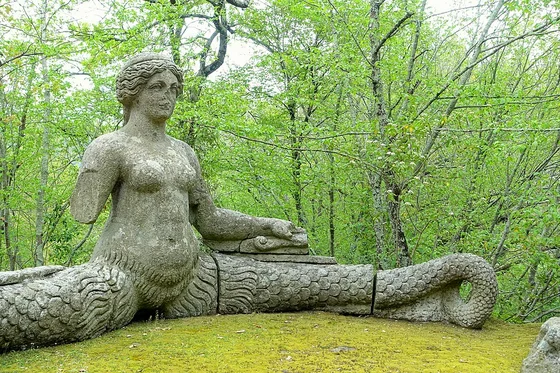
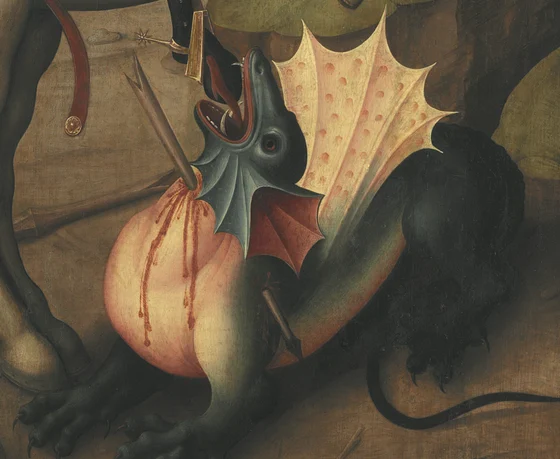
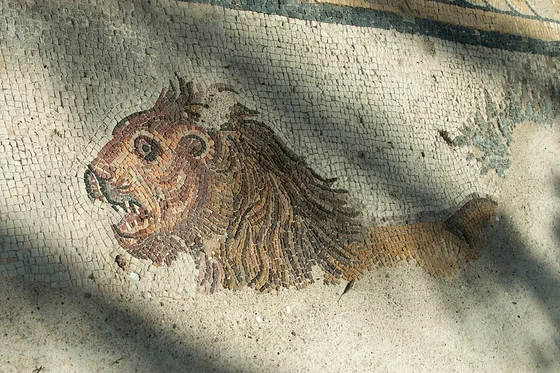
Image associated with the exact linked encyclopedia article; consult credited file description for its interpretation.
Overview
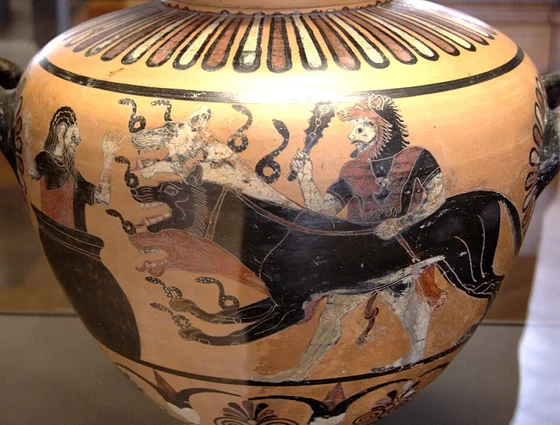
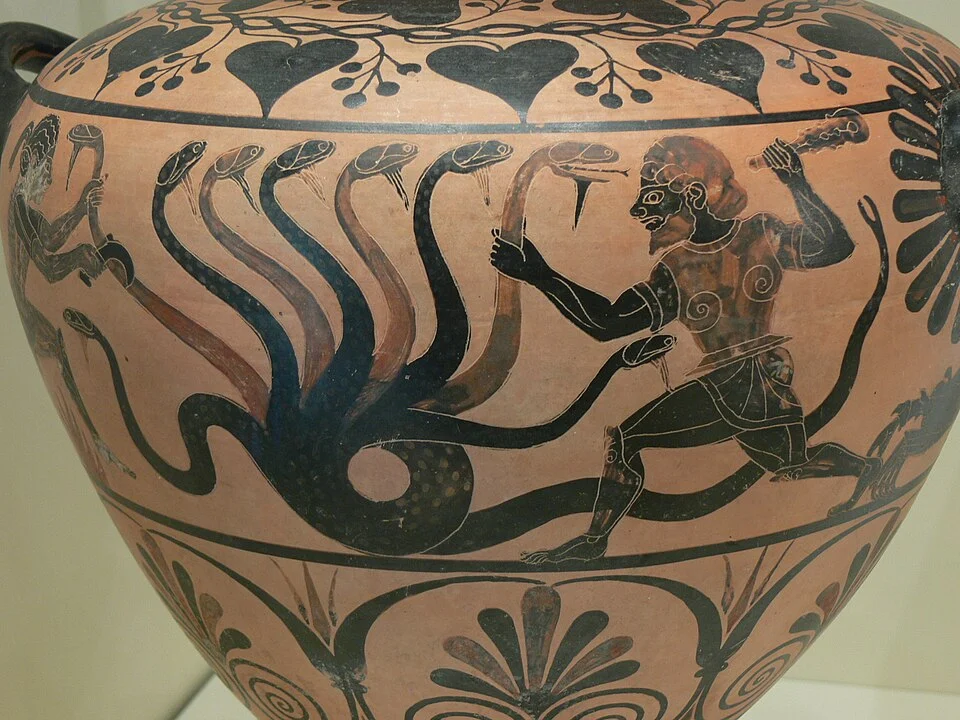
The Library places the Hydra in the wet country of Lerna, from which it ravages cattle and the surrounding land. Its nine heads include an immortal central one. When Heracles smashes a head, two grow in its place, so simply applying more force worsens the danger. A crab intervenes on the monster’s side, adding another complication to the fight.
Iolaus burns the severed necks to prevent regrowth, while Heracles buries the immortal head beneath a heavy stone. The creature’s harmful substance also enters the continuing story through the hero’s arrows. Eurystheus rejects the labor because help was needed, making the episode a dispute about what counts as an individual achievement. Other ancient accounts should be checked separately for different head counts.
The Library supplies further details of the encounter’s geography and tactics. Heracles arrives in a chariot driven by Iolaus and finds the den on a hill beside the springs of Amymone. Fiery missiles force the Hydra out; it coils around one of his feet while the crab bites that foot. Iolaus sets fire to neighbouring woodland and uses its brands on the neck-roots. The immortal head is buried under a heavy rock beside the road from Lerna to Elaeus, and Heracles coats his arrows with gall from the opened body. These particulars belong to this mythographer’s account; the continuing arrows do not imply that the severed body revives.
Hesiod’s Theogony, lines 313–318, gives an earlier poetic witness within the offspring of Echidna and Typhaon. Hera nurtures the Lernaean Hydra in hostility to Heracles. Heracles and Iolaus destroy it with a pitiless weapon through Athena’s plans. This short passage confirms the helper’s role and divine opposition and assistance, but it does not specify nine heads, an immortal central head, the crab or the regrowth mechanism. Those details should not be silently assigned to Hesiod merely because they occur in the later Library.
Pausanias, Description of Greece 2.37.4, reports a plane tree at the source of Amymone under which the Hydra was said to have grown. He accepts a water-snake of exceptional size and unusually deadly poison, linking its gall to Heracles’ arrows, but gives his own opinion that it had one head. He attributes the frightening multiplication of heads to the poet Peisander of Camirus. This is a named ancient writer’s rationalising interpretation of a local story, not independent proof of a real monster or grounds for replacing the Library’s nine-headed representation.
Origins & earliest records
Hesiod’s Theogony 313–318 preserves an archaic Greek poetic witness. The selected comparison also uses Pseudo-Apollodorus, Library 2.5.2, and Pausanias, Description of Greece 2.37.4; their dates identify different literary witnesses, not a securely dated beginning of the tradition.
Records & interpretation
Located ancient poem, mythographic narrative and travel account preserve different levels of description and an explicit ancient disagreement over head count.
In the literature
“The Hydra had nine heads, of which the middle one was immortal.”
Chapter XII, “Hercules”, second labour
A specific literary head count; other classical versions vary.
“the evil-minded Hydra of Lerna, whom the goddess, white-armed Hera nourished,”
Theogony, lines 306–332 · Hugh G. Evelyn-White
Hera nurtures the Hydra as an adversary of Heracles.
“together with warlike Iolaus, destroyed with the unpitying sword”
Theogony, lines 306–332 · Hugh G. Evelyn-White
The surrounding sentence credits Heracles and Iolaus with the Hydra’s destruction through Athena’s plans.
Selected bibliography
Documented works and useful reading. This is not a list of every appearance.
- 01
The Library, Book II, 2.5.2
Selected primary passage; wording is summarized independently, and incompatible later versions are not silently combined.
- 02
Theogony, lines 313–318
Hydra within Echidna and Typhaon offspring; Hera nurtures her, Heracles and Iolaus kill her through Athena’s plans. No head count given.
- 03
Description of Greece, 2.37.4
Local Amymone plane-tree report and explicitly attributed one-head interpretation; Peisander’s poetic multiplication of heads.
- 04
Theogony, in Hesiod, the Homeric Hymns, and Homerica
Historical English translation; translator’s preface dated 9 September 1914. Gutenberg includes the English portions and relocated footnotes.
- 05
Bulfinch’s Mythology: The Age of Fable (revised by E. E. Hale)
Exact contiguous excerpt checked against the linked primary e-text on 2026-10-05; only whitespace normalized. Work first published 1855; date of the Hale revision used by this e-text is not specified.
- 06
The Library (Bibliotheca)
Pseudo-Apollodorus, The Library, James George Frazer translation, Loeb Classical Library 121–122; Harvard University Press / William Heinemann, 1921.
Family, evolution & connections
Textual genealogy: Typhaon and Echidna in Theogony
The three sequentially enumerated offspring at Theogony lines 306–318.
Scroll sideways to see all branches. With a keyboard, focus the tree and use the arrow keys.
- Parents: Typhaon (Typhon) and Echidna
Follow the explicitly named pairing of Typhaon and Echidna and the first, second and third offspring in Evelyn-White's translation. Selected parentage in Hesiod. Typhaon is the name used here for Typhon. Later Chimera and Sphinx passages involve interpretive pronoun questions; those are not silently appended. Hera's nourishment of Hydra is not maternity. No claim of zoological ancestry.
Cerberus
The Theogony places the Lernaean Hydra after Orthrus and Cerberus among Echidna’s offspring. Within that passage Hydra and Cerberus occupy sibling positions despite very different bodies. This is a literary family connection; it does not identify a common real animal ancestor or make all later mythographers agree.
Echidna
Hesiod lists the Lernaean Hydra as Echidna’s third offspring after describing her union with Typhaon. The poem then says Hera nourished the Hydra in opposition to Heracles. Maternal parentage and foster nourishment are different relationships: this edge records Echidna as the stated mother without turning Hera’s care into birth, adoption law or biological ancestry.
Typhon
After describing Typhaon’s union with Echidna, Hesiod lists Orthus, Cerberus and the Hydra as their first, second and third offspring. This supplies the Hydra’s paternal relation in that sequence; Hera’s subsequent nourishment of the Hydra is distinct from biological parentage.
Located primary passages
Specific passages supporting details in this entry, grouped by their published witness.
Primary source witness
Historical English translation; translator’s preface dated 9 September 1914. Gutenberg includes the English portions and relocated footnotes.
- Hera nurtures the Hydra as an adversary of Heracles.
- The surrounding sentence credits Heracles and Iolaus with the Hydra’s destruction through Athena’s plans.
This passage documents one ancient literary version. Translation publication dates are not ancient composition dates or earliest-attestation claims.
Bulfinch’s Mythology: The Age of Fable (revised by E. E. Hale)
Exact contiguous excerpt checked against the linked primary e-text on 2026-10-05; only whitespace normalized. Work first published 1855; date of the Hale revision used by this e-text is not specified.
- A specific literary head count; other classical versions vary.
Literary witness only. Bulfinch is a nineteenth-century reteller rather than the ancient origin text. Matching is limited to the specified profile and does not cross franchise, culture or animal-species boundaries.
The Library, Book II, 2.5.2
Pseudo-Apollodorus, The Library, James George Frazer translation, Loeb Classical Library 121–122; Harvard University Press / William Heinemann, 1921.
- The Hydra has nine heads, with an immortal middle head in this version.
- Two heads regrow when Hercules smashes one.
- Iolaus burns the head roots to prevent regrowth.
- The immortal severed head is buried beneath a heavy rock.
A version-specific primary witness, not an earliest-attestation claim or proof of zoological existence.
Encyclopedia background
An additional attributed reference, separate from the editorial profile above.
Read the open encyclopedia overview
The Lernaean Hydra or Hydra of Lerna (Ancient Greek: Λερναῖα ὕδρα, romanized: Lernaîa Húdrā), more often known simply as the Hydra, is a serpentine lake monster in Greek mythology and Roman mythology. Its lair was the lake of Lerna in the Argolid, which was also the site of the myth of the Danaïdes. Lerna was reputed to be an entrance to the Underworld, and archaeology has established it as a sacred site older than Mycenaean Argos. In the canonical Hydra myth, the monster is killed by Heracles (Hercules) as the second of his Twelve Labours.
According to Hesiod, the Hydra was the offspring of Typhon and Echidna. It had poisonous breath and blood so virulent that even its scent was deadly. The Hydra possessed many heads, the exact number of which varies according to the source. Later versions of the Hydra story add a regeneration feature to the monster: for every head chopped off, the Hydra would regrow two heads. Heracles required the assistance of his nephew Iolaus to cut off all of the monster's heads and burn the neck using a sword and fire.
In ancient Greece, the proverbial expression Ὕδραν τέμνειν, meaning 'cutting off a hydra,' was used to describe tasks that are hopeless or endlessly futile, drawing from the myth of the Hydra's regenerative heads.
Text from Wikipedia contributors, “Lernaean Hydra”. CC BY-SA 4.0. Extracted introduction; formatting changed. Retrieved 5 October 2026. The source article may have changed since retrieval.
References
Sources supporting this profile. Linked pages have their own scope and editorial standards.
- Primary textThe Library, Book II: 2.5.2 (Theoi Classical Texts Library or Project Gutenberg transcription)Research access: 2026-10-05
- Primary ancient poem in historical translationHesiod: Theogony, Evelyn-White1914Research access: 2026-10-05
- Primary ancient travel account in historical translationPausanias: Description of Greece II, Jones1918Research access: 2026-10-05
Image credits
Reference illustrationLernaean Hydra
Image associated with the exact linked encyclopedia article; consult credited file description for its interpretation.