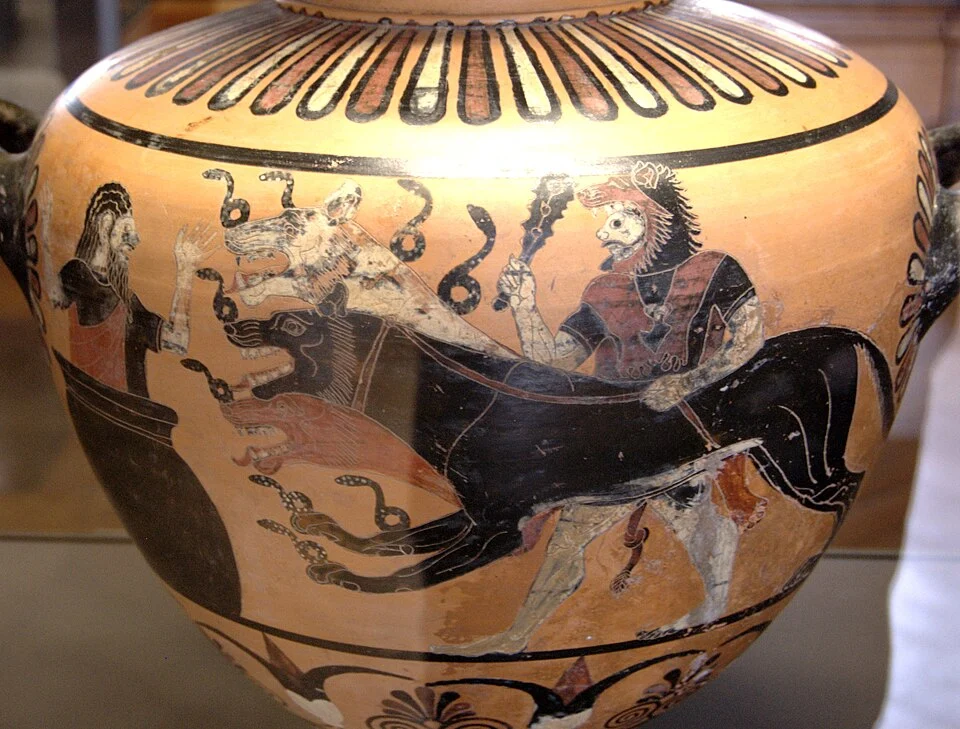
Cerberus
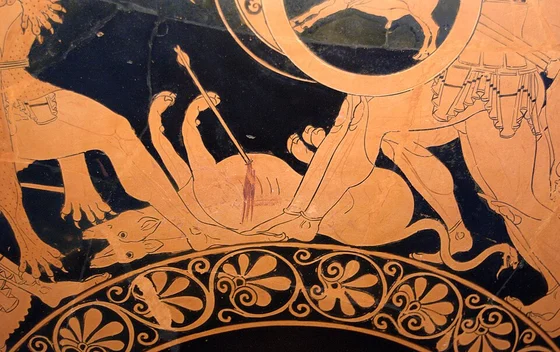
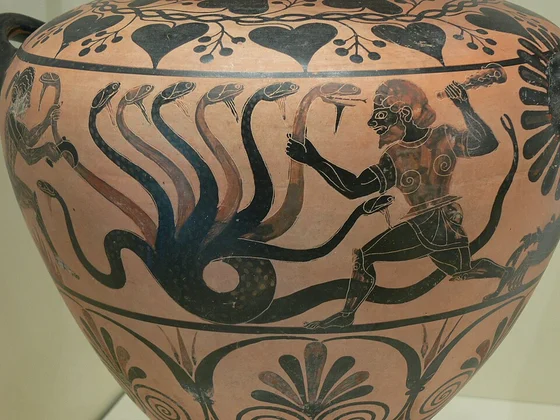
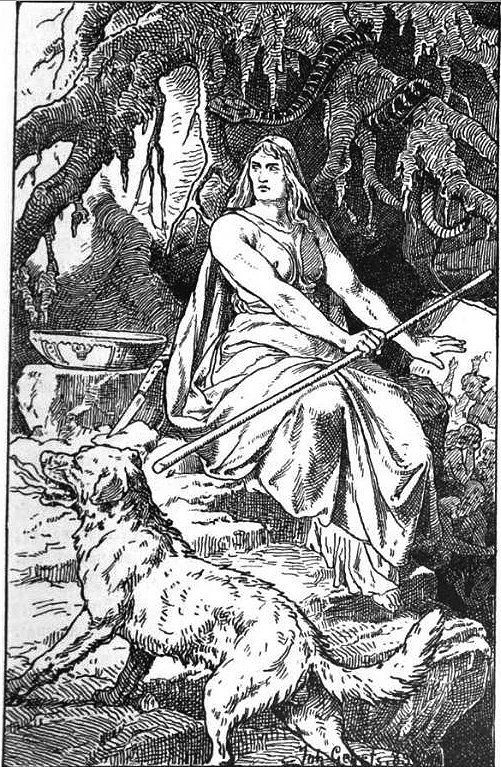
Image associated with the exact linked encyclopedia article; consult credited file description for its interpretation.
Overview
Cerberus is the hound associated with the Greek and Roman underworld, but the surviving writers do not give him one consistent anatomy or encounter. The familiar three-headed form is one ancient version. Hesiod names a fifty-headed creature, while the selected Homeric passages refer to the hound of Hades without naming Cerberus or specifying a head count. The variation belongs to the literary record itself; it does not require inventing different biological species for each poet.
In Hesiod’s Theogony, the passage beginning at line 306 places Cerberus among the offspring of Echidna and Typhaon, after Orthus and before the Lernaean Hydra. The poem emphasizes his terrible voice, strength and appetite for raw flesh. In its later account of Hades and Persephone’s halls, beginning at line 767, the guardian has a deceptive hospitality: he welcomes those arriving with movements of his ears and tail, yet attacks anyone he catches trying to depart. The asymmetry between entry and return explains his particular role at the boundary of death.
The Iliad’s Book VIII allusion occurs in Athena’s speech about her assistance to Heracles. In Odyssey XI, Heracles’ shade tells Odysseus that fetching the underworld hound was an exceptionally fearful command, accomplished with help from Hermes and Athena. These are brief recollections of the labour, rather than the detailed capture scene found in later mythography. Their unnamed hound should not silently inherit every anatomical feature supplied by another author.
Pseudo-Apollodorus’s Library 2.5.12 makes the capture Heracles’ twelfth labour. Its Cerberus has three canine heads, a dragon’s tail and further snake heads along his back. Before descending at Taenarum, Heracles undergoes purification and initiation at Eleusis. The subsequent underworld journey includes encounters with other dead figures, but his permission to remove the hound comes from Pluto and has a precise condition: he must overpower it without the weapons he brought. His armour and lion skin remain part of the encounter. At the gates of Acheron he holds Cerberus despite bites from the creature’s tail, forcing it to yield. He ascends through Troezen, displays the captive to Eurystheus and finally returns it to Hades. This account describes temporary capture, not the guardian’s death.
Virgil supplies two different ways past the same formidable guardian. In Aeneid VI, the Sibyl throws a honeyed preparation mixed with drugs to the three-mouthed hound. It eats, falls asleep and fills its cave, allowing Aeneas to pass. In Georgics IV, Cerberus’ triple jaws instead hang open amid the underworld’s astonishment at Orpheus’ music. Neither scene is Heracles’ wrestling capture, and the musical encounter is part of the larger, ultimately unsuccessful recovery of Eurydice.
Pausanias records disagreement within antiquity as well as stories about particular places. At Taenarum he questions the supposed underground route and reports Hecataeus of Miletus’s explanation that the hound was actually a deadly local serpent brought to Eurystheus. He also observes that Homer did not name or give a composite body to the creature. This is an ancient rationalizing interpretation, preserved by a later author; it is not independent zoological confirmation or a demonstrated origin of the entire tradition. Cerberus’ connections with Orthus and the Hydra are therefore presented as Hesiodic kinship, while alternative bodies, locations and encounters remain attached to their own witnesses.
Origins & earliest records
The Homeric allusions and Hesiod’s named, fifty-headed hound establish early Greek literary witnesses before the selected Roman-period mythographic account. Their precise relationship to earlier oral storytelling is not recoverable from these passages alone. The modern translations are access witnesses, not the dates of the underlying compositions. No claim is made here to have established the earliest surviving visual representation or one global origin for underworld guard animals.
Records & interpretation
The inspected poems, mythographic labour and travel account document different ancient representations and interpretations. They supply named kinship, head counts, capture conditions and literary encounters, rather than physical evidence of a multiheaded underworld animal. Hecataeus’s serpent explanation is known here through Pausanias and remains an attributed interpretation; neither its plausibility to that author nor resemblance to a real snake establishes Cerberus as an identified living species.
In the literature
“Cerberus, the three-headed dog”
Chapter VI, “Cupid and Psyche”, instructions for the journey to Proserpine
Brief naming excerpt from Psyche’s underworld journey.
“Cerberus who eats raw flesh, the brazen-voiced hound of Hades, fifty-headed, relentless and strong.”
Theogony, lines 306–332 · Hugh G. Evelyn-White
Hesiod’s fifty-headed Cerberus differs from the familiar three-headed representation.
“On those who go in he fawns”
Theogony767–774 · Hugh G. Evelyn-White
Deceptive welcome contrasts with the guardian’s prevention of exit.
“With three enormous mouths he gapes”
AeneidVI, Cerberus encounter after Charon crossing · John Dryden
Dryden’s guardian takes the Sibyl’s sop and falls asleep;1697 is first translation publication, selected print edition unresolved.
Selected bibliography
Documented works and useful reading. This is not a list of every appearance.
- 01
Theogony, lines 306 onward and 767–774
Complete selected genealogy and guardian passages inspected; fifty heads and the contrasting treatment of arrivals and departures.
- 02
Iliad VIII.366 onward
Located excerpt inspected, not the complete book; unnamed hound in Athena’s recollection.
- 03
Odyssey XI.623 onward
Located excerpt inspected; Heracles recalls the labour and divine assistance.
- 04
The Library II.5.12
Complete labour section inspected, including initiation, weapon condition, capture, ascent and return.
- 05
Aeneid VI, Cerberus encounter (Latin lines 417–425)
Selected passage read in the complete digital book; the Sibyl’s drugged honey preparation permits Aeneas to pass.
- 06
Georgics IV, Orpheus and Eurydice episode
Orpheus episode inspected, including Cerberus’ response and Eurydice’s subsequent loss; no translator identity inferred from wording.
- 07
Description of Greece III.25.4–6
Taenarum passage and reported Hecataeus explanation inspected; ancient interpretation distinguished from a verified species identification.
- 08
Theogony, in Hesiod, the Homeric Hymns, and Homerica
Historical English translation; translator’s preface dated 9 September 1914. Gutenberg includes the English portions and relocated footnotes.
- 09
Bulfinch’s Mythology: The Age of Fable (revised by E. E. Hale)
Exact contiguous excerpt checked against the linked primary e-text on 2026-10-05; only whitespace normalized. Work first published 1855; date of the Hale revision used by this e-text is not specified.
- 10
The Library (Bibliotheca)
Pseudo-Apollodorus, The Library, James George Frazer translation, Loeb Classical Library 121–122; Harvard University Press / William Heinemann, 1921.
Family, evolution & connections
Textual genealogy: Typhaon and Echidna in Theogony
The three sequentially enumerated offspring at Theogony lines 306–318.
Scroll sideways to see all branches. With a keyboard, focus the tree and use the arrow keys.
- Parents: Typhaon (Typhon) and Echidna
Follow the explicitly named pairing of Typhaon and Echidna and the first, second and third offspring in Evelyn-White's translation. Selected parentage in Hesiod. Typhaon is the name used here for Typhon. Later Chimera and Sphinx passages involve interpretive pronoun questions; those are not silently appended. Hera's nourishment of Hydra is not maternity. No claim of zoological ancestry.
Echidna
Hesiod places Cerberus among Echidna’s offspring after her union with Typhaon. This is a genealogy inside the poem, not biological evidence for monster reproduction. The same passage gives Cerberus fifty heads, illustrating why the relationship and description should retain their named textual version.
Typhon
Theogony lines 306–312 describe Typhaon’s union with Echidna and then list Orthus, Cerberus and the Lernaean Hydra as her offspring. Cerberus is the second named child in that sequence. This supplements the separately recorded maternal relationship and confines the father identification to Hesiod’s account; head counts and later descriptions are not used to infer descent.
Located primary passages
Specific passages supporting details in this entry, grouped by their published witness.
Primary source witness
Historical English translation; translator’s preface dated 9 September 1914. Gutenberg includes the English portions and relocated footnotes.
- Hesiod’s fifty-headed Cerberus differs from the familiar three-headed representation.
This passage documents one ancient literary version. Translation publication dates are not ancient composition dates or earliest-attestation claims.
Bulfinch’s Mythology: The Age of Fable (revised by E. E. Hale)
Exact contiguous excerpt checked against the linked primary e-text on 2026-10-05; only whitespace normalized. Work first published 1855; date of the Hale revision used by this e-text is not specified.
- Brief naming excerpt from Psyche’s underworld journey.
Chapter VI, “Cupid and Psyche”, instructions for the journey to Proserpine
Literary witness only. Bulfinch is a nineteenth-century reteller rather than the ancient origin text. Matching is limited to the specified profile and does not cross franchise, culture or animal-species boundaries.
The Library II.5.12
Pseudo-Apollodorus, The Library, James George Frazer translation, Loeb Classical Library 121–122; Harvard University Press / William Heinemann, 1921.
- Cerberus has three dog heads, a dragon tail and snake heads on his back in this version.
- Pluto permits the capture only if Hercules masters Cerberus without weapons.
- The dragon in the hound’s tail bites Hercules while he holds Cerberus.
- After displaying Cerberus to Eurystheus, Hercules returns him to Hades.
This documents a particular ancient compilation and translated version. The apple guardian is described here but not named Ladon in this passage; three-headed Cerberus differs from the fifty-headed Hesiod witness.
Theogony, lines 306 onward and 767–774
Hesiod; Hugh G.Evelyn-White translation,1914
- The underworld guardian fawns on arrivals with tail and ears but prevents departure, devouring those it catches exiting Hades and Persephone’s gates.
Selected complete guardian passage only. The earlier named fifty-headed genealogy is already recorded; no duplicate work or new numerical anatomy added.
Iliad VIII.366 onward
Homer; Richmond Lattimore translation, exact printed edition not independently established here
- Athena recalls Heracles’ descent to bring back the death-god’s hound and her assistance past the Styx. The selected passage names the hound by its underworld association rather than Cerberus.
Located excerpt collection only, not complete Iliad review. Modern translator’s text is paraphrased, not copied. No independently proved earliest attestation asserted.
Iliad VIII.366 onward
Homer; Walter Shewring translation, exact printed edition not independently established here
- Heracles’ shade describes Eurystheus assigning the feared hound-fetching task; he credits Hermes and Athena with bringing it from the underworld to earth.
Located excerpt only, not a full Odyssey reading. The hound is not numerically described in this selection; modern translation wording not copied.
Aeneid VI, Cerberus encounter (Latin lines 417–425)
Virgil; John Dryden English translation, first published1697; selected Gutenberg witness’s exact print date not established
- After the crossing the Sibyl gives the triple-mouthed, snake-crested guardian a honeyed sop mixed with drugs. It eats the bait, falls asleep and fills its cave, allowing Aeneas to pass.
Complete selected encounter read, not the entire Aeneid claimed. This is drugged sleep, not Cerberus’ death or a fight won by Aeneas.
Georgics IV, Orpheus and Eurydice episode
Virgil; English verse translation in Gutenberg232, translator and exact historical print edition not identified on inspected page
- Orpheus’ music astonishes the underworld, holding Cerberus’ three jaws open and stilling Ixion’s wheel. Eurydice’s near-return is lost when Orpheus looks back; the subsequent lament, death and singing head complete the episode.
GeorgicsIV, Proteus’ Orpheus/Eurydice narrative, Cerberus during underworld song
Complete selected Orpheus narrative read through its ending. Translator remains unidentified, so no quotation or unsupported global public-domain assertion for this English witness. The page’s29BC label is ancient composition context, not translation date.
Description of Greece III.25.4–6
Pausanias; W.H.S.Jones translation, selected Theoi witness; publication year not newly verified here
- Pausanias locates the claimed ascent at Taenarum but doubts an underground route there. He reports Hecataeus’ alternative lethal-serpent explanation and contrasts Homer’s unnamed hound with later poets’ Cerberus name and three heads.
Pausanias reports and evaluates competing interpretations; Hecataeus is mediated here, not independently read. His priority claim is attributed to Pausanias, not independently proven literary chronology.
Encyclopedia background
An additional attributed reference, separate from the editorial profile above.
Read the open encyclopedia overview
In Greek mythology, Cerberus ( or ; Ancient Greek: Κέρβερος Kérberos [ˈkerberos]), often referred to as the hound of Hades, is a multi-headed dog that guards the gates of the underworld to prevent the dead from leaving. He was the offspring of the monsters Echidna and Typhon, and was usually described as having three heads, a serpent for a tail, and snakes protruding from his body. Cerberus is primarily known for his capture by Heracles, the last of Heracles' twelve labours.
Text from Wikipedia contributors, “Cerberus”. CC BY-SA 4.0. Extracted introduction; formatting changed. Retrieved 5 October 2026. The source article may have changed since retrieval.
References
Sources supporting this profile. Linked pages have their own scope and editorial standards.
- Primary textHesiod, Theogony: genealogy and underworld guardianResearch access: 2026-10-05
- Primary excerpts in reference collectionLocated Homeric excerpts: Iliad VIII and Odyssey XIResearch access: 2026-10-05
- Primary textPseudo-Apollodorus, The Library II.5.12, Frazer translationResearch access: 2026-10-05
- Primary textVirgil, Aeneid VI, Dryden translationResearch access: 2026-10-05
- Primary textVirgil, Georgics IV, English translationResearch access: 2026-10-05
- Primary textPausanias, Description of Greece III.25, Jones translationResearch access: 2026-10-05
Image credits
Reference illustrationCerberus
Image associated with the exact linked encyclopedia article; consult credited file description for its interpretation.