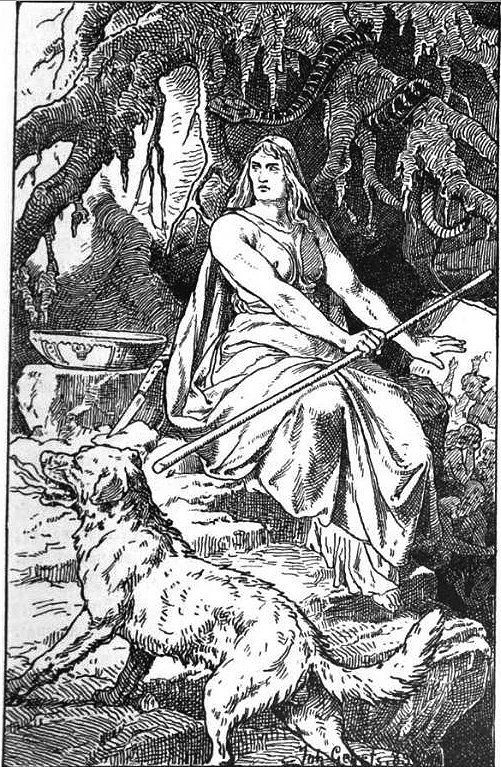
Garmr
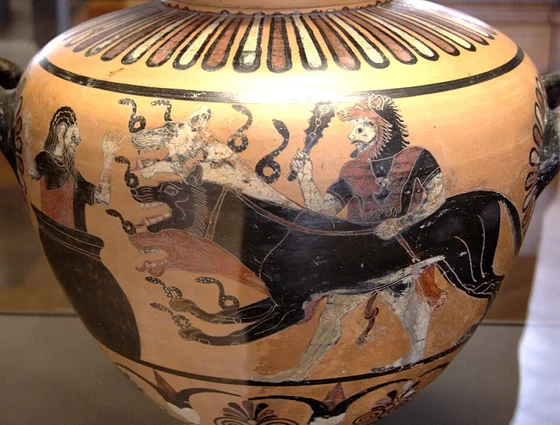
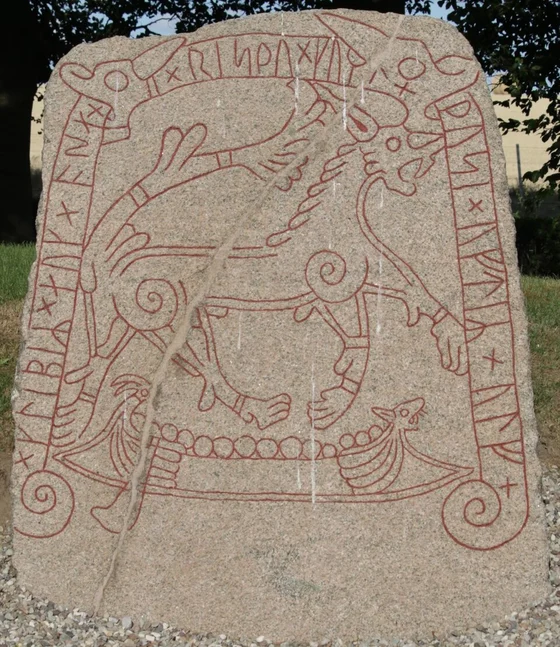
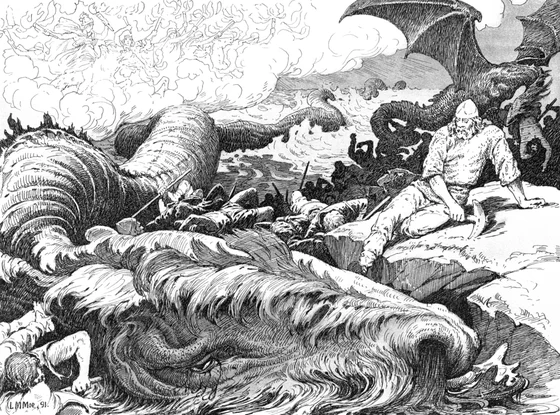
Image associated with the exact linked encyclopedia article; consult credited file description for its interpretation.
Overview
Snorri’s account identifies Garmr as foremost among hounds in a comparison of extraordinary beings. At Ragnarök the dog is released from its bond before Gnipa’s cave and fights Týr, with each killing the other. Its confinement and future violence connect the figure with the collapse of restraints during the final conflict.
The cited account gives Garmr a different opponent from Fenrir, who confronts Odin, and a different narrated location. Those distinctions matter even when scholarship considers relationships among Eddic canine figures. A later illustration may add a particular coat color, head count or gatekeeping scene, but those details are not supplied by this selected passage. Here the hound’s identity rests on its name, bond, place and mutual destruction with Týr.
The poetic witness gives a shorter, audible omen. In Benjamin Thorpe’s Völuspá translation, stanza 48 places Garm’s loud baying before the Gnupa-cave amid Yggdrasil’s trembling and the loosening of restraints. It then describes broken bonds and a running wolf. The surrounding stanzas move through the serpent, approaching forces, divine battles and the world’s burning; this particular translated passage does not name Týr as Garm’s opponent. The hound’s confrontation with that god is therefore retained as the separately located prose account, rather than inserted into the poem.
Brodeur’s Gylfaginning gives another setting for the name before that final battle. Section XLI quotes a ranking of outstanding beings, naming Garmr foremost among hounds alongside Yggdrasill among trees and Skídbladnir among ships. This brief prestige-list supplies no additional biography. In section LI, his release and mutual death with Týr appear among other distinct pairings: Odin with Fenris-Wolf, Thor with the Midgard Serpent and Freyr with Surtr. The named hound is not simply substituted for every canine adversary in that sequence.
Origins & earliest records
This entry follows Gylfaginning, sections XLI; LI, in Snorri Sturluson’s Prose Edda, composed around 1220 and translated here by Arthur Gilchrist Brodeur in 1916. The medieval work incorporates older poetic traditions, but its compilation date does not establish the beginning of a being’s oral history or every earlier attestation.
Records & interpretation
Located historical translations offer distinct prose and poetic witnesses: Gylfaginning XLI’s ranking, LI’s Garmr–Týr pairing, and Thorpe’s Völuspá stanza 48 in its apocalyptic context. Their wording supplies the literary claims and does not establish a zoological specimen.
In the literature
“He contends with Tyr, and they kill each other.”
The Fooling of Gylfe, chapter XVI, section 56 · Rasmus Björn Anderson
The preceding sentences identify the combatant as Garm, freed from Gnipa-cave.
Selected bibliography
Documented works and useful reading. This is not a list of every appearance.
- 01
Prose Edda: Gylfaginning, sections XLI; LI
Selected public-domain prose witness. Numbering follows the linked Brodeur translation; neither a universal canon nor an exhaustive bibliography.
- 02
Völuspá: The Vala’s Prophecy, stanza 48 and surrounding 47–65, pp. 7–8
Numbering follows this particular Thorpe printing. Selected complete apocalyptic/renewal passage; no direct original-manuscript collation.
- 03
The Younger Edda
Chicago: Scott, Foresman and Company, 1901; translation copyright 1879, with translator’s preface dated September 1879.
Family, evolution & connections
Fenrir
Younger Edda section 56 assigns the released dog Garm to Tyr, whom he kills and is killed by. The Fenris-wolf instead faces Odin and is subsequently slain by Vidar. Their parallel release and final battles support comparison, while the different opponents preserve their narrative distinction. This account does not identify Garmr as Fenrir or establish a family relationship.
Located primary passages
Specific passages supporting details in this entry, grouped by their published witness.
Primary source witness
Chicago: Scott, Foresman and Company, 1901; translation copyright 1879, with translator’s preface dated September 1879.
- The preceding sentences identify the combatant as Garm, freed from Gnipa-cave.
This documents Snorri’s literary account in Anderson’s translation, not zoological existence or a universal account of all Norse traditions.
Primary source witness
Rasmus Björn Anderson translation, Chicago: Scott, Foresman and Company, 1901; translation copyright 1879.
- Garmr is released from his binding before Gnipa-cave at Ragnarök.
Version-specific detail in the translated literary narrative; not an earliest-attestation or real-fauna claim.
Encyclopedia background
An additional attributed reference, separate from the editorial profile above.
Read the open encyclopedia overview
In Norse mythology, Garmr or Garm (Old Norse: Garmr [ˈɡɑrmz̠]) is a wolf or dog associated with both Hel and Ragnarök, and described as a blood-stained guardian of Hel's gate.
Text from Wikipedia contributors, “Garmr”. CC BY-SA 4.0. Extracted introduction; formatting changed. Retrieved 5 October 2026. The source article may have changed since retrieval.
References
Sources supporting this profile. Linked pages have their own scope and editorial standards.
- Primary textThe Prose Edda: Gylfaginning XLI; LI (Brodeur translation)Research access: 2026-10-05
- Primary poetic text in historical translationNorrœna 1906: Thorpe’s Völuspá translationResearch access: 2026-10-05
Image credits
Reference illustrationGarmr
Image associated with the exact linked encyclopedia article; consult credited file description for its interpretation.