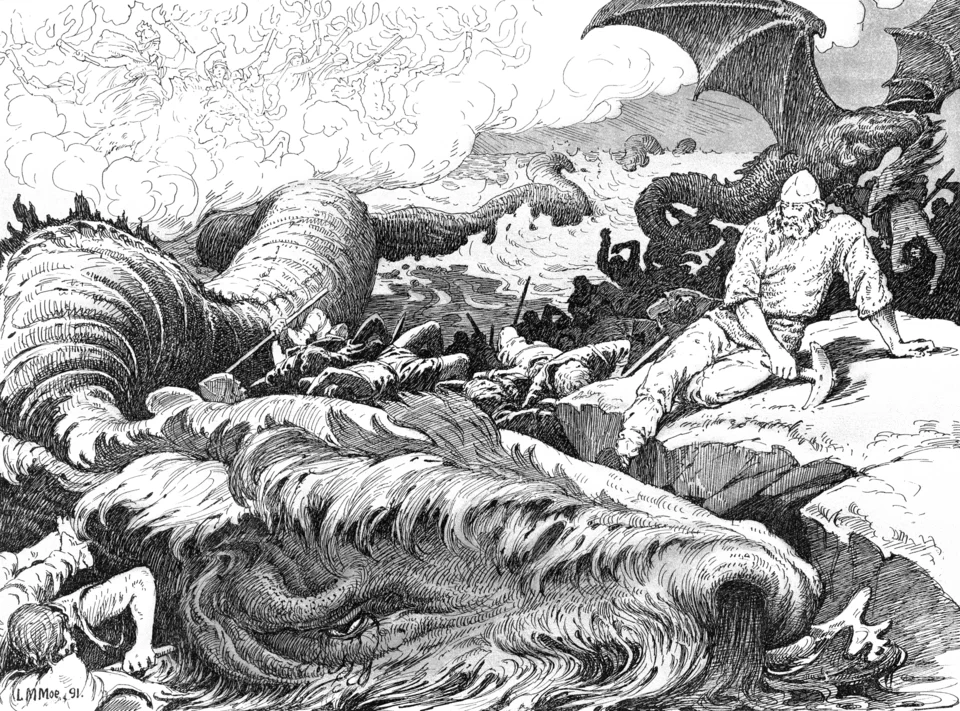
Jörmungandr
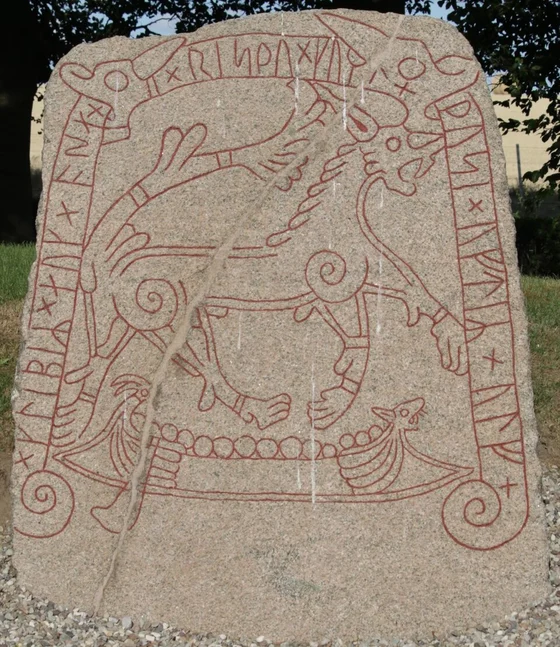
Image associated with the exact linked encyclopedia article; consult credited file description for its interpretation.
Overview
Snorri describes the serpent as another child of Loki and Angrboda, cast into the sea by Odin. It grows until it encircles the land and can grasp its own tail. Thor later tries to draw it from the water with an enormous hook baited with an ox’s head, making an everyday act of fishing into a confrontation with a cosmic boundary.
Hymir cuts the line as Thor prepares to strike, and the account acknowledges differing claims about what happened next. Snorri’s narrator maintains that the serpent still lives in the surrounding sea. At Ragnarök it and Thor kill one another, with the god surviving only briefly after the fight. This selected narrative does not establish every later image of an encircling serpent as Jörmungandr.
Another encounter appears in Gylfaginning XLVI–XLVII. At Útgarda-Loki’s hall, Thor is challenged to lift an enormous grey cat. It arches its back as he raises his hands, and he succeeds only in lifting one paw. Afterwards his host reveals that the apparent cat was the Midgard Serpent: the onlookers were frightened by how close Thor had come to lifting the world-encircling creature towards heaven. The feline appearance is an illusion within this specific contest, not the serpent’s ordinary anatomy.
Section XLVIII supplies the fishing episode’s preparations and physical struggle. Thor travels without his chariot, goats or attendants, appearing to Hymir as a young lad. He takes the head of Hymir’s largest ox, Himinbrjotr, as bait and insists on rowing beyond the giant’s usual fishing grounds. When the hook catches the serpent’s jaw, its pull crashes Thor’s fists against the gunwale. Thor braces so fiercely that his feet go through the boat, raises the serpent to its edge, and exchanges fierce looks with the venom-blowing creature. Hymir cuts the line as the hammer is raised. The narrator reports the claim that Thor’s thrown hammer removed its head, but explicitly prefers the account in which it remains alive.
In section LI the serpent’s movement drives the sea onto the land. It comes ashore alongside Fenrir and sprays venom through air and water. Thor finally kills it, walks nine paces and dies from its venom. The earlier fishing survival and this future death therefore remain separate stages of the prose account; the acknowledged alternative fishing ending is not silently incorporated as its final outcome.
Origins & earliest records
This entry follows Gylfaginning, sections XXXIV; XLVIII; LI, in Snorri Sturluson’s Prose Edda, composed around 1220 and translated here by Arthur Gilchrist Brodeur in 1916. The medieval work incorporates older poetic traditions, but its compilation date does not establish the beginning of a being’s oral history or every earlier attestation.
Records & interpretation
Located Gylfaginning episodes in Arthur Gilchrist Brodeur’s 1916 translation preserve the named being’s actions and the prose narrator’s qualifications. Chapter numbering and printed page references belong to this edition, rather than to every manuscript or modern translation.
In the literature
“surrounds all the earth, and bites his own tail.”
The Fooling of Gylfe, chapter IX, section 34 · Rasmus Björn Anderson
Jörmungandr grows in the sea surrounding all lands.
“poisoned by the venom that the serpent blows on him.”
The Fooling of Gylfe, chapter XVI, section 56 · Rasmus Björn Anderson
Thor kills the Midgard serpent but dies after retreating nine paces.
Selected bibliography
Documented works and useful reading. This is not a list of every appearance.
- 01
Prose Edda: Gylfaginning XXXIV; XLVI–XLVIII, pp. 65–70; LI, pp. 78–80
Brodeur’s located 1916 prose translation; episode outcomes and explicitly competing fishing accounts retained where applicable.
- 02
The Younger Edda
Chicago: Scott, Foresman and Company, 1901; translation copyright 1879, with translator’s preface dated September 1879.
Family, evolution & connections
Textual genealogy: Loki and Angrboda in Gylfaginning
Three children explicitly named in Gylfaginning chapter XXXIV.
Scroll sideways to see all branches. With a keyboard, focus the tree and use the arrow keys.
- Parents: Loki and Angrboda
- Hel (the named daughter)
Read the named parental pair and its enumerated children in Brodeur's translation. A joint-parent node represents two parents, not a single ancestor. A relationship in this medieval narrative, not a biological phylogeny or a synthesis of every Norse source. Hel is a named figure here, distinct from uses of Hel as a place. Other children of Loki are outside this selected branch.
Loki
The selected Gylfaginning passage names Loki and Angrboða as parents of the Midgard serpent, Fenrir and Hel. This is textual mythic parentage, not a scientific relationship between snakes and wolves.
Angrboða
The selected prose account explicitly names Angrboða as mother of Jörmungandr and his two named siblings. The relationship is confined to this account; no alternative version is silently merged.
Hel
The prose passage lists the Midgard serpent, Fenrir and Hel as the three children of Loki and Angrboða. Their different bodies and subsequent destinations do not make them unrelated within this textual genealogy.
Located primary passages
Specific passages supporting details in this entry, grouped by their published witness.
Primary source witness
Chicago: Scott, Foresman and Company, 1901; translation copyright 1879, with translator’s preface dated September 1879.
- Jörmungandr grows in the sea surrounding all lands.
This documents Snorri’s literary account in Anderson’s translation, not zoological existence or a universal account of all Norse traditions.
Primary source witness
Chicago: Scott, Foresman and Company, 1901; translation copyright 1879, with translator’s preface dated September 1879.
- Thor kills the Midgard serpent but dies after retreating nine paces.
This documents Snorri’s literary account in Anderson’s translation, not zoological existence or a universal account of all Norse traditions.
Primary source witness
Rasmus Björn Anderson translation, Chicago: Scott, Foresman and Company, 1901; translation copyright 1879.
- Odin places the young Midgard serpent in the surrounding sea.
Version-specific detail in the translated literary narrative; not an earliest-attestation or real-fauna claim.
Primary source witness
Rasmus Björn Anderson translation, Chicago: Scott, Foresman and Company, 1901; translation copyright 1879.
- The Midgard serpent spreads venom over air and sea at Ragnarök.
Version-specific detail in the translated literary narrative; not an earliest-attestation or real-fauna claim.
Encyclopedia background
An additional attributed reference, separate from the editorial profile above.
Read the open encyclopedia overview
In Norse mythology, Jörmungandr (Old Norse: Jǫrmungandr, see Etymology), also known as the Midgard Serpent or World Serpent (Old Norse: Miðgarðsormr, "worm of Midgard"), is an unfathomably large and monstrous sea serpent (or "worm", see Germanic dragon) who dwells in the world sea, encircling the Earth (Midgard) and biting his own tail, an example of an ouroboros. As a result of him surrounding Midgard, the beast is referred to as the World Serpent. Jörmungandr releasing his tail is one of the signs of the beginning of Ragnarök.
Jörmungandr is said to be the middle child of the god Loki and the jötunn Angrboða. According to the Prose Edda, Odin took Loki's three children by Angrboða – the wolf Fenrir, underworld ruler Hel, and the serpent Jörmungandr – and removed them from Asgard (the world of the Æsir). The serpent Jörmungandr was tossed into the great ocean that encircles Midgard. There the serpent grew so large that he was able to surround the Earth and grasp his own tail. The old Norse thunder god, Thor, has a lengthy feud with Jörmungandr and the serpent is regarded as his archenemy. During Ragnarök, Thor and Jörmungandr engage in a ferocious battle, culminating in both of their deaths.
Text from Wikipedia contributors, “Jörmungandr”. CC BY-SA 4.0. Extracted introduction; formatting changed. Retrieved 5 October 2026. The source article may have changed since retrieval.
References
Sources supporting this profile. Linked pages have their own scope and editorial standards.
- Primary textThe Prose Edda: Gylfaginning XXXIV; XLVIII; LI (Brodeur translation)Research access: 2026-10-05
Image credits
Reference illustrationJörmungandr
Image associated with the exact linked encyclopedia article; consult credited file description for its interpretation.