Nāga
Image associated with the exact linked encyclopedia article; consult credited file description for its interpretation.
Overview
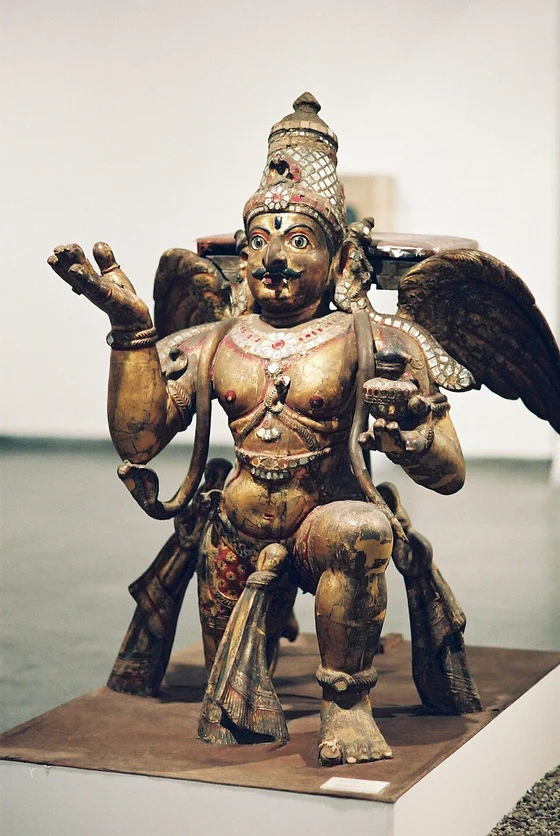
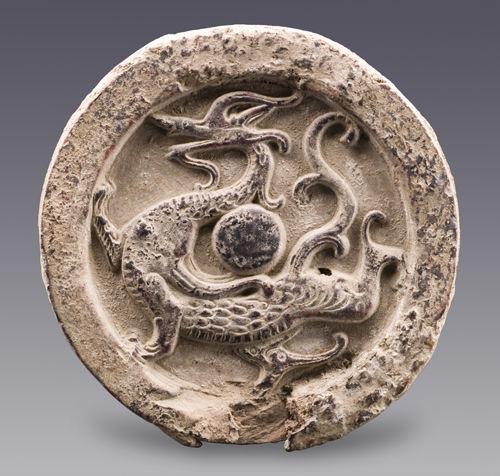
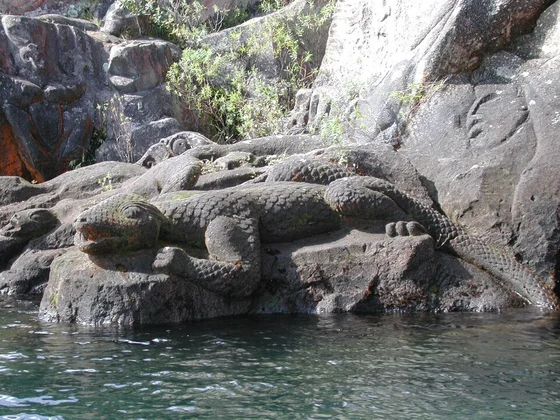
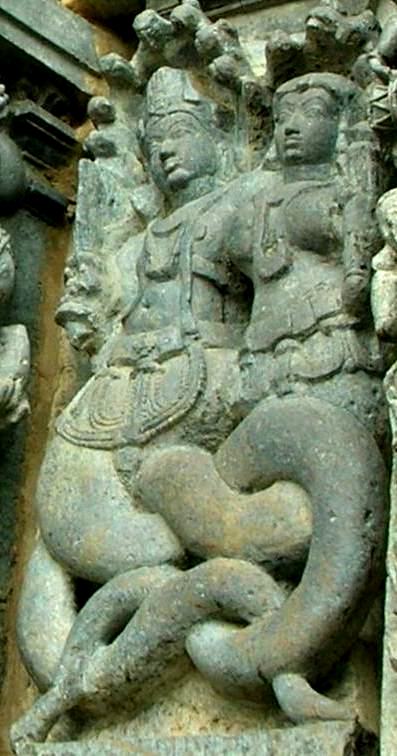
A nāga can be represented as a serpent, a humanlike figure with serpent attributes or a being whose hooded form shelters another sacred figure. Those representations express different contexts rather than a single species description. Nāga stories may concern water, treasures, family descent and conflicts with Garuḍa.
The Mahābhārata’s Āstīka narrative places serpent lineages within a complex account of conflict and its restraint. Buddhist and Southeast Asian uses add other meanings that cannot all be read through that Sanskrit epic. The Met’s Gandharan relief is a specific art-historical witness to Garuḍa and nāga imagery, while present practitioners may understand such figures through active religious relationships.
The selected epic translation gives the serpents a family history. In section XVI, the sisters Kadru and Vinata are wives of Kasyapa. Kadru asks for a thousand equally splendid serpent sons, while Vinata asks for two sons surpassing them in strength. Their eggs hatch at different times; Vinata’s sons are Aruna and Garuda. Section XXXV names Sesha first and Vasuki second among the serpents, followed by Takshaka, Karkotaka and other principal figures. The narrator expressly declines to enumerate all their descendants. This is the epic’s named household and lineage, not a taxonomy of every being called nāga in other traditions.
The quarrel that leads to bondage concerns the celestial horse Uchchaihsravas. Vinata calls it white; Kadru claims that its tail is black, and the sisters stake their freedom on the answer. Kadru orders her sons to become black hairs on the tail. They initially refuse and receive her curse of destruction at Janamejaya’s snake-sacrifice. In section XXII they reconsider and carry out the deception. Kadru wins the apparent test and enslaves Vinata. The sequence therefore includes both an initial refusal and later compliance.
Garuda is made to transport the serpents and asks what will free him and his mother. They demand that he bring amrita. After overcoming its guards, he returns with the vessel and places it on kusa grass, telling the serpents to bathe before drinking. They acknowledge Vinata’s release. While they are away, Indra retrieves the amrita under an agreement with Garuda. The serpents lick the grass where it stood and split their tongues. That is this narrative’s explanation of forked tongues and the grass’s sacredness; they do not successfully drink the elixir in this episode.
The family is not morally uniform. In section XXXVI, Sesha leaves his quarrelling brothers and practises severe austerities, specifically regretting their treatment of Vinata and her son. He calls Garuda another brother. Brahma grants his wish for steadfast virtue and assigns him to support the earth from beneath it; the passage also calls him Ananta. Its ending gives Garuda to him as a helper. These details qualify any simple rule that bird and serpent must always be enemies.
Vasuki convenes the other serpents to seek protection from the threatened sacrifice. Their proposals range from persuasion and obstructing the ritual to killing its officiants. Some explicitly condemn the violent suggestions, and Vasuki is dissatisfied with the counsel. Elapatra then reports a prophecy: the ascetic Jaratkaru will marry Vasuki’s sister, also named Jaratkaru, and their son Astika will save the surviving serpents. Sections XIV–XV narrate the marriage and birth, so the relationship is more than a prophecy left unfulfilled.
The closing sacrifice scene preserves both loss and rescue. Section LVII lists serpent lineages already burned, including descendants associated with Vasuki and Takshaka, and describes varying sizes and numbers of heads. As Takshaka is drawn toward the fire after Indra abandons him, Astika asks Janamejaya to end the sacrifice. He rejects offers of wealth and repeats his request on behalf of his maternal relatives. Astika’s command holds Takshaka in midair; the king grants the boon and the rite stops. The surviving serpents’ subsequent promise to spare those recalling Astika belongs to the religious story, and the ending does not revive those already burned.
A separately located Buddhist account appears in Udāna 2.1. Shortly after the Buddha’s awakening, an unseasonable storm lasts seven days. Muccalinda, called a nāga king, encircles him with seven coils and spreads a protective hood. When the weather clears, Muccalinda withdraws the coils, assumes a young man’s appearance and pays homage. The Buddha’s concluding utterance concerns contentment, restraint, dispassion and relinquishing the conceit of self. Seven here counts the coils; this translation does not specify seven heads. The protective encounter has its own setting and purpose alongside the epic’s family conflicts.
The Met’s schist relief, object 1980.325, is catalogued as Garuda Vanquishing the Naga Clan and dated approximately to the second–third century in ancient Gandhara, now Pakistan. Its object date supplies a material witness to representation. It does not date the composition of the epic or identify the first origin of nāga traditions.
Origins & earliest records
Selected evidence includes a Gandharan schist relief dated approximately second–third century by the Met, the composite Mahābhārata in Ganguli’s nineteenth-century English translation, and Udāna 2.1 in Ṭhānissaro Bhikkhu’s published translation. Object dates, textual composition and translation dates are distinguished; none establishes one first appearance of all nāga traditions.
Records & interpretation
Complete selected Ganguli sections XIII–XVI, XX, XXII–XXXVIII and LV–LVIII read, including genealogy, conflicting counsel and the sacrifice ending. Complete Udāna 2.1 checked on the translator’s current site after the older Access to Insight version; the article paraphrase is under 150 words and quotes none of the modern translation. Met object metadata checked. No complete Sanskrit/Pāli collation or new object-image inspection claimed.
In the literature
“the gods and the Asuras made of Mandara a churning staff and Vasuki the cord”
Book I, Adi Parva, section XVIII (Astika Parva); paragraph beginning ““And the gods and the Asuras made of Mandara…” · Kisari Mohan Ganguli
Ādi Parva XVIII uses the serpent Vasuki in the churning of the ocean.
“practised hard penances, living upon air and rigidly observing his vows.”
Book I, Adi Parva, section XXXVI; paragraph beginning ““Sauti said, ‘The illustrious Sesha amongst them, of great renown, leaving his…” · Kisari Mohan Ganguli
Sesha follows ascetic discipline, showing a virtuous naga distinct from his quarrelling brothers.
“place her on my head.”
Book I, Adi Parva, section XXXVI; paragraph beginning ““Sesha said, ‘O divine Lord of all creatures, O bestower of boons,…” · Kisari Mohan Ganguli
Sesha accepts the task of supporting the Earth.
“lives underneath the Earth, alone supporting the world at the command of Brahman.”
Book I, Adi Parva, section XXXVI; paragraph beginning ““Sauti continued, ‘The snake, Sesha, the lord Ananta, of great prowess, lives…” · Kisari Mohan Ganguli
The narrator confirms Sesha/Ananta’s support of the world.
Selected bibliography
Documented works and useful reading. This is not a list of every appearance.
- 01
Mahābhārata, Ādi Parva, Āstīka narrative — family, curse and horse-tail wager
Located sections XIII–XVI, XX, XXII–XXIII. Complete selected sections read; other intervening ocean-churning sections not claimed as newly read.
- 02
Mahābhārata, Ādi Parva, Āstīka narrative — Garuda bargain, forked tongues and serpent counsel
Located sections XXIV–XXXVIII. Complete selected sequence read. XXXV names principal serpents; XXXVI gives Sesha’s ascetic and earth-supporting role; XXXVIII gives the prophecy.
- 03
Mahābhārata, Ādi Parva, Āstīka narrative — Astika’s appeal and the end of the snake-sacrifice
Located sections LV–LVIII. Complete four-section ending read, including the intervening list of casualties and the survivors’ boon.
- 04
Udāna 2.1 — Muccalinda Sutta
Complete short discourse and attached note read. Seven coils, protective hood, young-man transformation and final utterance kept distinct from later imagery.
- 05
The Mahabharata of Krishna-Dwaipayana Vyasa, Volume I, Books 1–3
English prose translation; hosted title states publication range 1883–1896. Section numbers are those of this translation.
Family, evolution & connections
Kadru’s serpent sons in the selected Mahabharata passages
Adi Parva XVI’s thousand-serpent brood, with named examples from LXV.
Scroll sideways to see all branches. With a keyboard, focus the tree and use the arrow keys.
- Kadru and Kasyapa (joint parent pair)
- Thousand serpent sons (collective family; examples below)
- Sesha or Ananta
- Vasuki
- Takshaka
- Kumara
- Kulika
Explicit relationships in the named source witness. The five names are examples within the thousand, not five extra sons. Other scriptural genealogies are separate witnesses. No claim is made about all nāga traditions or natural snake ancestry. The collective brood node groups named examples visually; it is not an intervening generation.
Vasuki’s sister, the two Jaratkarus and Astika
Completed kinship in Ganguli’s Adi Parva XIV–XV and LVIII.
Scroll sideways to see all branches. With a keyboard, focus the tree and use the arrow keys.
- Vasuki and his younger sister (sibling grouping)
- Vasuki (elder brother)
- Jaratkaru (younger sister); married to ascetic Jaratkaru
- Astika (their son)
- Unnamed sons of Astika
- Unnamed grandsons of Astika
Sibling grouping, with the sister’s spouse named on her label and their descendants below. The two spouses share a name but remain different people. The grouping root is not an ancestor; no shared parents are inferred for Vasuki and his sister here. Descendants are unnamed and uncounted. XIV’s closing formula mistakenly says thirteenth; its heading is SECTION XIV. No wider nāga genealogy is inferred.
Kadru
The Astika narrative gives Kadru a thousand serpent sons, hatched from her eggs. This is a specific Hindu epic genealogy, not a claim that every Buddhist or regional nāga tradition has the same parentage.
Kasyapa
Kasyapa grants Kadru’s request for a thousand serpent sons and instructs her to care for the embryos. This family account is presented as epic parentage, not biological evidence about snakes.
Sesha or Ananta
Adi Parva LXV explicitly includes Sesha or Ananta among Kadru’s sons. The name identifies a member of this textual family; it does not supply a scientific species classification.
Vasuki
Adi Parva LXV explicitly includes Vasuki among Kadru’s sons. The name identifies a member of this textual family; it does not supply a scientific species classification.
Takshaka
Adi Parva LXV explicitly includes Takshaka among Kadru’s sons. The name identifies a member of this textual family; it does not supply a scientific species classification.
Vasuki’s younger sister Jaratkaru and her son Astika
Section XIV marries Vasuki’s younger sister Jaratkaru to the ascetic of the same name; XV records their son Astika’s birth. LVIII supplies his later sons and grandsons without names. These are named epic-family facts, not parentage for every nāga tradition.
Located primary passages
Specific passages supporting details in this entry, grouped by their published witness.
The Mahabharata of Krishna-Dwaipayana Vyasa, Volume I, Books 1–3
English prose translation; hosted title states publication range 1883–1896. Section numbers are those of this translation.
- Ādi Parva XVIII uses the serpent Vasuki in the churning of the ocean.
Attests this published account; does not establish zoological existence, consensus belief or earliest origin.
The Mahabharata of Krishna-Dwaipayana Vyasa, Volume I, Books 1–3
Exact contiguous excerpt verified against the downloaded primary HTML on 2026-10-05; whitespace only normalized. English prose translation; hosted title states publication range 1883–1896. Section numbers are those of this translation.
- Sesha follows ascetic discipline, showing a virtuous naga distinct from his quarrelling brothers.
- Sesha accepts the task of supporting the Earth.
- The narrator confirms Sesha/Ananta’s support of the world.
The passage documents this literary version, not zoological existence, earliest attestation or a universal statement of living tradition.
Encyclopedia background
An additional attributed reference, separate from the editorial profile above.
Read the open encyclopedia overview
In various Asian religious traditions, the Nāgas (Sanskrit: नाग, romanized: Nāga) are a divine, or semi-divine, race of half-human, half-serpent beings that reside in the netherworld (Patala), and can occasionally take human or part-human form, or are so depicted in art. Furthermore, nāgas are also known as dragons and water spirits. A female nāga is called a Nagini (Hindi: नागिन nāgin). According to legend, they are the children of the sage Kashyapa and Kadru. Rituals devoted to these supernatural beings have been taking place throughout South Asia for at least 2,000 years. They are principally depicted in three forms: as entirely human with snakes on the heads and necks, as common serpents, or as half-human, half-snake beings in Hinduism and Buddhism.
Nagaraja is the title given to the king of the nāgas. Narratives of these beings hold cultural significance in the mythological traditions of many South Asian and Southeast Asian cultures, and within Hinduism and Buddhism. Communities such as the Nagavamshi, Khmer and Sri Lankan Tamils claim descent from this race.
Text from Wikipedia contributors, “Nāga”. CC BY-SA 4.0. Extracted introduction; formatting changed. Retrieved 5 October 2026. The source article may have changed since retrieval.
References
Sources supporting this profile. Linked pages have their own scope and editorial standards.
- MuseumThe Met: Garuda Vanquishing the Naga ClanResearch access: 2026-10-05
- Historical English translation of primary narrativeGanguli, Āstīka XIII–XVI: Jaratkaru marriage, Astika and serpent householdResearch access: 2026-10-05
- Historical English translation of primary narrativeGanguli, XX and XXII–XXIII: curse and horse-tail deceptionResearch access: 2026-10-05
- Historical English translation of primary narrativeGanguli, XXXIV–XXXVIII: amrita outcome, principal serpents, Sesha and councilResearch access: 2026-10-05
- Historical English translation of primary narrativeGanguli, LV–LVIII: Astika’s intervention and survivorsResearch access: 2026-10-05
- Modern translation of Pāli primary textṬhānissaro Bhikkhu, complete Udāna 2.1Research access: 2026-10-05
Image credits
Reference illustrationNāga
Image associated with the exact linked encyclopedia article; consult credited file description for its interpretation.