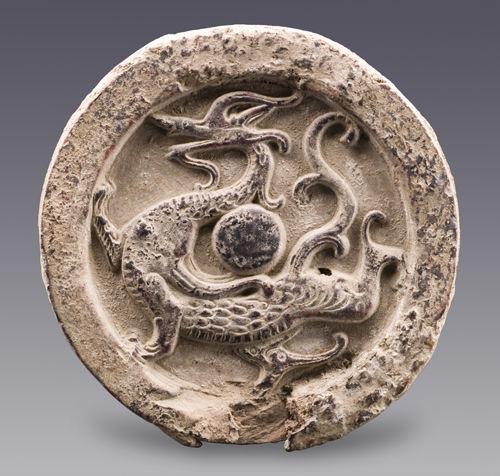
Chinese dragon
Image associated with the exact linked encyclopedia article; consult credited file description for its interpretation.
Overview
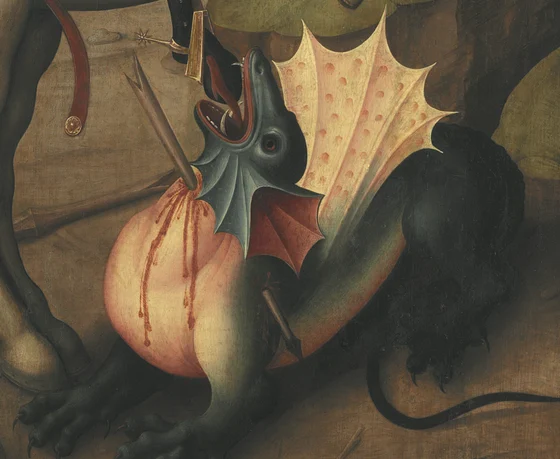
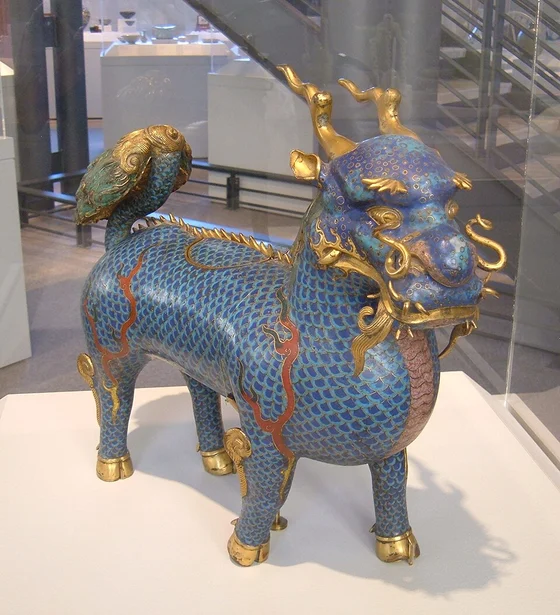
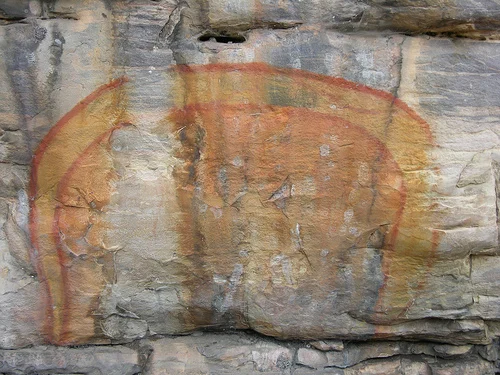
Chinese lóng traditions include composite beings, images of water and the sky, moral emblems, and symbols of courtly authority. Their sinuous bodies, horns and claws vary across works and periods. The English word dragon is a convenient translation, but it does not establish a shared anatomy, genealogy or moral identity with every other creature given that name.
The National Palace Museum’s jade carving conventionally called a pig-dragon is an early material comparison. Its selection catalogue dates the object to late Hongshan culture, 3500–3000 BCE. The curved body, large ears, wrinkled nose and arched mouth differ from many later imperial dragons. The museum notes competing pig and bear identifications and cautiously discusses an embryo-like form as a possible image of vitality. These are interpretations of a surviving carving. Its modern name does not prove that its maker used the later word lóng, or that the object supplies a complete ancestral form from which all later dragon images descended.
In James Legge’s 1882 translation of the Book of Changes, the first hexagram, Qian or Khien, uses dragon imagery to discuss changing circumstances. A dragon is hidden, appears in a field, seems to leap from the deep and flies in the sky; the top line warns of exceeding proper limits. Legge’s notes read it as an emblem of exceptional human character and authority. He interprets the additional passage about dragons losing their heads through humility and submission. This is a particular translated text and interpretive tradition, not a description of a dragon’s growth stages or a biological classification.
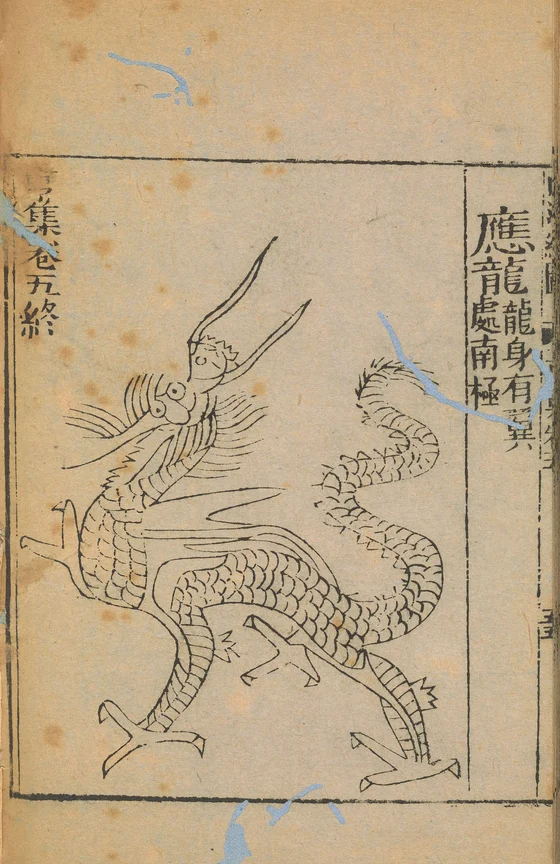
The Classic of Mountains and Seas gives more specific narrative beings. In the Great Eastern Wilderness, Yinglong kills Chiyou and Kuafu but cannot return above; during drought, making its form brings rain. The Great Northern Wilderness separately links Yinglong’s southern residence with plentiful rainfall. Another northern notice has the Yellow Emperor send it against Chiyou: Yinglong gathers water, the opposing wind and rain powers raise a storm, and the drought figure Ba stops the rain. These notices preserve different emphases and should not be silently assembled into one continuous battle chronology. The selected passages do not specify Yinglong’s wings or a complete body plan.
A separate, short notice in the Classic of Regions Within the Seas: East locates a thunder spirit in Thunder Marsh, west of Wu. It has a dragon body and a human head and drums on its belly. That explicit combination belongs to this Leishen passage. It neither supplies the missing anatomy of Yinglong nor fixes the appearance of every later thunder deity. Named beings and broad dragon imagery therefore remain separate subjects within the same textual corpus.
The Met dates its porcelain water pot to the Qianlong period (1736–1795) and identifies the decoration as underglaze copper red from Jingdezhen. The coiling dragon is deliberately painted indistinctly, suggesting distance or flight through clouds. The museum cautiously identifies brush-and-ink writing as the vessel's most likely use. At seven centimetres tall, the pot places that powerful image on a small object associated with a scholar's working environment.
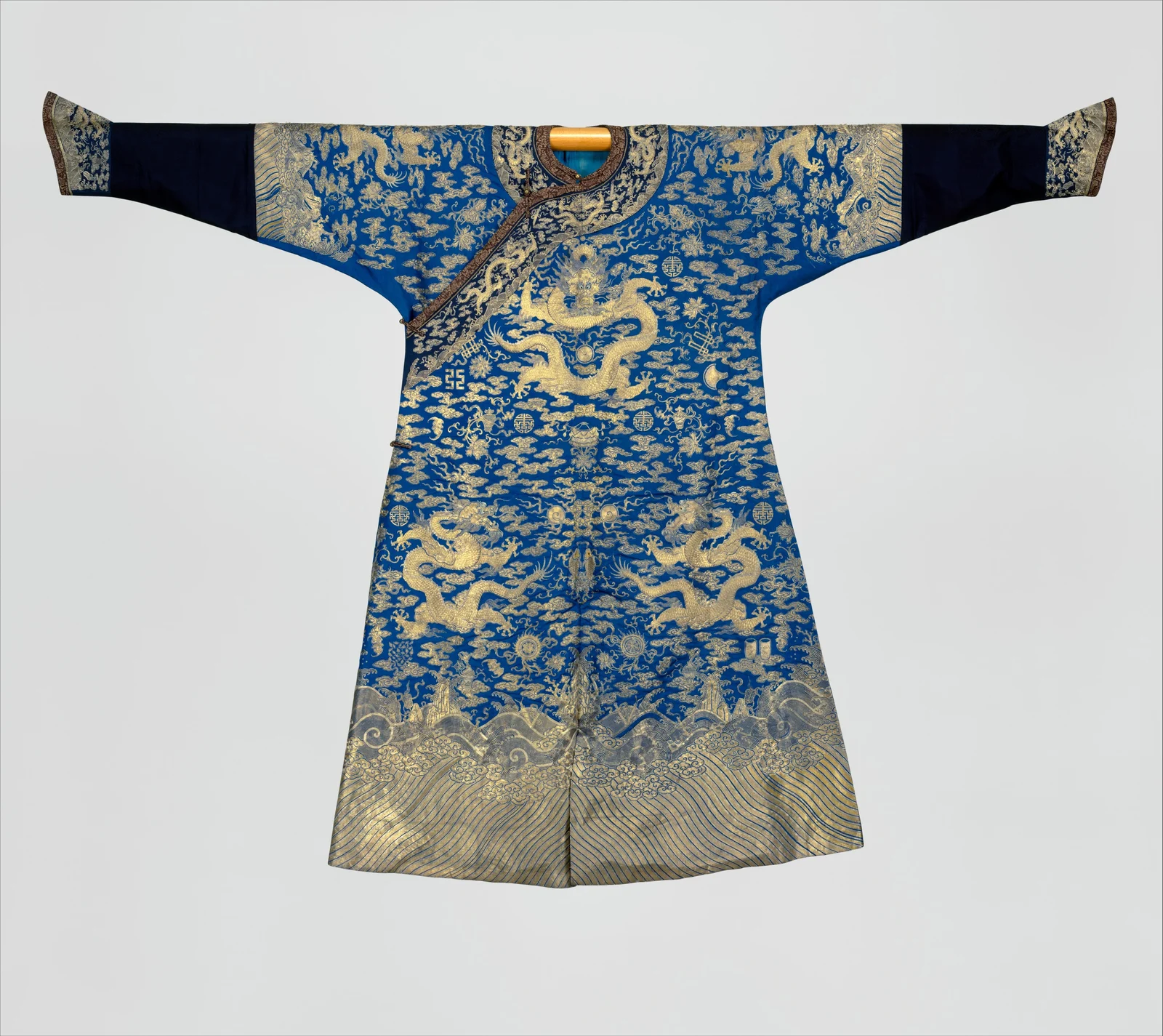
The Met’s Qianlong-period twelve-symbol festival robe provides a different court setting. Silk embroidery with gold and silver thread places dragons among a regulated set of imperial emblems, including heavenly bodies, mountains, birds, ritual vessels and cultivated plants. The museum relates the ensemble to righteous rule and identifies festival banquets and military inspections among its uses. This particular garment supports a claim about rank and ceremony. It does not make every dragon object an emperor’s possession or every use of dragon imagery an exclusively political one.
Griffis’s Japanese Fairy World supplies a later Japanese literary use of the Chinese Dragon Gate motif. In The Dream Story of Gojiro, a twelve-year-old boy in Fukui receives illustrated Chinese stories after completing a reading task. He falls asleep and dreams of the Yellow River. A sage writes the place-name Lung Men, which Gojiro recognizes as Riu Mon in Japanese. Numerous carp struggle at the rapids, and many fail. One finally reaches smooth water beyond the gate; a descending cloud meets it, and the fish becomes a white dragon that rises toward heaven with flashes of red fire and shining scales.
The boy then wakes. His mother interprets the successful carp as a lesson in perseverance and hopes that he will overcome obstacles and rise to office. The story connects this image with examination ambitions and a paper carp raised on a pole. This is an explicitly framed dream and moral interpretation in a Japanese story retold in English. It is not an early Chinese attestation, a claim that living carp undergo such an evolution, or a universal explanation of every dragon’s origin.
The Bird With Nine Heads, in the 1921 Chinese Fairy Book edited by Richard Wilhelm and translated by Frederick H. Martens, gives a dragon a different role: helper and host. After killing the bird and rescuing a princess, the human hero is abandoned in its cliffside cave by a rival. He touches a fish fixed to the wall with four nails; it turns into a young man, who thanks him, and the two agree to regard each other as brothers. When the hungry rescuer later sees a dragon licking a stone, he copies it and his hunger disappears. The dragon then carries him down from the inaccessible cave on its tail.
The hero subsequently finds magical pearls in a tortoise shell. One parts the sea and brings him before a sea-dragon, whom the narrative explicitly identifies as the same dragon he met near the cave. The rescued young man is there too and is explicitly the dragon’s son. The father accepts the human as another son because he saved the captive and formed a bond of brotherhood with him. This is a story of biological fatherhood alongside adopted social kinship; the human has not acquired dragon ancestry or undergone a transformation into a dragon.
At the son’s advice, the guest asks for a small gourd flask instead of money or jewels. The dragon initially resists but eventually grants it, and the gift supplies food and successive forms of transport for the journey home. The hero reaches the royal city, proves his identity with the halves of a hairpin and silk handkerchief, and marries the princess after the false rescuer is exposed and punished. The dragon’s assistance thus contributes to the human story’s resolution. The edition’s note calls the fish the dragon’s son and compares Chinese sea dragons with Indian Nagaradjas; that editorial comparison does not establish a shared biological family or demonstrated historical borrowing.
Another tale in the same 1921 collection, Black Arts, makes the dragon a dangerous pursuer. A young husband is sent to obtain eggs from what his father-in-law calls a phoenix nest. Following his wife’s warning, he cuts at the tree with a blade fastened to long poles and runs. A huge dragon appears above him, with lamp-like eyes, two feelers reaching toward the ground, and fire and flame issuing from its mouth. It follows him through the air. The passage provides an explicit fire-breathing example within this Chinese tale collection; a general rule denying that trait to every Chinese dragon would contradict this witness.
The husband escapes by throwing bread and then scattering the hens’ eggs his wife supplied, delaying the pursuer while it eats. The dragon is neither slain nor subdued, and the text does not explain its relationship to the reported phoenix nest. The rest of the tale concerns the couple’s flight from her parents and eventual establishment of a home together. Those later adversaries are separate characters, not additional forms of the dragon. The edition’s disparaging depiction of a regional human community is also kept apart from the creature description and is not adopted as ethnography.
Origins & earliest records
Selected evidence spans the National Palace Museum’s late Hongshan jade attribution, early Chinese received texts, and Qianlong-period objects. The jade is dated 3500–3000 BCE in the museum selection record, but its modern identification is debated. The dates of objects, textual composition, surviving copies and modern translations are different kinds of evidence; none of these witnesses establishes the first origin of every Chinese dragon tradition.
Records & interpretation
The jade, porcelain water pot and embroidered robe are material witnesses to artistic practice. The Book of Changes and Classic of Mountains and Seas preserve attributed textual uses and narratives. Museum interpretations and Legge’s nineteenth-century commentary remain identified as such. No inspected source supplies an authenticated composite animal, demonstrated weather control, or biological evolution from one dragon image into another. The complete1921 English tale The Bird With Nine Heads and its attached note supply a further literary witness, with the title/copyright and full translator preface checked. The preface describes retelling with some presentational changes; no earlier Chinese manuscript, field recording or first oral attestation was inspected for that episode. Complete Black Arts, LIX pp201–206 and its note also read; its dragon description is distinguished from the narrator’s prejudicial framing of a human community and from later events involving the wife’s parents.
Additional images
 View larger
 Embroidered dragons on a Qing Qianlong-period imperial festival robe, Met54.14.2
Dragons appear among clouds, waves and the other emblems of this imperial ceremonial garment. The Met identifies the robe with the emperor’s twelve-symbol ensemble and regulated court dress. This shows dragons as symbols of rule in a particular Qing artwork; it does not establish the body of every dragon in earlier Chinese texts.
In the literature
“the dragon on the wing in the sky.”
I. The Khien Hexagram, fifth line statement, printed p.57; PDF p.85 · James Legge
Legge’s rendering of the fifth-line dragon image; symbolic interpretation is given separately in his notes.
Selected bibliography
Documented works and useful reading. This is not a list of every appearance.
- 01
Yijing / Book of Changes: Qian (Khien), first hexagram
Sacred Books of the East XVI, text pp. 57–58 and associated translator notes through p. 60. Notes distinguished from the translated statements.
- 02
Shanhaijing / Classic of Mountains and Seas: Great Eastern Wilderness
Complete selected Yinglong notice beginning with Mount Xiongli Tuqiu; hosted Chinese transcription, not an inspected ancient manuscript.
- 03
Shanhaijing: Great Northern Wilderness
Separate southern-rain and Yellow Emperor–Chiyou battle notices involving Yinglong.
- 04
Shanhaijing: Classic of Regions Within the Seas, East
Complete thunder-marsh notice beginning 雷澤中有雷神; original English summary of the received Chinese wording.
- 05
Japanese Fairy World: Stories from the Wonder-lore of Japan — XXVII: The Dream Story of Gojiro, pp.227–235
Complete chapter read in the 1887 London edition transcription; preface dated1880. Japanese dream retelling of Chinese Dragon Gate imagery, not a first-attestation claim.
- 06
The Chinese Fairy Book — VII: The Bird With Nine Heads
Complete tale pp13–17 and its attached note read, plus English title/copyright and full translator preface. Dragon father, captive fish-form son and socially adopted human brother are distinct roles. Earlier oral provenance not established; note’s reference to No81 remains unresolved.
- 07
The Chinese Fairy Book — LIX: Black Arts
Complete tale pp201–206 and attached note read. Dragon pursuit on203–204 explicitly includes flight, fire and two feelers; escape leaves dragon alive. No relationship to the reported phoenix nest explained.
- 08
Yijing / The Yî King — I. The Khien Hexagram
TheSacredBooksOfChina, TextsOfConfucianismPartII TheYîKing, translatedJamesLegge, OxfordClarendonPress1882, original title visually checked. CompleteKhien first hexagram57–58 and associated Legge commentary58–60 read in original page images85–88. Other hexagrams and fullYijing not claimed read.
- 09
Shanhaijing / Classic of Mountains and Seas — GreatEasternWilderness / 大荒東經
Anonymous received Shanhaijing Chinese text hosted by Wikisource, revision331930. Selected complete named notices directly read2026-10-05; no original manuscript or critical-print edition identified. Original English paraphrase, not a copied modern English translation.
- 10
Shanhaijing / Classic of Mountains and Seas — GreatNorthernWilderness / 大荒北經
Anonymous received Shanhaijing Chinese text hosted by Wikisource, revision316477. Selected complete named notices directly read2026-10-05; no original manuscript or critical-print edition identified. Original English paraphrase, not a copied modern English translation.
- 11
Shanhaijing / Classic of Mountains and Seas — WithinSeasEast / 海內東經
Anonymous received Shanhaijing Chinese text hosted by Wikisource, revision2642241. Selected complete named notices directly read2026-10-05; no original manuscript or critical-print edition identified. Original English paraphrase, not a copied modern English translation.
Family, evolution & connections
The sea-dragon and his rescued son — Wilhelm/Martens VII
The complete The Bird With Nine Heads narrative and its accompanying note, pp.13–17.
Scroll sideways to see all branches. With a keyboard, focus the tree and use the arrow keys.
- Unnamed son, rescued from fish form
The youth released from fish form is explicitly called the sea-dragon’s son. This two-person parentage belongs to this named tale, not every Chinese dragon. Sworn brotherhood with the human rescuer and reciprocal social fatherhood are excluded from the biological branch. No mother, personal names or further dragon generations are supplied.
The unnamed sea-dragon’s fish-presenting son
The fish rescued from the cave becomes a youth, later explicitly identified as the sea-dragon’s son. The rescuer recognizes that sea-dragon as the same dragon who helped him leave the cave.
The human rescuer and dragon’s son
After the fish becomes a youth, he and the human rescuer agree to regard one another as brothers. The text distinguishes this social bond from the youth’s explicit father–son relation with the sea-dragon.
The unnamed human rescuer
Because the human saved his son and became his brother, the sea-dragon calls himself the human’s father. This explanation establishes social affiliation in the tale, without claiming the rescuer was born to a dragon.
Located primary passages
Specific passages supporting details in this entry, grouped by their published witness.
Yijing / The Yî King — I. The Khien Hexagram
TheSacredBooksOfChina, TextsOfConfucianismPartII TheYîKing, translatedJamesLegge, OxfordClarendonPress1882, original title visually checked. CompleteKhien first hexagram57–58 and associated Legge commentary58–60 read in original page images85–88. Other hexagrams and fullYijing not claimed read.
- The first hexagram moves through a hidden dragon, one appearing in the field, a vigilant superior man, a dragon poised to leap from the deep, one flying in the sky and one exceeding proper limits. A supplementary paragraph describes a host of dragons relinquishing their heads. Legge’s commentary separately identifies the dragon as a symbol of the superior or great man and celestial virtues; he relates excessive force to repentance and the headless host to transition from force and pride toward submission and humility. His historical attribution and symbolic interpretation are distinguished from translated line statements.
FirstKhien/Qian hexagram complete printed57–58; associated Legge notes58–60
No biological wing-anatomy claim or uniform dragon species inferred from Legge’s idiom. Attributions to kingWan/dukeKau/Confucius belong to this historical edition; not independently demonstrated historical authorship. Full text and later critical scholarship not claimed read.
Shanhaijing / Classic of Mountains and Seas — GreatEasternWilderness / 大荒東經
Anonymous received Shanhaijing Chinese text hosted by Wikisource, revision331930. Selected complete named notices directly read2026-10-05; no original manuscript or critical-print edition identified. Original English paraphrase, not a copied modern English translation.
- At Xiongli Tuqiu in the northeastern wilderness, the received notice says Yinglong killed Chiyou and Kuafu, could not return above and was associated with repeated drought. Making its likeness during drought is narrated as bringing heavy rain.
Hosted received Chinese transcription, including 出/處 variant marker; full selected notice read, not the entire book or an ancient manuscript. Rainmaking is a narrated textual association, not a copied procedure or a general present-day community practice. No modern YuanKe annotation copied.
Shanhaijing / Classic of Mountains and Seas — GreatNorthernWilderness / 大荒北經
Anonymous received Shanhaijing Chinese text hosted by Wikisource, revision316477. Selected complete named notices directly read2026-10-05; no original manuscript or critical-print edition identified. Original English paraphrase, not a copied modern English translation.
- One notice narrates Kuafu chasing the sun, insufficiently drinking the river and dying before reaching the great marsh; its following statement nevertheless says Yinglong killed Chiyou and Kuafu, moved south and explains abundant southern rain. A separate battle notice has the Yellow Emperor send Yinglong against Chiyou in Jizhou. Yinglong gathers water; Chiyou invokes wind and rain figures, while the descending Nüba stops rain, enabling Chiyou’s killing. Nüba cannot return above and her dwelling remains rainless.
Kuafu paragraph beginning 大荒之中,有山名曰成都載天 and YellowEmperor battle paragraph beginning 有係昆之山者
Complete selected two paragraphs read in the received transcription. The juxtaposed Kuafu death accounts are preserved without harmonisation; in the second notice the final killing follows Nüba’s intervention and is not silently assigned exclusively to Yinglong. No ritual instructions quoted, modern critical edition or entire Shanhaijing review claimed.
Shanhaijing / Classic of Mountains and Seas — WithinSeasEast / 海內東經
Anonymous received Shanhaijing Chinese text hosted by Wikisource, revision2642241. Selected complete named notices directly read2026-10-05; no original manuscript or critical-print edition identified. Original English paraphrase, not a copied modern English translation.
- A thunder-marsh notice describes Leishen with a dragon body and human head, drumming his own belly, and locates him west of Wu. This is a particular dragon-bodied divine figure, distinct from Yinglong’s battle and rain accounts.
Whole short notice read in received Chinese transcription; modern editorial relocation annotations omitted. No uniform human-headed Chinese-dragon anatomy or original exact composition date inferred.
Encyclopedia background
An additional attributed reference, separate from the editorial profile above.
Read the open encyclopedia overview
The Chinese dragon, known as long or loong (/lʊŋ/ LUUNG) is a legendary creature in Chinese mythology, Chinese folklore, and Chinese culture generally. Chinese dragons have many animal-like forms, such as turtles and fish, but are most commonly depicted as snake-like with four legs. Academics have identified four reliable theories on the origin of the Chinese dragon: snakes, Chinese alligators, thunder worship and nature worship. They traditionally symbolize potent and auspicious powers, particularly control over water and weather.
Text from Wikipedia contributors, “Chinese dragon”. CC BY-SA 4.0. Extracted introduction; formatting changed. Retrieved 5 October 2026. The source article may have changed since retrieval.
References
Sources supporting this profile. Linked pages have their own scope and editorial standards.
- MuseumThe Met: Water pot with dragons among cloudsResearch access: 2026-10-05
- Custodial object description and interpretationNational Palace Museum: Jade Pig-dragon, late Hongshan selectionResearch access: 2026-10-05
- Historical translation and commentaryLegge 1882, The Yî King, original printed volumeResearch access: 2026-10-05
- Received primary text transcriptionShanhaijing, Great Eastern Wilderness: YinglongResearch access: 2026-10-05
- Received primary text transcriptionShanhaijing, Great Northern Wilderness: Yinglong noticesResearch access: 2026-10-05
- Received primary text transcriptionShanhaijing, Regions Within the Seas, East: thunder spiritResearch access: 2026-10-05
- Custodial object descriptionThe Met: Emperor’s twelve-symbol festival robe, object 54.14.2Research access: 2026-10-05
- Historical English literary retellingGriffis, Japanese Fairy World, XXVII: The Dream Story of Gojiro, pp.227–235Research access: 2026-10-05
- Historical English literary retelling and editorial noteWilhelm/Martens1921: The Bird With Nine Heads, full tale and noteResearch access: 2026-10-05
- Historical English literary retellingWilhelm/Martens1921 LIX: Black Arts, explicit fiery dragon pursuitResearch access: 2026-10-05
Image credits
Reference illustrationChinese dragon
Image associated with the exact linked encyclopedia article; consult credited file description for its interpretation.
Further credits appear with each additional image.