Garuda
Image associated with the exact linked encyclopedia article; consult credited file description for its interpretation.
Overview
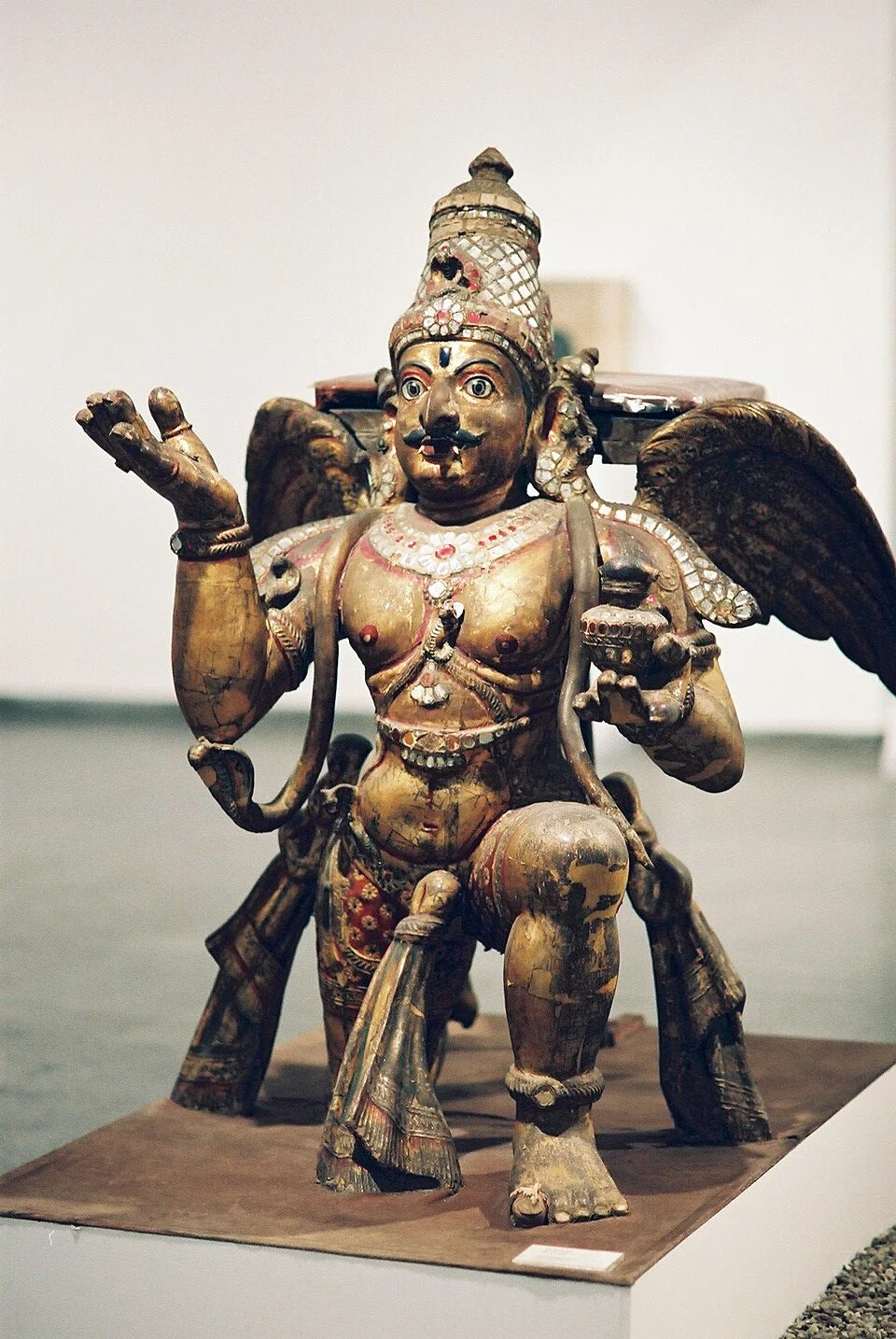
Garuḍa’s forms range from a great bird to a winged humanlike figure with avian features. In Hindu contexts his relationship with Vishnu is especially prominent. Epic narratives connect him with a quest involving his mother’s freedom and opposition to nāgas, giving the figure motivations and relationships beyond a simple predator’s role.
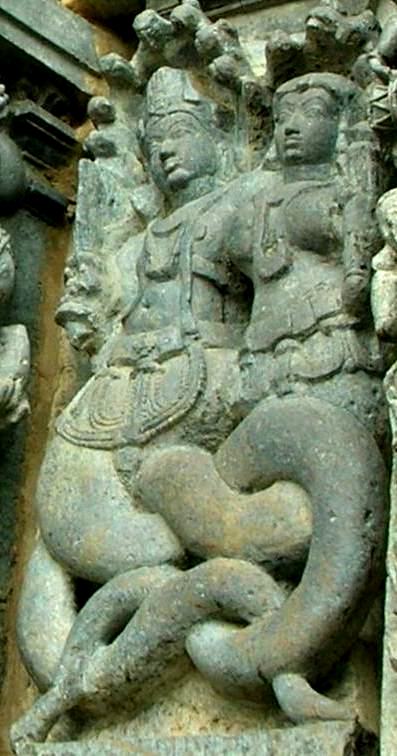
Buddhist and Southeast Asian art develops distinct representations, including architectural encounters between Garuḍa and serpents. The Angkor National Museum discusses such forms in Khmer objects and buildings. These shared motifs do not make every tradition identical, and contemporary national emblems add another layer of reception. A selected sculpture should be interpreted within its local religious and historical setting.
A distinct Tibetan form is documented by the Rubin Museum painting catalogued as Himalayan Art Resources item 616, dated to the eighteenth century. Jeff Watt identifies Black Garuda, khyung nag po, as an enlightened deity in a Nyingma setting. The central figure has an eagle face, curved beak, round eyes, two horns and upward yellow hair. A green jewel is associated with the nāgas; hands and beak hold a snake. A feathered lower body and unfurled wings complete this particular representation. Its protective interpretation belongs to the religious artwork and differs from classification as an ordinary bird.
In Ganguli’s Āstīka translation, Garuda is the son of Vinata and Kasyapa and the younger brother of Aruna. Their mother receives two eggs after asking for sons stronger than Kadru’s thousand serpent children. She opens one too soon, leaving Aruna incompletely developed; he foretells her enslavement and the later son’s role in ending it. Garuda emerges unaided from the remaining egg. His initial radiance frightens the gods into mistaking him for a spreading fire, and he reduces his brilliance and size when they appeal to him. The narrative gives him control over form, scale and energy rather than one fixed set of dimensions.
A second account of his birth’s purpose appears within section XXXI. Indra mocks the tiny Valakhilya sages while they struggle to carry fuel for Kasyapa’s sacrifice. Their anger produces a rite intended to create another Indra. Kasyapa reconciles the competing promises by directing its result toward a lord of birds. The sages’ austerity and Kasyapa’s desire for offspring thus become part of Garuda’s narrative origin. This explains his exceptional power within the episode without making him a replacement for Indra’s existing office.
The quest for amrita has a family motive. Kadru wins her wager against Vinata through the serpent children’s deception about a horse’s tail. As a result, Vinata carries Kadru and Garuda carries the serpents. When he learns why they command him, he asks what will buy release. They demand the gods’ amrita. Before setting out, he seeks food and his mother’s blessing. The account then has him swallow many Nishada fishermen, but release a Brahmana whose presence burns his throat, together with that man’s Nishada wife at the husband’s request. This unequal treatment is part of the epic’s social hierarchy.
Kasyapa directs him to an enormous elephant and tortoise, formerly the quarrelling brothers Supritika and Vibhavasu, transformed by reciprocal curses over property. Garuda seizes one in each claw. A great banyan offers him a resting place, but the branch breaks under his weight. Finding ascetics hanging from it, he catches and carries the branch in his beak so they will not fall. Kasyapa obtains the sages’ cooperation, and Garuda deposits the emptied branch in a region without human inhabitants before eating his prey. The text links his name to this extraordinary carrying feat; that is a narrative explanation rather than an independently established linguistic derivation.
The approach to the amrita proceeds through several defenses. Garuda battles its divine guardians, obscures them with dust raised by his wings and survives their renewed attack when Vayu clears the air. He assumes ninety times ninety mouths to take in river water and extinguish the surrounding fire, then makes himself small. Inside, he passes between the spokes of a revolving razor-edged steel wheel. Two fiery snakes guard the vessel with deadly gazes. He covers their eyes with dust and kills them, takes the amrita, breaks the machine and escapes. He carries the elixir without drinking it.
Vishnu rewards that abstention. Garuda asks for immortality and freedom from disease without consuming amrita, and for a position above Vishnu. The reciprocal boon makes him Vishnu’s carrier, while a place on the chariot’s flagstaff satisfies the requested elevation. Indra then strikes him with the thunderbolt. Garuda says the blow has not hurt him, but sheds a feather out of respect for Indra, the weapon and the sage whose bone formed it. The beautiful feather prompts the name Suparna in this passage. Indra responds by seeking friendship rather than continuing the attack.
Their agreement governs the conclusion. Garuda tells Indra that nobody will be allowed to drink the amrita and that he may reclaim it after it is set down. Indra grants the request that snakes become Garuda’s food. At home Garuda places the vessel on kusa grass, secures the serpents’ acknowledgment that Vinata is free and sends them to perform ablutions. Indra removes it while they are absent. The returning serpents lick the empty grass and divide their tongues. Garuda and his mother are reunited; the quest succeeds through delivery and retrieval of the vessel, not through Garuda drinking it or the serpents gaining immortality.
The epic also preserves a qualified relationship with the serpent Sesha. In section XXXVI Sesha recognizes Garuda as a brother through their shared father, deplores the others’ treatment of Vinata’s household and is assigned to support the earth. Brahma gives Garuda to him as a helper. This passage makes cooperation part of the same selected corpus. Its narrative kinship and service relationships should remain distinguishable from the Tibetan Black Garuda painting and from regional artistic or political emblems.
Origins & earliest records
The selected narrative is the composite Mahābhārata’s Āstīka material as represented in Ganguli’s English translation published across 1883–1896. The inherited Khmer and eighteenth-century Tibetan object records are distinct later witnesses. No single invention date or earliest global bird-being origin is inferred from these sources.
Records & interpretation
Complete selected Ganguli sections XIII–XVI, XX and XXII–XXXVIII read, including birth, the Valakhilyas, food episodes, defenses of amrita, reciprocal boons, release and Sesha’s cooperation. Earlier reviewed Tibetan iconographic interpretation retained verbatim. Textual forms and narrated powers are treated as religious-literary evidence, not measurements of an observed bird species; no complete Sanskrit collation or new artwork-pixel claim.
In the literature
“that bird capable of assuming at will any form, of going at will everywhere”
Book I, Adi Parva, section XXIII (Astika Parva); paragraph beginning ““In the meantime, when his time came, burst forth…” · Kisari Mohan Ganguli
Ādi Parva XXIII portrays Garuda’s powers immediately after his hatching.
“I shall diminish my energy.”
Book I, Adi Parva, section XXIII; paragraph beginning ““And Garuda said, ‘Let no creature be afraid; as ye are in…” · Kisari Mohan Ganguli
Garuda offers to diminish his terrifying energy to reassure other beings.
“come out soon from my mouth which I open for thee.”
Book I, Adi Parva, section XXIX; paragraph beginning ““Sauti continued, ‘A certain Brahmana with his wife had entered the throat…” · Kisari Mohan Ganguli
Garuda spares the Brahmana lodged in his throat, along with the man’s wife.
“I shall fetch it today for emancipating my mother from her bondage.”
Book I, Adi Parva, section XXIX; paragraph beginning ““Garuda replied, ‘My mother is ever well. And so is my brother,…” · Kisari Mohan Ganguli
Garuda seeks amrita to free Vinata from slavery.
Selected bibliography
Documented works and useful reading. This is not a list of every appearance.
- 01
Mahābhārata, Ādi Parva, Garuḍa narrative
Selected relevant primary or ethnographic work; the online source below is separate.
- 02
Black Garuda, Rubin Museum F1998.5.1 / HAR 616
Specific animal-feature enlightened deity; Nyingma context. Photograph copyright is expressly retained by Rubin, not presumed reusable.
- 03
Mahābhārata, Ādi Parva, Āstīka narrative — Vinata, Kadru and the two sons
Located sections XVI, XX, XXII–XXIV. Complete selected sections read; the premature egg and unaided hatching are distinguished.
- 04
Mahābhārata, Ādi Parva, Āstīka narrative — service, quest, Valakhilyas and defenses of amrita
Located sections XXV–XXXIII. Complete selected sequence read; rescue of the ascetics, divine battle and reciprocal Vishnu boons retained.
- 05
Mahābhārata, Ādi Parva, Āstīka narrative — release of Vinata and cooperation with Sesha
Located sections XXXIV–XXXVI. Complete selected sections read. Garuda does not drink amrita; Sesha’s helper passage qualifies universal-enmity claims.
- 06
The Mahabharata of Krishna-Dwaipayana Vyasa, Volume I, Books 1–3
English prose translation; hosted title states publication range 1883–1896. Section numbers are those of this translation.
Family, evolution & connections
Textual family: Vinata’s two sons in Mahabharata XVI
Only the two sons and parent household described in Adi Parva XVI.
Scroll sideways to see all branches. With a keyboard, focus the tree and use the arrow keys.
- Vinata and Kasyapa (joint parents)
- First son: Surya’s charioteer (unnamed here)
Explicit eggs, birth sequence and named mother within the Kasyapa household. The first child is identified as Surya’s charioteer but unnamed in this section. Its birth interval is narrated time, not a zoological estimate. Kadru’s serpent brood is a separate maternal family. No universal Garuda genealogy is inferred.
Nāga
Angkor National Museum identifies repeated depictions of Garuda with Nāga on Khmer architectural elements and sculptures. This connects two distinct beings through a represented encounter and artistic tradition. It is not a shared biological lineage, and the relationship in a particular relief should not be generalized into one uniform account for all Buddhist and Hindu contexts.
Eagles
Angkor National Museum describes Garuda’s Khmer sculptural form as combining a giant eagle with a human body. Real eagles provide an anatomical comparison, while the museum supplies the artistic and religious context. This does not identify Garuda with a particular living species or reduce the figure’s role to that of an ordinary predatory bird.
Vinata
Garuda emerges from Vinata’s second egg and is explicitly called her son. This identifies one epic witness, not every regional Garuda tradition.
Kasyapa
The passage places Vinata’s two sons in Kasyapa’s promised household offspring. His separate brood with Kadru is not collapsed into Vinata’s two children.
Vinata’s earlier-hatched son, Surya’s charioteer
Vinata prematurely opens the first egg; that child rises to become Surya’s charioteer. The selected section does not give his personal name, so the node remains descriptive rather than importing it from another passage.
Sesha (Ananta)
In XXXVI Sesha calls Vinata’s son another brother, naming their shared father Kasyapa. The section ends with Brahma assigning that bird to assist Ananta. This passage qualifies any blanket assertion that every serpent is invariably hostile to Garuda.
Located primary passages
Specific passages supporting details in this entry, grouped by their published witness.
The Mahabharata of Krishna-Dwaipayana Vyasa, Volume I, Books 1–3
English prose translation; hosted title states publication range 1883–1896. Section numbers are those of this translation.
- Ādi Parva XXIII portrays Garuda’s powers immediately after his hatching.
Attests this published account; does not establish zoological existence, consensus belief or earliest origin.
The Mahabharata of Krishna-Dwaipayana Vyasa, Volume I, Books 1–3
Exact contiguous excerpt verified against the downloaded primary HTML on 2026-10-05; whitespace only normalized. English prose translation; hosted title states publication range 1883–1896. Section numbers are those of this translation.
- Garuda offers to diminish his terrifying energy to reassure other beings.
- Garuda spares the Brahmana lodged in his throat, along with the man’s wife.
- Garuda seeks amrita to free Vinata from slavery.
The passage documents this literary version, not zoological existence, earliest attestation or a universal statement of living tradition.
Encyclopedia background
An additional attributed reference, separate from the editorial profile above.
Read the open encyclopedia overview
Garuda (Sanskrit: गरुड, romanized: Garuḍa; Pali: गरुळ, romanized: Garuḷa) is a Hindu deity who is primarily depicted as the mount (vahana) of the Hindu god Vishnu. This divine creature is mentioned in the Hindu, Buddhist, and Jain faiths. Garuda is also the half-brother of the Devas, Gandharvas, Daityas, Danavas, Nāgas, Vanaras and Yakshas. He is the son of the sage Kashyapa and Vinata. He is the younger brother of Aruna, the charioteer of the Sun. Garuda is mentioned in several other texts such as the Puranas and the Vedas.
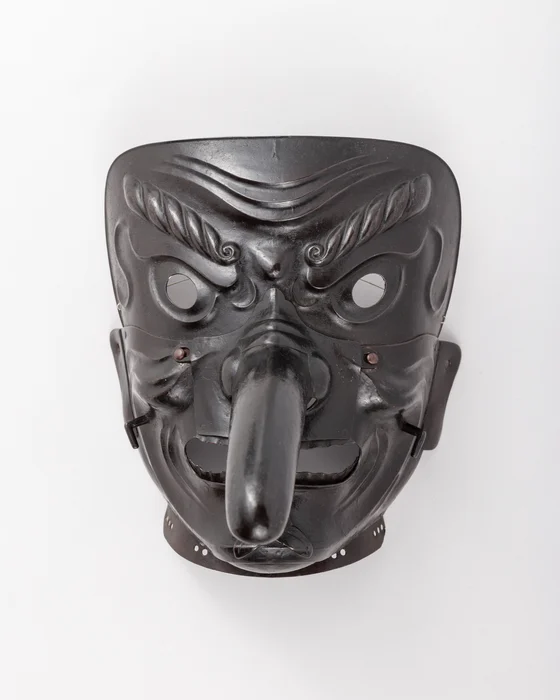
Garuda is described as the king of the birds and a kite-like figure. He is shown either in a zoomorphic form (a giant bird with partially open wings) or an anthropomorphic form (a man with wings and some bird-like features). Garuda is generally portrayed as a protector with the power to swiftly travel anywhere, ever vigilant and an enemy of every serpent. He is also known as Tarkshya and Vainateya.
Garuda is a part of the state insignia of India, Indonesia and Thailand. Both Indonesia and Thailand have Garuda as their coat of arms, and the Indian Army uses the Garuda on its Guards Brigade Regimental Insignia. The Indian Air Force named their special operations unit after him as the Garud Commando Force.
The name Garuda is often associated with the Greater adjutant stork (Leptoptilos dubius).
Text from Wikipedia contributors, “Garuda”. CC BY-SA 4.0. Extracted introduction; formatting changed. Retrieved 5 October 2026. The source article may have changed since retrieval.
References
Sources supporting this profile. Linked pages have their own scope and editorial standards.
- MuseumAngkor National Museum: GarudaResearch access: 2026-10-05
- Museum object / scholarly iconographyHimalayan Art Resources item616: Garuda–BlackResearch access: 2026-10-05
- Historical English translation of primary narrativeGanguli, XVI: Kadru and Vinata’s offspringResearch access: 2026-10-05
- Historical English translation of primary narrativeGanguli, XXIII–XXVII: radiance, Aruna, bondage and demandResearch access: 2026-10-05
- Historical English translation of primary narrativeGanguli, XXVIII–XXXI: food, rescued ascetics and birth purposeResearch access: 2026-10-05
- Historical English translation of primary narrativeGanguli, XXXII–XXXIV: amrita defenses, Vishnu and Indra agreements, releaseResearch access: 2026-10-05
- Historical English translation of primary narrativeGanguli, XXXVI: Sesha and Garuda’s assigned helpResearch access: 2026-10-05
Image credits
Reference illustrationGaruda
Image associated with the exact linked encyclopedia article; consult credited file description for its interpretation.