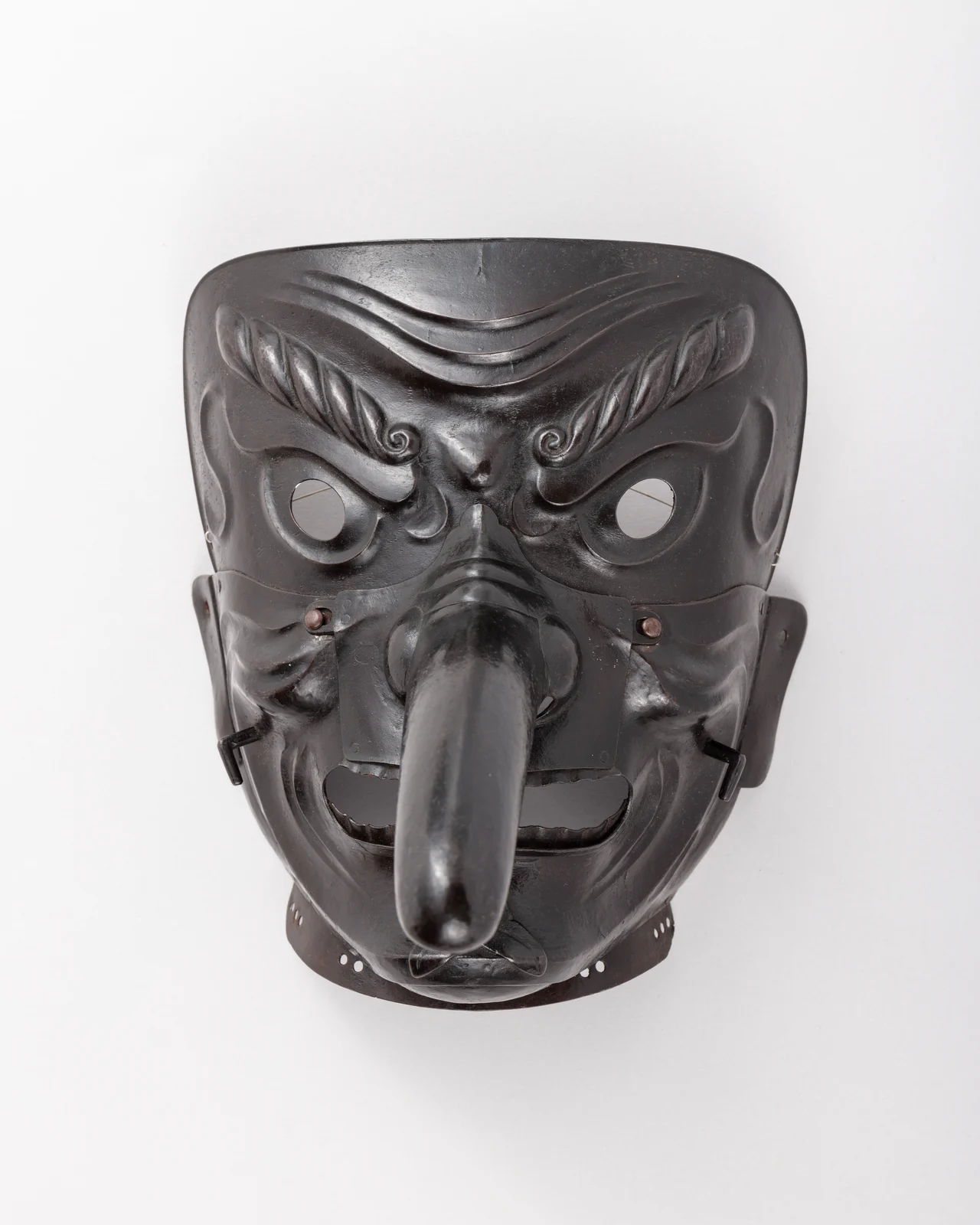
Long-nosed tengu full-face armor mask in lacquered iron, early eighteenth century
This lacquered iron somen represents the long-nosed Ko no ha Tengu type. The eye openings, hinges and attachments belong to wearable armor; the object shows an Edo-period artist’s interpretation of a tengu face, rather than a living creature or its full body.
Overview
Tengu appear in different visual and narrative forms. The Metropolitan Museum’s early eighteenth-century full-face armor mask, 36.25.263a,b, renders the long human nose in embossed and lacquered iron. Its catalogue contrasts this with a beaked, bird-headed type and discusses wings, occasional talons, mountain settings and associations with yamabushi. The object shows how a recognized supernatural face entered armor design; it is not a specimen of an animal. The museum also describes both destructive and protective roles, so a single moral alignment is inadequate.
Hearn’s Story of a Tengu gives a particular bird transformation and an act of gratitude. A priest from Saito on Mount Hiyei-Zan sees boys tormenting a captured kite near Kyoto. He exchanges his fan for the bird and releases it. Soon a monk approaches, identifies himself as the rescued kite and offers a reward through his supernatural abilities. The seventy-year-old priest wants no wealth or status: he regrets never having witnessed the Buddha’s great assembly at Vulture Peak in India.
The tengu promises a representation of that assembly and leads him to a hillside. The priest must keep his eyes closed until he hears the preaching and, once the spectacle begins, refrain from prayer, bowing or any expression of reverence. The warning is about harm to the tengu if the illusion is worshipped. At night an overwhelming vision appears, with the Buddha, disciples, bodhisattvas, deities and other beings. Moved by devotion, the priest forgets his promise and prostrates himself. The entire scene immediately vanishes.
The tengu returns in pain and explains the result: the Guardian of the Doctrine has struck the performers for deceiving a devout person. The others fled, and one of the speaker’s wings is broken, leaving it unable to fly. It then disappears from the story. This ending is not the priest’s death, the tengu’s death or a successful physical journey into the Buddha’s lifetime. It sets the being’s gratitude and theatrical power against a religious limit it had warned the human to observe.
Hearn’s note identifies Jikkun-Shō as a source in which the story may be found and points to the Nō play Dai-É as another treatment of the legend. Those are useful named literary connections, but this entry has directly read Hearn’s complete retelling and note, not the earlier Japanese collection or a performance text of the play. His note also describes several bird and human appearances. None supplies a biological family tree joining tengu to real raptors, nor does visual resemblance alone demonstrate descent from another mythical bird.
Origins & earliest records
Hearn’s In Ghostly Japan (1899), Story of a Tengu, is the completely read narrative here. His footnote names Jikkun-Shō and the Nō play Dai-É as connected witnesses, without independently collated texts here. The Met mask documents early eighteenth-century material culture; Konjaku Monogatarishū remains earlier bibliographic context rather than a located first attestation.
Records & interpretation
Complete Hearn story and attached note read; Met24145 object record and curatorial description checked. Nichibunken’s catalogue confirms the 1899 book and lists Story of a Tengu at 215 in its London copy; that pagination is catalogue evidence, not an inspected original-page claim.
Additional images
 View larger
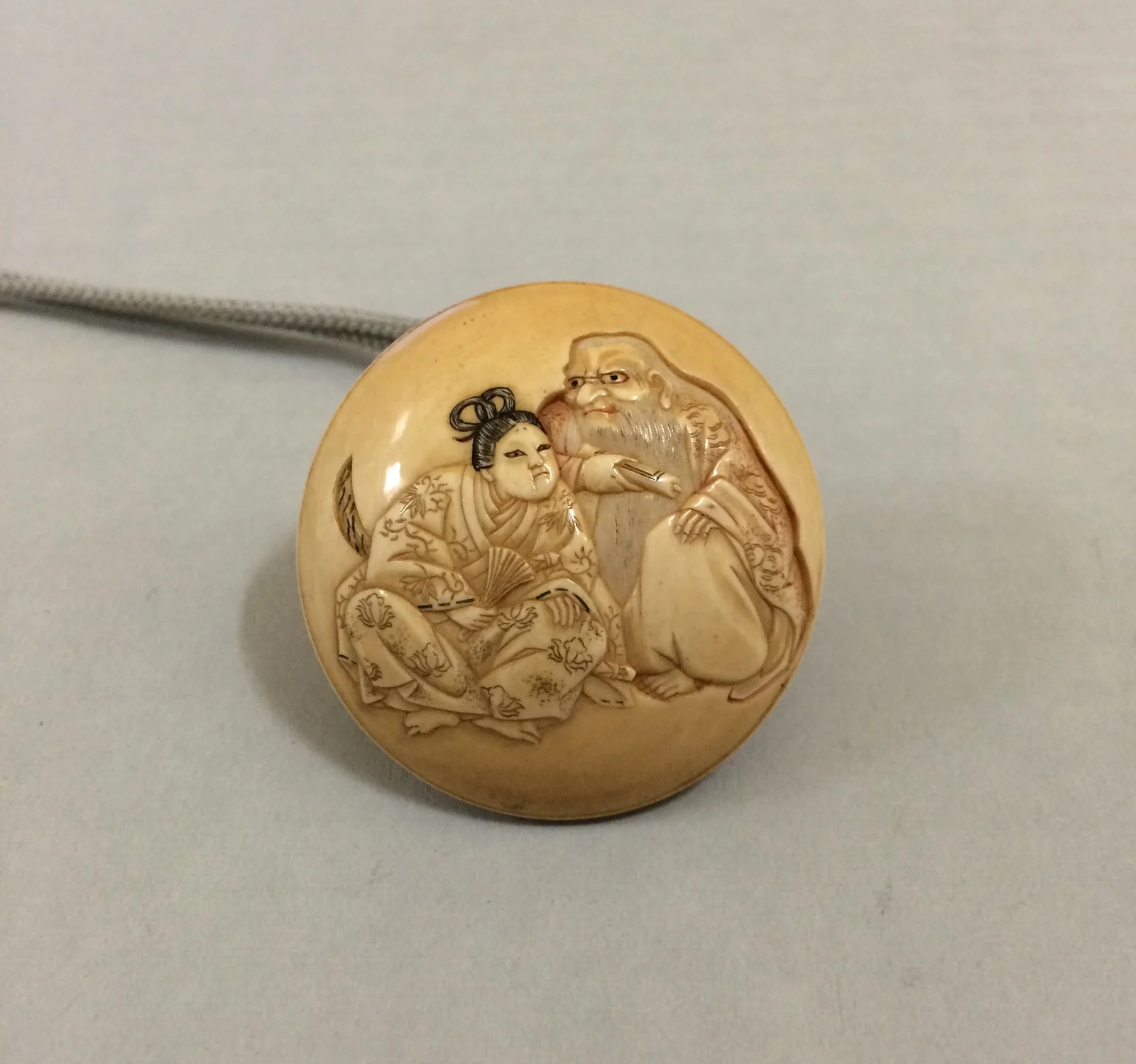
 Nineteenth-century Japanese netsuke showing young Yoshitsune beside a bearded Tengu
The netsuke places the child Yoshitsune beside a bearded, long-nosed Tengu, with a fan between the figures. This is the named nineteenth-century artistic scene in the Met’s catalogue. Its humanlike robes and beard belong to this representation; the image does not supply wings or bird anatomy for all Tengu traditions.
In the literature
“with the head of a hawk and the body of a man.”
“The Tengus, or the Elves with Long Noses”, opening paragraph, p. 112 · William Elliot Griffis (translations and retellings)
Descriptive excerpt from Griffis’s adaptation; specific tengu forms differ across Japanese traditions.
“They are hatched out of eggs, and have wings and feathers, until full grown.”
“The Tengus, or the Elves with Long Noses”; paragraph beginning “C URIOUS CREATURES are the tengus, with the head of a hawk…” · William Elliot Griffis (translations and retellings)
Griffis gives the tengu an avian early stage; retained as this retelling’s account.
“In his left hand he carries a large fan made of seven wide feathers.”
“The Tengus, or the Elves with Long Noses”; paragraph beginning “The Dai Tengu, or master, is a solemn-faced, scowling individual with a…” · William Elliot Griffis (translations and retellings)
The master tengu’s feather fan marks his rank.
“lived in Kurama mountain and taught Yoshitsuné.”
“The Tengus, or the Elves with Long Noses”; paragraph beginning “The greatest of the Dai Tengu lived in Kurama mountain and taught…” · William Elliot Griffis (translations and retellings)
The master tengu instructs Yoshitsune in the mountain legend.
Selected bibliography
Documented works and useful reading. This is not a list of every appearance.
- 01
In Ghostly Japan — Story of a Tengu
Complete retelling and note read. 1899 verified through Nichibunken; its London contents locate the story at 215. Gutenberg’s exact print exemplar not identified.
- 02
Jikkun-Shō
Named by Hearn’s story note; bibliographic lead, earlier Japanese narrative not independently read.
- 03
Dai-É (The Great Assembly)
Hearn identifies this Nō play as a treatment of the same legend; performance text not independently read.
- 04
Konjaku Monogatarishū
Retained bibliographic context; no numbered tengu tale independently collated for this profile.
- 05
Japanese Fairy World: Stories from the Wonder-Lore of Japan
Exact contiguous excerpt checked against the linked primary e-text on 2026-10-05; only whitespace normalized. London: Trübner, 1887 title-page edition; preface dated 1880.
- 06
In Ghostly Japan
In Ghostly Japan, first published 1899; linked historical English e-text, exact Gutenberg source impression unidentified. Story of a Tengu and its author note read in full.
Family & connections
A source-supported family tree or inspiration record has not yet been compiled for this profile. Related reading below indicates a connection in subject matter, not a proven lineage or creative influence.
Located primary passages
Specific passages supporting details in this entry, grouped by their published witness.
Japanese Fairy World: Stories from the Wonder-Lore of Japan
Exact contiguous excerpt checked against the linked primary e-text on 2026-10-05; only whitespace normalized. London: Trübner, 1887 title-page edition; preface dated 1880.
- Griffis gives the tengu an avian early stage; retained as this retelling’s account.
- The master tengu’s feather fan marks his rank.
- The master tengu instructs Yoshitsune in the mountain legend.
- Descriptive excerpt from Griffis’s adaptation; specific tengu forms differ across Japanese traditions.
“The Tengus, or the Elves with Long Noses”, opening paragraph, p. 112
The passage documents this literary version, not zoological existence, earliest attestation or a universal statement of living tradition. Griffis’s1887 selected English adaptation is a literary witness. Its hawk-headed form is specific to this rendering, not mandatory anatomy for all tengu traditions. Matching stays within the specified literary profile and does not cross franchise, culture or animal-species boundaries.
In Ghostly Japan — Story of a Tengu
In Ghostly Japan, first published 1899; linked historical English e-text, exact Gutenberg source impression unidentified. Story of a Tengu and its author note read in full.
- A rescued kite is revealed as a tengu who recreates a Buddhist assembly; the priest’s worship breaks their agreement and the tengu reports a broken wing.
The priest sees a staged supernatural spectacle, not an established journey into the historical Buddha’s actual assembly. Jikkun-Shō and Dai-É are named leads, not independently read originals in this record; devotional words and assembly litany omitted.
Encyclopedia background
An additional attributed reference, separate from the editorial profile above.
Read the open encyclopedia overview
Tengu ( TENG-goo; Japanese: 天狗, pronounced [teŋɡɯ], lit. 'Heavenly Dog') are a type of legendary creature found in Shinto belief. They are considered a type of yōkai (supernatural being) or kami (god or spirit). The Tengu were originally thought to take the forms of birds of prey and a monkey deity, and they were traditionally depicted with human, monkey, and avian characteristics. Sarutahiko Ōkami is considered to be the original model of Konoha-Tengu (a supernatural creature with a red face and long nose), which today is widely considered the Tengu's defining characteristic in the popular imagination. He is the Shinto monkey deity who is said to shed light on Heaven and Earth. Some experts theorize that Sarutahiko was a sun god worshiped in the Ise region prior to the popularization of Amaterasu.
Buddhism long held that the Tengu were disruptive demons and harbingers of war. Their image gradually softened, however, into one of protective, if still dangerous, spirits of the mountains and forests. Tengu are associated with the ascetic practice of Shugendō, and they are usually depicted in the garb of its followers, the yamabushi.
Text from Wikipedia contributors, “Tengu”. CC BY-SA 4.0. Extracted introduction; formatting changed. Retrieved 5 October 2026. The source article may have changed since retrieval.
References
Sources supporting this profile. Linked pages have their own scope and editorial standards.
- Historical English literary retellingHearn, In Ghostly Japan, Story of a Tengu and noteResearch access: 2026-10-05
- Museum object and curatorial interpretationThe Met, Mask in the Shape of a Mountain Demon’s Face, 36.25.263a,bResearch access: 2026-10-05
- Research-library bibliographyNichibunken, In Ghostly Japan 1899 catalogue and contentsResearch access: 2026-10-05
Image credits
Historical armor-mask photographLong-nosed tengu full-face armor mask in lacquered iron, early eighteenth century
This lacquered iron somen represents the long-nosed Ko no ha Tengu type. The eye openings, hinges and attachments belong to wearable armor; the object shows an Edo-period artist’s interpretation of a tengu face, rather than a living creature or its full body.
Further credits appear with each additional image.