Kappa
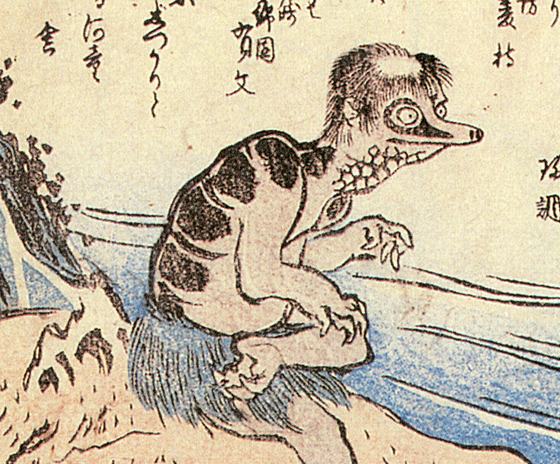
Image associated with the exact linked encyclopedia article; consult credited file description for its interpretation.
Overview
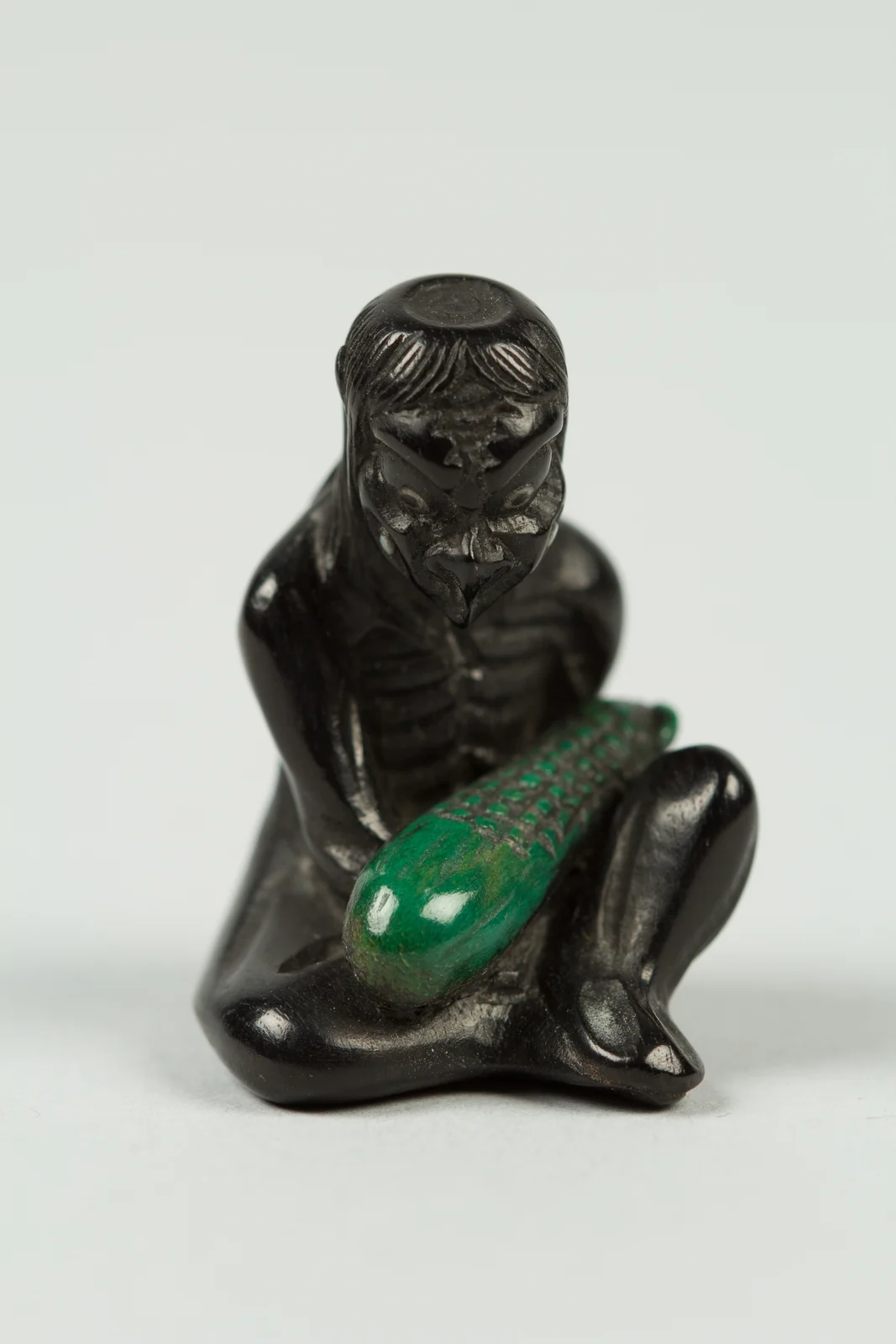
Kappa are Japanese water beings whose appearance and conduct should be traced to particular images and accounts. The British Museum’s discussion of a seated wooden netsuke describes a combination of turtle-like body, monkey-like head and frog-like limbs, with a fluid-filled hollow on the head. This is an explanation of a familiar artistic form, not a universal anatomical description. A separate nineteenth-century wooden netsuke at the Metropolitan Museum is explicitly catalogued as a kappa with a cucumber, documenting that association in an identifiable object.
Lafcadio Hearn’s By the Japanese Sea records a more threatening account. During a discussion of the Bon season and fears surrounding the sea, he describes kappa dragging swimmers down and consuming their internal organs. His accompanying note qualifies the habitat: the being belongs to rivers and visits the sea around river mouths. He also reports that people in Izumo use the name Kawako, which he explains as child of the river. These are Hearn’s recorded regional statements, rather than proof that all Japanese communities used one name or explanation.
The note gives a complete story associated with Kawachi-mura near Matsue and a shrine called Kawako-no-miya. A kappa that has been attacking villagers and domestic animals tries to seize a drinking horse. Its head becomes caught beneath the animal’s belly-band, and the frightened horse drags it out of the river into a field. The owner and other villagers bind it. Although some want to kill it, the horse’s owner, also the village headman, proposes a promise of future safety instead.
The captured being bows and asks for mercy. Unable to write, it agrees to mark the prepared promise with an inked handprint. After its release, the story says, it never again attacks a person or animal belonging to that village. Hearn reports a document said to bear this mark at the shrine; the passage does not establish the document’s supernatural authorship. Nor does the bow in this account empty the head cavity or destroy the being. The outcome depends on capture, negotiation and a locally defined obligation.
These witnesses offer different kinds of evidence: carved objects show historical representation, while Hearn’s travel writing preserves a narrated encounter and its claimed relic. The Metropolitan Museum dates another wooden kappa netsuke to the eighteenth century. That supplies an earlier selected artistic witness than Hearn’s 1894 book, without establishing the first kappa story or a biological lineage linking turtles, monkeys and frogs.
A different literary setting appears in Griffis’s Lord Cuttle-fish Gives a Concert. The sea queen has recovered after care and rest, despite the failure to obtain the monkey’s liver mentioned at the opening. Curious about unusual music, she slips out with two attendants and watches her court physician perform several instruments at once. Among the servants bringing refreshments are little green kappas. Griffis describes them as between monkey and tortoise, with yellow frog-like eyes, ape-like hands, closely cropped hair and very broad mouths. Here they are domestic attendants at an underwater entertainment rather than the horse-seizing river adversary in Hearn’s Kawachi story.
The servants are pleased that their livers will not serve as medicine, a joke connected to this queen’s preceding search for a monkey’s liver. It does not establish a general kappa belief about unsuitable organs. The queen returns home laughing; the physician overindulges and wakes with a headache. Griffis’s preface says the volume includes translations, condensations and some sketches of his own. Its specific comic anatomy and court setting therefore remain attributed to this English retelling, without being imposed on the museum sculptures or other regional accounts.
Origins & earliest records
Selected evidence includes an eighteenth-century wooden kappa netsuke catalogued by the Metropolitan Museum, a nineteenth-century cucumber-bearing example, and Hearn’s 1894 Glimpses of Unfamiliar Japan. These identify surviving objects and a published regional account, not the beginning of the tradition. Sekien’s 1776 collection remains a bibliographic lead; its actual kappa plate was not inspected in this review.
Records & interpretation
Read Hearn’s complete chapter 6 sections 1–2 and note 2, including the Kawachi capture, handprint promise and ending. Museum records independently document two dated wooden objects and the British Museum’s iconographic interpretation. The British Museum page has conflicting production-date and label-date wording, so it is not used to establish the earliest date here. No shrine document or biological specimen was examined.
Additional images
 View larger
 Nineteenth-century wooden Kappa netsuke holding a green cucumber, photographed by the Met
This small wooden netsuke represents a Kappa holding a green cucumber. Its depressed crown, beaked face and folded pose belong to the nineteenth-century carving. The photograph shows a historical sculpture, rather than a living creature. The Met dates it to the Edo or Meiji period without naming the carver.
In the literature
“empty like a long-dried gourd.”
ChapterSix By the Japanese Sea, §2, final sentence
Hearn’s comparison for the light, hollow corpse described in the reported Kappa belief.
Selected bibliography
Documented works and useful reading. This is not a list of every appearance.
- 01
Gazu Hyakki Yagyō
Retained bibliographic lead. The actual kappa plate has not been inspected in this review and is not used to prove a first appearance.
- 02
Glimpses of Unfamiliar Japan, second series: By the Japanese Sea
Complete sections 1–2 and note 2 read. Note2 contains the Kawachi-mura capture and written-promise story; the rest of the chapter is not claimed as reviewed.
- 03
Netsuke of a Kappa, object 10.211.1857
Dated wood carving; catalogue evidence for historical representation.
- 04
Kappa with a cucumber, object 10.211.1961
Identified wooden netsuke; not evidence for every cucumber-related story.
- 05
Japanese Fairy World: Stories from the Wonder-lore of Japan — XVIII: Lord Cuttle-fish Gives a Concert, pp.157–171
Complete concert chapter and preface read; the preceding monkey expedition is referenced through the chapter’s opening, not newly claimed as a complete root reading.
- 06
Glimpses of Unfamiliar Japan, Second Series — By the Japanese Sea
Glimpses of Unfamiliar Japan, Second Series; work copyright1894 independently confirmed in Nichibun catalogue https://shinku.nichibun.ac.jp/gpub/book/g0815.html . Exact print impression underlying PG8133 unidentified. Hosted ChapterSix §§1–2 and complete note2 independently read; no whole chapter/book reading claimed.
Family & connections
A source-supported family tree or inspiration record has not yet been compiled for this profile. Related reading below indicates a connection in subject matter, not a proven lineage or creative influence.
Located primary passages
Specific passages supporting details in this entry, grouped by their published witness.
Glimpses of Unfamiliar Japan, Second Series — By the Japanese Sea
Glimpses of Unfamiliar Japan, Second Series; work copyright1894 independently confirmed in Nichibun catalogue https://shinku.nichibun.ac.jp/gpub/book/g0815.html . Exact print impression underlying PG8133 unidentified. Hosted ChapterSix §§1–2 and complete note2 independently read; no whole chapter/book reading claimed.
- After a coastal passage framed around returning ghosts, Hearn reports that swimmers fear Kappa as consumers of a victim’s entrails. A corpse may appear outwardly unwounded yet light and hollow, unless surf or fish have damaged it. These are Hearn’s reported beliefs, not an anatomical diagnosis.
A mediated local-belief description, not a verified encounter or a universal Kappa anatomy. No prayer or ritual formula reproduced.
Primary source witness
Glimpses of Unfamiliar Japan, Second Series; work copyright1894 independently confirmed in Nichibun catalogue https://shinku.nichibun.ac.jp/gpub/book/g0815.html . Exact print impression underlying PG8133 unidentified. Hosted ChapterSix §§1–2 and complete note2 independently read; no whole chapter/book reading claimed.
- The note calls Kappa principally river goblins, present at sea near river mouths, and records Izumo’s Kawako name. In the Kawachi village account a Kappa becomes caught beneath a horse’s belly-band and is dragged into a field. Villagers bind it, and the headman obtains an undertaking to spare that village’s people and animals, signed by an inked hand because the captive cannot write. The released creature reportedly ceases its attacks there.
Specific Kawachi narrative rather than a general oath-binding law; oath wording and ritual instructions not copied.
Encyclopedia background
An additional attributed reference, separate from the editorial profile above.
Read the open encyclopedia overview
In Japanese folklore, the kappa (河童; "river-child") is a familiar type of water monster, considered one of three major yōkai.
Kappa are said to be inhabiting the ponds and rivers of Japan. It is also known by various local names, including kawatarō (川太郎; "river-boy").
The kappa had been dangerous mankillers that drowned people, also targeting horses and cattle to be dragged into water. Later, they came to be depicted as mischievous beings which get punished (captured, having its arm severed, etc.), and in exchange of forgiveness, gratefully performed labor, or revealed a secret medicinal recipe (kappa's wonder drug).
Accounts typically depict them as green, slimy (or scaly), human-like beings with webbed hands and feet and turtle-like carapaces on their backs. A depression on the head, called a "dish" (sara), retains water, and if this receptacle is damaged or if its liquid is spilled or dried, a kappa becomes severely weakened.
The kappa favor cucumbers and love to engage in sumo-wrestling. They are often accused of assaulting humans in water and removing a mythical organ called the shirikodama (lit. "buttocks-wee-ball") from their victim's anus.
Text from Wikipedia contributors, “Kappa (folklore)”. CC BY-SA 4.0. Extracted introduction; formatting changed. Retrieved 5 October 2026. The source article may have changed since retrieval.
References
Sources supporting this profile. Linked pages have their own scope and editorial standards.
- MuseumBritish Museum, seated kappa netsuke F.747Research access: 2026-10-05
- Primary textHearn, By the Japanese Sea, sections 1–2 and note 2Research access: 2026-10-05
- MuseumMetropolitan Museum, Netsuke of a KappaResearch access: 2026-10-05
- MuseumMetropolitan Museum, Kappa with a cucumberResearch access: 2026-10-05
- CatalogueNichibunken catalogue, Hearn 1894 two-volume editionResearch access: 2026-10-05
- Historical English literary retellingGriffis, Japanese Fairy World, XVIII: Lord Cuttle-fish Gives a Concert, pp.157–171Research access: 2026-10-05
Image credits
Reference illustrationKappa
Image associated with the exact linked encyclopedia article; consult credited file description for its interpretation.
Further credits appear with each additional image.