Kelpie
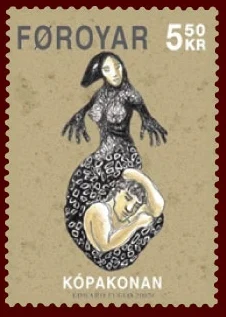
Image associated with the exact linked encyclopedia article; consult credited file description for its interpretation.
Overview
Kelpie narratives place a deceptive water being beside roads, pools and dangerous crossings. In William Grant Stewart's inspected revised edition, the creature usually offers itself as a beautifully equipped riding horse. A tired traveller mistakes it for a useful stray and mounts; the apparently quiet animal then cries out and carries the rider into water to consume the body. Stewart frames the kelpie as an agent of Satan, whose commission concerns both the victim's soul and the creature's appetite. That explicit Christian framework is a feature of this account, rather than a neutral definition shared by every Scottish water-horse story. Stewart also calls it Ech Uisque, whereas Campbell's later Gaelic collection objects to identifying the kelpie and each-uisge without distinction. The difference matters: collectors themselves did not agree on the limits of these names.
Stewart's longer episode is attributed to Mr Wellox and concerns his ancestor James Macgrigor. The ancestor strikes the disguised horse with a sword and captures a fallen piece of its bridle. The kelpie then speaks at length, protesting the assault and bargaining for the object. Its explanation makes the bridle a source of transformation and unusual sight; without its commission, it claims that annihilation will follow. Macgrigor refuses to return it and throws it through a rear window to his wife, defeating the creature's attempt to guard the doorway. The story turns menace into a comic dispute over authority, property and clever evasion. Campbell supplies a contrasting Shetland report in which a kelpie stops a watermill while the water continues to flow. That account does not specify a horse body, showing why one dramatic riding episode should not dictate every recorded kelpie's appearance.
Origins & earliest records
Stewart's collection first appeared in 1823, but the inspected Gutenberg witness is a revised edition with a dedication dated June 1851. Campbell's 1900 collection supplies a later, explicitly contrasting treatment of the kelpie and Gaelic water-horse. These witnesses document changing terminology and particular stories; their publication dates do not establish the beginning of the oral traditions.
Records & interpretation
The sources offer a narrated bridle encounter, a collector's Christian explanation and a correspondent's report about a stopped mill. They document representations and disagreements within folklore collecting. No independently authenticated magical bridle or shape-changing animal is identified, and real water hazards do not by themselves verify the supernatural actions attributed to the creature.
In the literature
“The Water-horse haunts lochs, the Kelpie streams and torrents.”
Chapter V, The Kelpie; paragraph beginning “The Kelpie that swells torrents and devours women and…” · John Gregorson Campbell
Campbell distinguishes the names by habitat.
“The Kelpie that swells torrents and devours women and children”
Chapter V, The Kelpie; paragraph beginning “The Kelpie that swells torrents and devours women and…” · John Gregorson Campbell
Campbell describes a dangerous stream-being while denying an exact Gaelic counterpart.
Selected bibliography
Documented works and useful reading. This is not a list of every appearance.
- 01
The Popular Superstitions and Festive Amusements of the Highlanders of Scotland
Inspected revised witness has a June 1851 dedication; Part IV, Water-Kelpies, pp. 99–107. Do not label this hosted text as the 1823 first edition.
- 02
Superstitions of the Highlands & Islands of Scotland
Chapter V, Kelpie, p. 215: rejects automatic identity with the Gaelic water-horse and gives a Shetland mill report.
Family, evolution & connections
Domestic horse
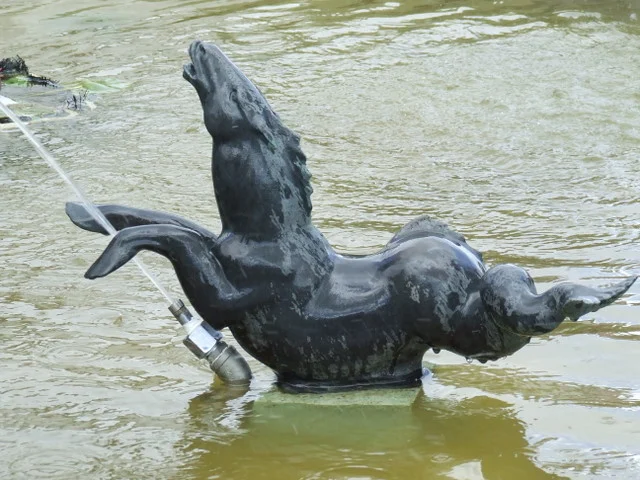
The kelpie's horse-like appearance connects a recognizable domestic animal with a supernatural water danger. The folklore reference supports the story figure and the animal account supplies zoological context. This comparison distinguishes a narrative warning from horse biology; it does not claim that real horses are aquatic predators or that one breed generated the tradition.
Located primary passages
Specific passages supporting details in this entry, grouped by their published witness.
Primary source witness
Glasgow: James MacLehose and Sons, 1900.
- Campbell distinguishes the names by habitat.
Chapter V, The Kelpie; paragraph beginning “The Kelpie that swells torrents and devours women and…”
- Campbell describes a dangerous stream-being while denying an exact Gaelic counterpart.
Chapter V, The Kelpie; paragraph beginning “The Kelpie that swells torrents and devours women and…”
Published witness, not zoological proof or an established earliest origin.
Encyclopedia background
An additional attributed reference, separate from the editorial profile above.
Read the open encyclopedia overview
In Scottish folklore, a kelpie, or water kelpie (Scottish Gaelic: each-uisge), is a mythical shape-shifting spirit inhabiting lochs in Scotland. They also inhabit meres and streams in Yorkshire (Jórvik) mythology. Legends of these shape-shifting water-horses, under various names, spread across the British Isles, appearing in the Northern Isles, Irish, Manx, Northern English, and Welsh folklore. It is usually described as a grey or white horse-like creature, able to adopt human form. Some accounts state that the kelpie retains its hooves when appearing as a human, leading to its association with the Christian idea of Satan as alluded to by Robert Burns in his 1786 poem "Address to the Devil".
Almost every sizeable body of water in Scotland has an associated kelpie story, but the most extensively reported is that of Loch Ness. The kelpie has counterparts across the world, such as the Germanic nixie, the wihwin of Central America and the Australian bunyip. The origins of narratives about the creature are unclear, but the practical purposes of keeping children away from dangerous stretches of water and warning young women to be wary of handsome strangers has been noted in secondary literature.
Kelpies have been portrayed in their various forms in art and literature, including two 30-metre-high (100 ft) steel sculptures in Falkirk, The Kelpies, completed in October 2013.
Text from Wikipedia contributors, “Kelpie”. CC BY-SA 4.0. Extracted introduction; formatting changed. Retrieved 5 October 2026. The source article may have changed since retrieval.
References
Sources supporting this profile. Linked pages have their own scope and editorial standards.
- ReferenceEncyclopædia Britannica (1911): KelpieResearch access: 2026-10-05
- Primary textStewart, revised 1851 edition: Water-Kelpies, pp. 99–107Research access: 2026-10-05
- Primary textCampbell 1900: Kelpie, p. 215Research access: 2026-10-05
Image credits
Reference illustrationKelpie
Image associated with the exact linked encyclopedia article; consult credited file description for its interpretation.