Selkie
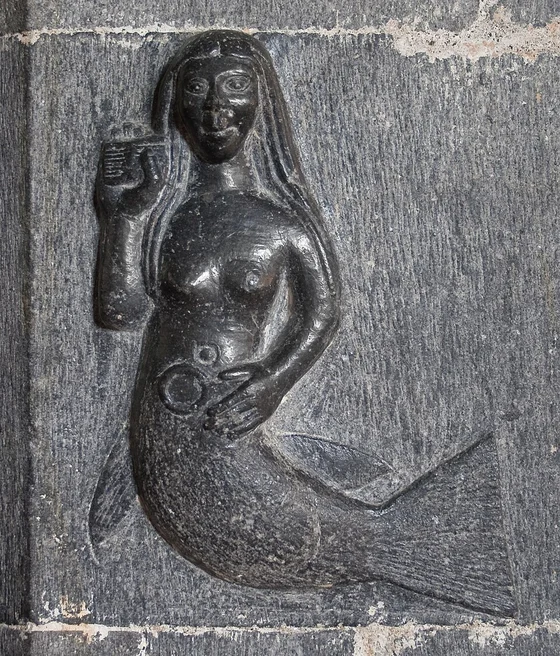
Image associated with the exact linked encyclopedia article; consult credited file description for its interpretation.
Overview
Seal-person narratives involve relationships across the boundary between human homes and the sea, but their local witnesses differ. John Gregorson Campbell's 1900 collection records a North Uist account of the MacCodrums of the seals. Their ancestor sees seals remove their coverings and takes one skin, hiding it above his doorway. The owner follows him; he supplies human clothes, marries her and has a family. When she eventually recovers the hidden covering, she disappears. The skin is therefore more than costume: withholding it removes her route back to the sea. This account also supplies a particular family's narrated descent, rather than proving that everyone with that surname shares one literal animal genealogy. The scene gives an identifiable household mechanism to the familiar loss-and-return pattern. It describes a seal covering, without requiring the fish tail often assigned to a generic mermaid.
Campbell also records two stories in which an injured seal later confronts the person responsible in a human household. A Shetlander wounds a resting seal with a knife, which escapes into the water carrying the blade. Visiting Norway afterwards, he recognises the knife inside a house; his host returns it and tells him not to disturb a resting sea animal again. Campbell prints this as a letter-supplied account framed in the period's language about Norway Finns. That label records a teller's identification; it is not a classification of a real people as supernatural creatures. In the Connsmun episode west of Uist, Egan secures a struck seal with a loop through its paw, then finds it gone. Later, a hospitable stranger names him and reproaches him for putting that loop through his hand. Neither episode follows the stolen-skin marriage plot. Together they emphasise recognition, hospitality, injury and consequences, while showing that a human encounter can reveal the seal relationship without a transformation being visibly witnessed.
The Orkney Book adds two specifically attributed comparisons. Robertson’s vanishing-island account distinguishes Fin-men from sea-trows and preserves an arrival as heather-rope rolls alongside an alternative arrival as seals shedding skins. The household welcomes visiting human relatives, and a lost knife removes their future access to the island. Alice L. Dundas’s Boray poem instead makes the seal-form dancers the drowned followers of Odin, temporarily restored to human shape on Midsummer Eve. Eric hides a woman’s covering and marries her after baptism. Three years later she returns to the island to test whether she is free from that fate, and dies holding a cross; the poem frames her death as redemption. This authored Christian ending should not replace the recovered-skin departure in Campbell’s North Uist account or be treated as a general theology of seal people.
Origins & earliest records
John Gregorson Campbell's Superstitions of the Highlands and Islands of Scotland, 1900, is the inspected primary witness for the North Uist, Shetland/Norway and Connsmun episodes, printed pages 283–285. John Spence's 1899 Shetland Folk-Lore remains selected bibliography. Publication dates record collection and transmission, not the beginning of seal-person traditions.
Records & interpretation
Campbell explicitly records skin removal, family descent and two injured-seal recognition episodes, with local settings and an indicated letter source. These are textual witnesses to narrated relationships. The actual existence of seals does not verify their transformations; a family tradition or the collector's ethnic label is not zoological evidence or a supernatural classification of living people.
In the literature
“Enrobed in this magic coat, they could take to the water”
Printed p. 24; paragraph beginning “In Shetland folk-lore the Finns, both men and women,…”
Spence’s legendary Finns have seal-like coats; his historical ethnic interpretation is not endorsed.
“the rest of their days must be spent on terra firma like other ordinary mortals.”
Printed p. 24; paragraph beginning “In Shetland folk-lore the Finns, both men and women,…”
Losing the coat prevents an aquatic return in this account.
“An I am a silkie in the sea;”
Child ballad 113, stanza 3
The ballad’s father identifies his marine form; only eight lyric words reproduced.
Selected bibliography
Documented works and useful reading. This is not a list of every appearance.
- 01
Shetland Folk-Lore
Selected relevant literary or collected witness. The linked source below is separate museum or reference interpretation; bibliography is not exhaustive.
- 02
Superstitions of the Highlands and Islands of Scotland
Transformation section, Seals, printed pp. 283–285: MacCodrums, Shetland/Norway knife episode and Egan at Connsmun.
- 03
The Orkney Book, A Legend of Boray Island
pp. 403–407; complete contribution. Earlier separate publication not independently collated.
- 04
The Orkney Book, A Vanishing Island
pp. 391–395; complete contribution. Earlier separate publication not independently collated.
- 05
The English and Scottish Popular Ballads: The Great Silkie of Sule Skerry
Child ballad 113, stanza 3; historical wording, not a modern musical arrangement.
Family, evolution & connections
Gray seal
Selkie narratives connect seals with human transformation, while the wildlife account describes real seals' marine biology. The museum discussion supports the folklore context, and the NOAA account provides an animal comparison. Removing a skin to become human is a narrative device; it is not a biological process or evidence that gray seals specifically explain every regional selkie story.
Located primary passages
Specific passages supporting details in this entry, grouped by their published witness.
Primary source witness
Lerwick, 1899; printed p. 24, validated transcription of scan page 31.
- Spence’s legendary Finns have seal-like coats; his historical ethnic interpretation is not endorsed.
Printed p. 24; paragraph beginning “In Shetland folk-lore the Finns, both men and women,…”
- Losing the coat prevents an aquatic return in this account.
Printed p. 24; paragraph beginning “In Shetland folk-lore the Finns, both men and women,…”
Published witness, not zoological proof or an established earliest origin.
The English and Scottish Popular Ballads: The Great Silkie of Sule Skerry
Child ballad 113, stanza 3; historical wording, not a modern musical arrangement.
- The ballad’s father identifies his marine form; only eight lyric words reproduced.
Published witness, not zoological proof or an established earliest origin.
Encyclopedia background
An additional attributed reference, separate from the editorial profile above.
Read the open encyclopedia overview
Selkies are mythological creatures that can shapeshift between seal and human forms by removing or putting on their seal skin. They feature prominently in the oral traditions and mythology of various cultures, especially those of Celtic and Norse origin. The term "selkie" derives from the Scots word for "seal", and is also spelled as silkies, sylkies, or selchies. Selkies are sometimes referred to as selkie folk (Scots: selkie fowk), meaning "seal folk". Selkies are mainly associated with the Northern Isles of Scotland, where they are said to live as seals in the sea but shed their skin to become human on land.
Selkies have a dual nature: they can be friendly and helpful to humans, but they can also be dangerous and vengeful. Selkies are often depicted as attractive and seductive in human form, and many stories involve selkies having romantic or sexual relationships with humans, sometimes resulting in children. Selkies can also be coerced or tricked into marrying humans, usually by someone who steals and hides their seal skin, preventing them from returning to the sea. Such marriages are often unhappy, as the selkie always longs for the sea and may eventually escape if they find their skin.
Selkies have counterparts in other cultures. They are sometimes confused with other seal-like creatures, such as the mermaids or the finfolk. Selkies have inspired many works of art, literature, music, and film.
Text from Wikipedia contributors, “Selkie”. CC BY-SA 4.0. Extracted introduction; formatting changed. Retrieved 5 October 2026. The source article may have changed since retrieval.
References
Sources supporting this profile. Linked pages have their own scope and editorial standards.
- MuseumNational Museums Scotland: The Creeping and The Wise—animals in Scottish folkloreResearch access: 2026-10-05
- Primary textCampbell1900: Seals, pp. 283–285Research access: 2026-10-05
- Primary textThe Orkney Book, A Legend of Boray IslandResearch access: 2026-10-05
- Primary textThe Orkney Book, A Vanishing IslandResearch access: 2026-10-05
Image credits
Reference illustrationSelkie
Image associated with the exact linked encyclopedia article; consult credited file description for its interpretation.