Melusine
Image associated with the exact linked encyclopedia article; consult credited file description for its interpretation.
Overview
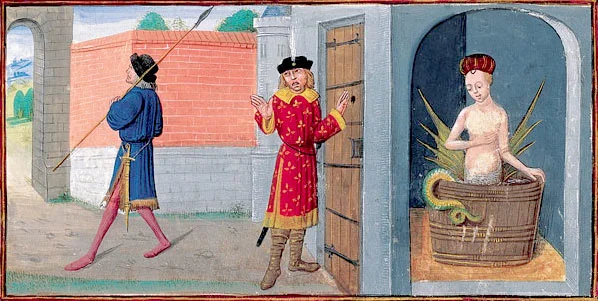
Melusine’s marriage brings prosperity and a lineage of remarkable children, but it rests on a condition: her husband must respect a forbidden time of privacy. When he spies on her, he sees a body partly transformed into a serpent. The discovery does not merely reveal an unusual anatomy; it exposes a breach of trust within the marriage.
The romance connects intimate obligation with the prestige and troubles of the Lusignan family. Melusine can become a builder, mother and omen of dynastic fate as well as a wondrous being. Later images sometimes give her fishlike or twin tails, so a modern emblem should not be mistaken for the exact form described in every medieval text.
Baring-Gould’s nineteenth-century retelling supplies a particular sequence behind the general marriage taboo. Raymond accidentally kills his benefactor while fighting a boar, then meets three golden-haired women dressed in white beside a fountain. Melusina advises him and promises to build a palace on land measured by a stag’s hide. Cut into threads, the hide encloses a large estate. Their marriage rests on her Saturday seclusion. He eventually spies through the bath’s keyhole and sees a lower body described as a fish or serpent tail, but keeps the discovery secret for a time.
Her final departure follows a second breach: after Geoffry with the Tooth burns the monastery where his brother Freimund lives, Raymond publicly calls her a serpent. She leaves through a window with a wail, promising to hover over Lusignan when a new lord is to come. The nurses later see her return at night to feed her two infants, with a blue-and-white scaly fish-tail; she vanishes at dawn. These body terms and the separation between private observation and public accusation belong to this retelling, rather than being silently imposed on every medieval version.
The same chapter reports the ancestral Pressina story: a fountain fay leaves King Helmas after he violates her prohibition on visiting her during childbirth. Melusina and her sisters later imprison their father, and their mother imposes the periodic altered body as punishment. Baring-Gould also transmits Brantôme’s account of local fountain, tower and warning-cry traditions. These are identifiable later receptions and reported witnesses, not independent confirmation of the family’s supernatural genealogy.
Donald’s 1895 edition of the anonymous Middle English translation allows a direct comparison with that later retelling. Chapter I, pp. 14–16, makes Pressyne condemn the eldest daughter for instigating the imprisonment of their father. Melusyne must become serpent-shaped below the navel each Saturday. A husband’s observance of the condition could allow her a natural human lifespan and burial; its failure restores penitence until Judgement. The text also connects her appearances with a new lord of her castle and deaths within her lineage.
The bath episode, pp. 295–299, is more specific than a generic keyhole discovery. Raymondyn’s brother alleges adultery or fairy penitence. Raymondyn pierces an iron door with his sword and sees her combing her hair in a marble bath: human above the navel, with a barrel-thick serpent tail reaching the high ceiling. He closes the hole with wax and drives his brother away. Melusyne knows what happened but tolerates it because he has not disclosed her condition. Her later response, pp. 314–317, expressly distinguishes that forgiven private breach from his public denunciation.
The departure, pp. 319–322, gives a complete flying serpent fifteen feet long, distinct from the half-serpent bathing body. She circles the residence and then Lusynen three times, crying with a woman’s voice compared to a mermaid’s. That vocal comparison does not give her a fish tail. Before leaving she gives two gold rings promising protection in legal disputes or battle when the holder’s cause is just. Afterwards nurses witness her caring for Raymond and Theodoryk; the narration says that Raymondyn never again sees her in womanly form, while others do. These details belong to this English textual witness.
Origins & earliest records
Jean d’Arras composed his prose romance in 1392–1393, drawing on traditions associated with Lusignan and broader supernatural-wife stories. That literary composition is securely dated, but it does not supply an exact oral beginning. Later verse, print and heraldic versions changed emphasis and visual appearance.
Records & interpretation
Manuscript and printed romances establish the forbidden observation, transformation and dynastic narrative. Heraldic or decorative images supply evidence for later visual forms, which may differ from the text. These sources document a literary and cultural figure rather than a verified human-serpent organism or an independently confirmed genealogy. The complete opening Baring-Gould retelling and attributed reception passages were read through page 482; direct medieval manuscript collation remains open. The host’s 1876 label differs from the transcribed title page’s 1877 date. Original 1895 edition OCR directly inspected for the Saturday curse, bath discovery and departure/nursing sequence; distinct body descriptions and private/public breaches retained.
Selected bibliography
Documented works and useful reading. This is not a list of every appearance.
- 01
Roman de Mélusine
Selected relevant literary or collected witness. The linked source below is separate museum or reference interpretation; bibliography is not exhaustive.
- 02
Curious Myths of the Middle Ages, Melusina, pp. 471–482
Complete opening retelling and related Pressina/Brantôme passages read. Historical retelling and interpretation, not direct collation of Jean d’Arras’s medieval manuscript.
- 03
Melusine, anonymous Middle English translation: Chapter I pp. 14–16; XXXVII pp. 295–299; XLII–XLVIII pp. 314–322
Original edition OCR directly read at the named complete episodes; no full-romance collation claimed. Editorial title’s medieval composition range not substituted for manuscript chronology.
Family, evolution & connections
Melusina and her sisters — Keightley’s selected retelling
The three daughters of Pressina and Elinas in Keightley’s Legend of Melusina.
Scroll sideways to see all branches. With a keyboard, focus the tree and use the arrow keys.
- Pressina and Elinas (joint parents)
- Melior
- Palatina
Explicit named parentage in the 1892 literary retelling. A source-specific narrative family, not biological phylogeny. Elinas’s earlier marriage and son Nathas are recorded separately as a connection; other Melusine versions may differ.
Mermaid (merrow)
Mélusine and merrow stories can be compared through water-associated nonhuman partners and the consequences of violating conditions or discovering hidden identities. Their literary and regional histories are nevertheless separate. This edge offers a narrative comparison supported by their reference texts, without turning shared motifs into proof of direct borrowing or treating either tradition as a zoological report.
Pressina and Elinas
Keightley names the fairy Pressina and King Elinas as Melusina’s parents. Their three daughters are born together, before Elinas breaks his promise about entering during his wife’s confinement. This is the parentage of one literary retelling, rather than a claim that every regional Melusine narrative uses the same family.
Melior and Palatina
Melior and Palatina are the other two daughters born to Pressina and Elinas alongside Melusina in Keightley’s account. The sisters later join Melusina in imprisoning their father and receive different punishments. The text names siblings within its story; their grouping does not establish a natural species or an evolutionary branch.
Nathas
Before marrying Pressina, Elinas has a son named Nathas by his previous wife. Keightley makes Nathas the person who tells his father that the three daughters have been born. Melusina and Nathas therefore share a father in this account, while the text explicitly distinguishes their mothers and the two marriages.
Raymond
Raymond marries Melusina after their encounter at the Fountain of Thirst in Keightley’s retelling. The marriage depends on his respecting her Saturday privacy; his later inspection reveals her serpent form, and a subsequent public accusation precipitates separation. This records a spousal relationship and its narrative condition, not biological parentage or a universal marriage rule for fairies.
Encyclopedia background
An additional attributed reference, separate from the editorial profile above.
Read the open encyclopedia overview
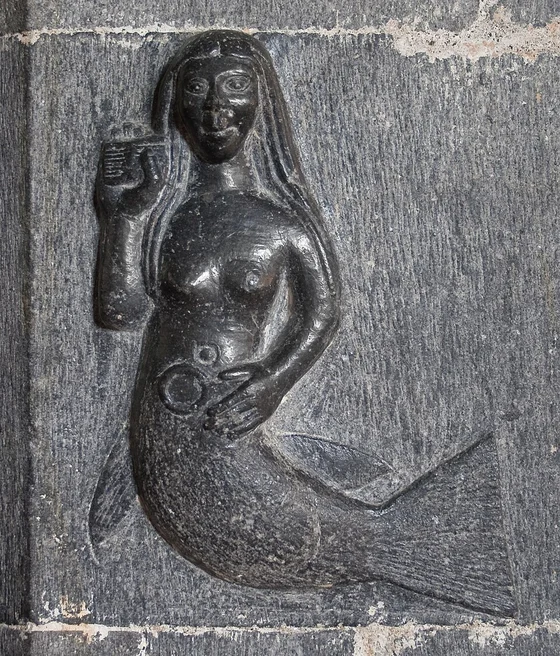
Mélusine (French: [melyzin]) or Melusine or Melusina is a figure of European folklore, a female spirit of fresh water in a holy well or river. She is usually depicted as a woman who is a serpent or fish from the waist down (much like a lamia or a mermaid). She is also sometimes illustrated with wings, two tails, or both. Her legends are especially connected with the northern and western areas of France, Luxembourg, and the Low Countries.
The Limburg-Luxemburg dynasty (which ruled the Holy Roman Empire from 1308 to 1437 as well as Bohemia and Hungary), the House of Anjou and their descendants the House of Plantagenet (kings of England), and the French House of Lusignan (kings of Cyprus from 1205–1472, and for shorter periods over Cilician Armenia and Jerusalem) are said in folk tales and medieval literature to be descended from Melusine. The story combines several major legendary themes, such as the Nereids, Naiad, water nymph or mermaid, the earth being (terroir), the genius loci or guardian spirit of a location, the succubus who comes from the diabolical world to unite carnally with a man, or the banshee or harbinger of death.
Text from Wikipedia contributors, “Melusine”. CC BY-SA 4.0. Extracted introduction; formatting changed. Retrieved 5 October 2026. The source article may have changed since retrieval.
References
Sources supporting this profile. Linked pages have their own scope and editorial standards.
- ReferenceEncyclopædia Britannica (1911): MélusineResearch access: 2026-10-05
- Historical retelling and interpretationBaring-Gould, Melusina, opening narrative and attributed historical receptionResearch access: 2026-10-05
- Library manuscript catalogueBritish Library: Royal MS 18 B II, Romance of MelusineResearch access: 2026-10-05
- Primary literary editionDonald 1895 edition: Melusine, selected primary passagesResearch access: 2026-10-05
Image credits
Reference illustrationMelusine
Image associated with the exact linked encyclopedia article; consult credited file description for its interpretation.