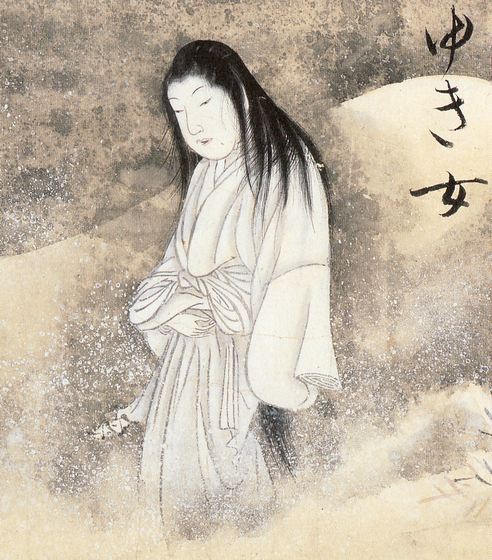
Yuki-onna
Image associated with the exact linked encyclopedia article; consult credited file description for its interpretation.
Overview
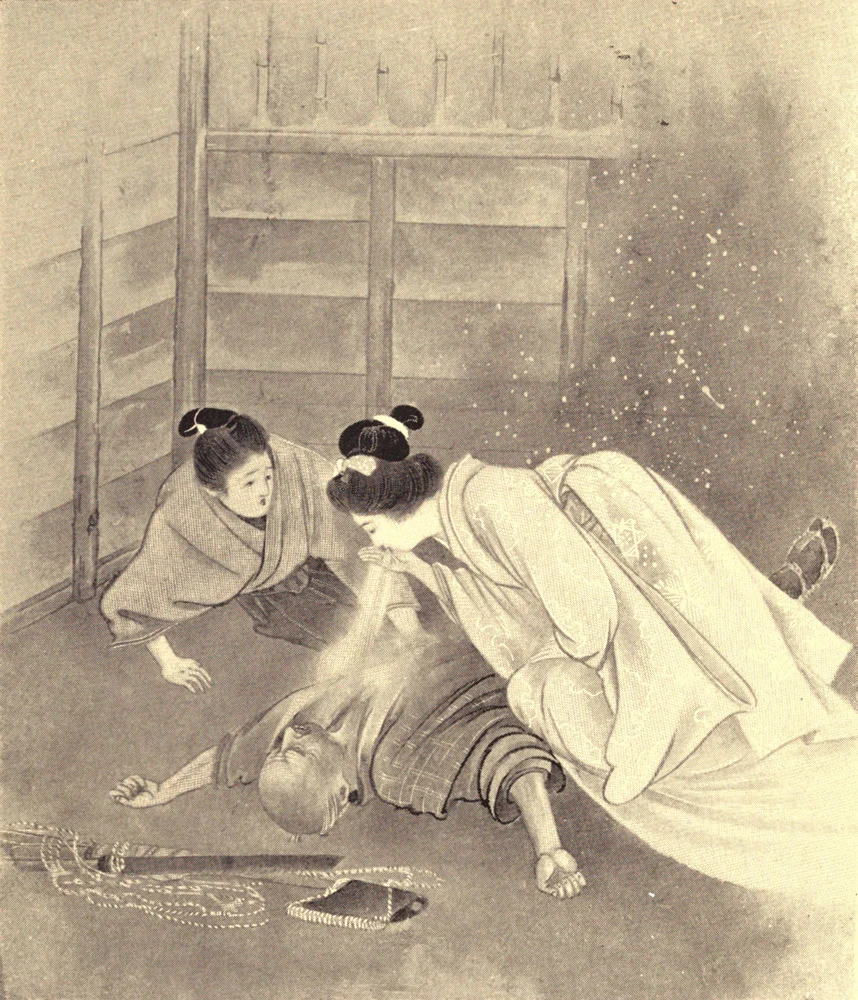
Hearn’s Musashi story begins with two woodcutters, the elderly Mosaku and his eighteen-year-old apprentice Minokichi. A snowstorm overtakes them on their return journey, and the ferry is stranded on the opposite bank. They shelter in the ferryman’s small, unheated hut. During the night Minokichi sees a woman dressed in white bending over Mosaku, breathing something like luminous white smoke upon him. She then approaches the younger man. Her beauty and her frightening eyes coexist; this is not an account of an indistinct shape seen only at a distance.
The visitor says that she intended to kill Minokichi too, but spares him because of his youth. She makes his survival conditional on silence, explicitly including his mother among those he must not tell. After she leaves, Mosaku is found frozen and dead. Minokichi is rescued the next morning and remains ill for some time. He initially wonders whether the woman was a dream or an effect of snowlight. That uncertainty belongs to his experience within the narrative; the later recognition is what connects the two episodes.
In the following winter he meets a young woman who calls herself O-Yuki. She says that her parents have died and that she is travelling to Yedo to find work through relatives. Minokichi brings her home, his mother welcomes her, and she stays as his wife. The mother dies about five years later, praising her daughter-in-law. O-Yuki bears ten children, boys and girls, yet retains her youthful appearance. The story does not name the children, give them supernatural powers or say that all ten were born within those five years.
One night her lamplit face reminds Minokichi of the woman in the hut. At O-Yuki’s invitation he tells the old story, admitting that he has never known whether it was a dream. She identifies herself as that same visitor and reproaches him for breaking his promise. Their sleeping children are the stated reason she does not kill him. She orders him to care for them well, threatens consequences if they have cause to complain, and dissolves into white mist that escapes through the smoke-hole. Hearn ends by saying that she is never seen again; he does not narrate her death, a later reconciliation or the children’s fate.
The source is unusually specific about its mediation: Hearn says a farmer from Chōfu in Nishitama-gōri, Musashi, told him a legend of the farmer’s native village. He does not name the farmer and says he does not know whether this version had been written in Japanese. This marriage-and-silence plot is therefore a located English telling, not a complete definition of every regional snow-woman tradition.
Origins & earliest records
Kwaidan (1904), Yuki-Onna; Hearn’s prefatory statement dated Tokyo, 20 January 1904 identifies an unnamed farmer of Chōfu, Nishitama-gōri, Musashi. This dates and locates the selected English witness, not the first appearance of the wider tradition.
Records & interpretation
The complete Yuki-Onna narrative and Hearn’s prefatory provenance statement were read. The hut, breath, ten children, recognition and final disappearance are textual evidence for this telling; no independent report of a supernatural death is claimed.
Additional images
 View larger
 Takeuchi Keishu’s Yuki-onna blowing cold breath upon Mosaku, Kwaidan frontispiece, 1904
The woman in white bends over the older woodcutter Mosaku while Minokichi watches in the ferryman’s hut. This 1904 illustration presents the deadly first encounter in Hearn’s Musashi telling, rather than every regional snow-woman tradition.
In the literature
“her breath was like a bright white smoke.”
YUKI-ONNA; paragraph beginning “He was awakened by a showering of snow in…” · Lafcadio Hearn (English retellings)
The snow-woman bends over Mosaku in the ferryman’s hut.
“You are a pretty boy, Minokichi; and I will not hurt you now.”
YUKI-ONNA; paragraph beginning “He was awakened by a showering of snow in…” · Lafcadio Hearn (English retellings)
She spares Minokichi while imposing a secrecy condition.
“And O-Yuki bore Minokichi ten children, boys and girls,—handsome children all of them”
YUKI-ONNA; paragraph beginning “O-Yuki proved a very good daughter-in-law. When Minokichi’s mother…” · Lafcadio Hearn (English retellings)
The disguised woman’s domestic life in Hearn’s particular narrative.
“she melted into a bright white mist that spired to the roof-beams”
YUKI-ONNA; paragraph beginning “Even as she screamed, her voice became thin, like…” · Lafcadio Hearn (English retellings)
Her disappearance after Minokichi reveals their earlier encounter.
Selected bibliography
Documented works and useful reading. This is not a list of every appearance.
- 01
Kwaidan: Stories and Studies of Strange Things — Yuki-Onna
Complete selected story and Hearn’s January 1904 prefatory provenance statement read. Modern digitizer notes are distinguished from Hearn’s text.
- 02
Kwaidan: Stories and Studies of Strange Things
Public English e-text; author’s preface dated Tokyo, 20 January 1904.
Family, evolution & connections
O-Yuki, Minokichi and their ten children
Hearn’s selected Musashi narrative, published in Kwaidan (1904).
Scroll sideways to see all branches. With a keyboard, focus the tree and use the arrow keys.
- O-Yuki / snow woman and Minokichi
- Ten unnamed children (boys and girls, collectively)
The joint-parent heading branches to the ten expressly stated children collectively. No children’s names or individual sex assignments are supplied. O-Yuki and the snow woman are the same narrative individual. Her introductory account of deceased parents is a character’s claim, not a basis for a larger reconstructed pedigree; other versions remain separate.
Minokichi in Hearn’s Musashi account
The woman welcomed as O-Yuki becomes Minokichi’s wife and later identifies herself as the snow woman he encountered. These are one narrative person. Mosaku is Minokichi’s master, not his father, and this marriage belongs specifically to Hearn’s telling.
Ten unnamed children of O-Yuki and Minokichi
The narrator states that O-Yuki bears Minokichi ten children, boys and girls. Their presence restrains her final threat, but their names, individual ages and allocation by sex are not supplied. This household is not imposed on every yuki-onna version.
Located primary passages
Specific passages supporting details in this entry, grouped by their published witness.
Kwaidan: Stories and Studies of Strange Things
Public English e-text; author’s preface dated Tokyo, 20 January 1904.
- The snow-woman bends over Mosaku in the ferryman’s hut.
YUKI-ONNA; paragraph beginning “He was awakened by a showering of snow in…”
- She spares Minokichi while imposing a secrecy condition.
YUKI-ONNA; paragraph beginning “He was awakened by a showering of snow in…”
- The disguised woman’s domestic life in Hearn’s particular narrative.
YUKI-ONNA; paragraph beginning “O-Yuki proved a very good daughter-in-law. When Minokichi’s mother…”
- Her disappearance after Minokichi reveals their earlier encounter.
YUKI-ONNA; paragraph beginning “Even as she screamed, her voice became thin, like…”
Attests this published account; does not establish zoological existence, consensus belief or earliest origin.
Kwaidan: Stories and Studies of Strange Things — Yuki-Onna
Hearn’s English text; Kwaidan first published 1904, author’s prefatory statement dated Tokyo, 20 January 1904. The exact print impression used by Gutenberg is unidentified; author notes distinguished from digitizer notes.
- The white woman spares Minokichi, later becomes O-Yuki, and disappears after he breaks secrecy, with the children determining her restraint.
YUKI-ONNA, complete narrative and two author notes; prefatory statement dated 20 January 1904
This verifies Hearn’s complete published narrative, not every Japanese version or an independently inspected original of the books named in his preface. No recitation or ritual formula reproduced. O-Yuki’s initial biographical account is a character’s statement; no source-wide claim of immortality or return is inferred.
Encyclopedia background
An additional attributed reference, separate from the editorial profile above.
Read the open encyclopedia overview
Yuki-onna (雪女; lit. 'snow woman') is a yūrei or yōkai in Japanese folklore that is often depicted in Japanese literature, films, or animation.
She may also go by such names as yuki-musume (雪娘, "snow daughter"), yukihime (雪姫, "snow princess"), yuki-onago (雪女子, "snow girl"), yukijorō (雪女郎, "snow woman"), yuki anesa (雪姉さ, "snow sis"), yuki-onba (雪乳母, "snow granny" or "snow nanny"), yukinba (雪婆, "snow hag") in Ehime, yukifuri-baba (雪降り婆々, "snowfall witch" or "snowfall hag") in Nagano. They are also called several names that are related to icicles, such as tsurara-onna, kanekori-musume, and shigama-nyōbō.
Text from Wikipedia contributors, “Yuki-onna”. CC BY-SA 4.0. Extracted introduction; formatting changed. Retrieved 5 October 2026. The source article may have changed since retrieval.
References
Sources supporting this profile. Linked pages have their own scope and editorial standards.
- Historical English literary retellingHearn, Kwaidan, Yuki-Onna — complete narrativeResearch access: 2026-10-05
- Author’s reported oral provenanceHearn’s prefatory source statement for Yuki-OnnaResearch access: 2026-10-05
Image credits
Reference illustrationYuki-onna
Image associated with the exact linked encyclopedia article; consult credited file description for its interpretation.
Further credits appear with each additional image.