Kitsune
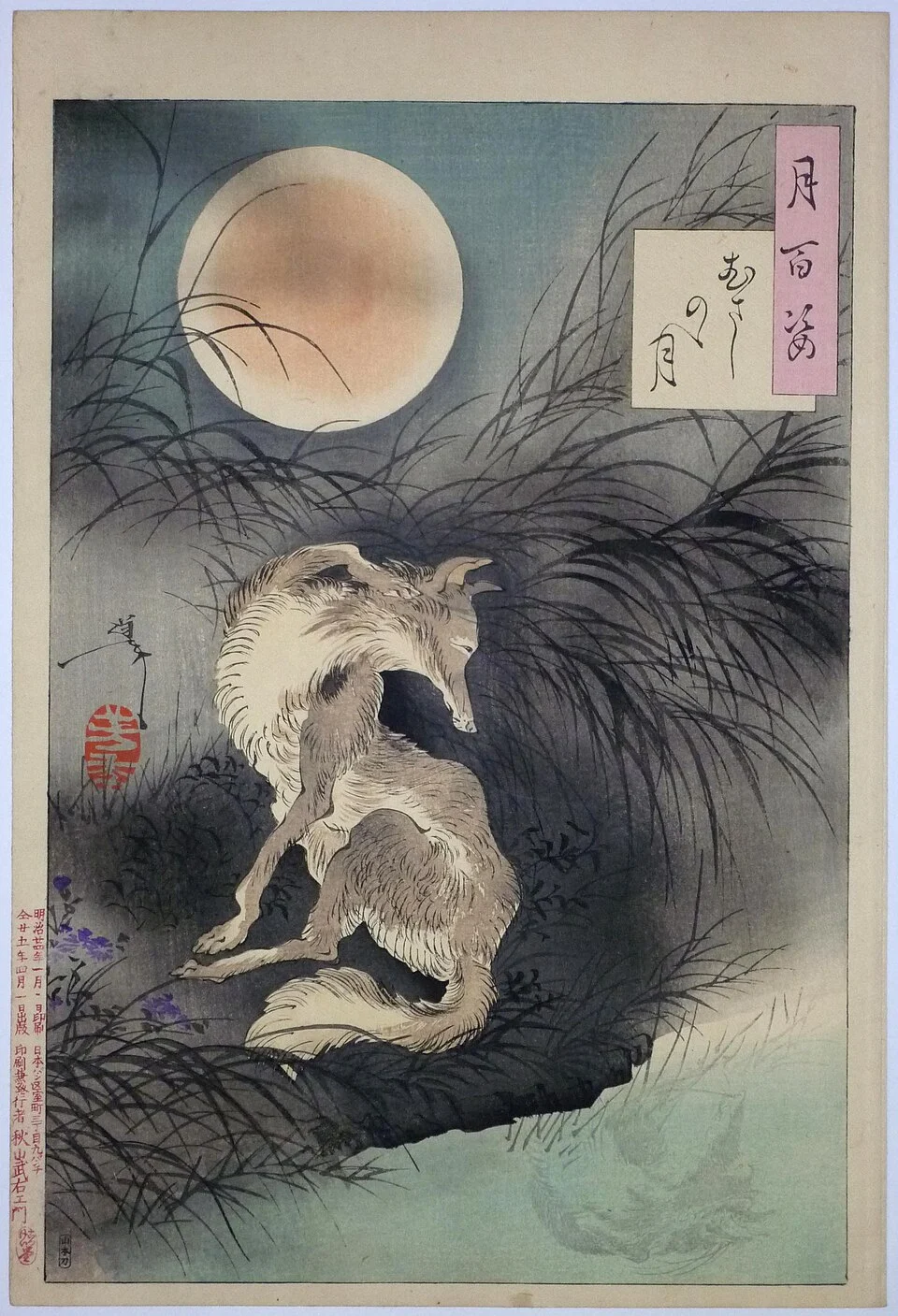
Image associated with the exact linked encyclopedia article; consult credited file description for its interpretation.
Overview
Kitsune is the Japanese word for fox, while supernatural fox accounts attribute transformation, illusion, gratitude and possession to particular animals or spirits. Hearn’s 1894 chapter does not produce a consistent taxonomy. He records several competing classifications from his Izumo experience, including distinctions among Inari-associated foxes, wild foxes and household Ninko or Hito-kitsune. He acknowledges contradictions between places and informants. His proposed classes, ages and powers should consequently be read as reported traditions, not standardized species or stages in an evolutionary sequence.
Sacred fox imagery needs its own context. Fushimi Inari Taisha’s current explanation identifies invisible fox messengers associated with Inari Okami and explicitly distinguishes the deity from a fox. That institutional account should not be replaced by Hearn’s recurring shorthand of a fox-god or his speculation about popular religion. His observations of paired stone foxes, small offerings and particular Matsue shrines remain valuable historical testimony, but his judgments about rural worshippers are his own. At Oba he describes petitioners taking small clay foxes from a shrine box, keeping them until a request is granted and then returning them. He associates keys in fox-images’ mouths with Inari’s provision of wealth. These are located historical observations, not a rule for every shrine.
The chapter describes both harmful deception and helpful repayment, including fox-wives who marry and bear children in gratitude for kindness. In one Matsue story, a man drives dogs away from a fleeing fox with his umbrella. A young woman visits his home the next evening to thank him, leaving two ducks and two silver coins. One coin becomes grass; the other remains money. In another, the physician Sugitean attends a childbirth at an apparently magnificent house on Shiragayama. When he returns to give thanks, only forest can be found. Again, one payment changes to grass while the rest remains good. These episodes do not make every fox gift wholly worthless.
Hearn also separates supernatural stories from frauds exploiting their reputation. A tofu seller trusts a visitor who appears to have a white tail and promises to protect his property from a predicted fire. Given private access to the storehouse, the impostor removes the valuables; no fire follows. Another supposed benefactor doubles a trader’s small deposits until he risks his entire savings, which disappear. These are human deceptions in the chapter, not additional documented powers of fox spirits.
Possession and fox-keeping accusations have a social history in the same source. Hearn reports household prosperity ascribed to invisible retainers, but also marriage exclusion, reduced land values and violence against people believed possessed. Such reports document the effects of belief and the author’s interpretation; they do not establish an inherited supernatural condition in the accused families. His assertion that schooling would extinguish these beliefs is a late nineteenth-century forecast, not a description of contemporary Japanese religion.
Several literary connections remain specific. Hearn mentions the golden, nine-tailed Tamamonomae without assigning nine tails to every fox. His excerpt attributed to Jippensha Ikku’s Hiza-Kuruge has two frightened travellers mistake one another for a disguised animal until a dog’s indifference resolves the misunderstanding. A separate report, relayed by Hearn’s servant, tells of a missing child returned after playing with an unknown companion; identifying that companion as a fox is the community’s inference. None of these episodes supplies one common genealogy or a single explanation for every human–fox relationship.
The complete chapter and its eighteen notes combine local observations, second-hand anecdotes, literary excerpts and broader claims whose sources vary. The selected bibliography identifies that scope. It does not claim to list every fox narrative, to authenticate each event, or to establish the first Japanese record from a collection published in 1894.
Origins & earliest records
Glimpses of Unfamiliar Japan, first series, chapter 15 Kitsune (1894) is the complete historical witness used. Nichibunken records1894 copyright and places Kitsune at 310 in its London volume I. Earlier tales mentioned by Hearn are leads, not a demonstrated earliest attestation; his proposed late introduction of supernatural-fox belief is not adopted here as settled chronology.
Records & interpretation
All 15 sections of Hearn’s Kitsune and all 18 chapter notes read. Their firsthand observations, named or unnamed reports, literary examples and explicit frauds are distinguished. Fushimi Inari Taisha’s current FAQ checked for the deity–messenger distinction. Neither source makes supernatural claims zoological evidence.
In the literature
“So the Fox changed herself into a human form”
“The Fox and the Badger”, p. 73 · William Elliot Griffis (translations and retellings)
The tale’s supernatural fox transforms to sell the badger. “Kitsune” is the match label; this English text itself says Fox.
“All foxes have supernatural power. There are good and bad foxes.”
Chapter Fifteen, Kitsune; paragraph beginning “All foxes have supernatural power. There are good and…”
Hearn introduces reported popular beliefs, not a zoological or medical conclusion.
“It is rarely seen, keeping itself invisible, except to those to whom it attaches itself.”
Chapter Fifteen, Kitsune; paragraph beginning “All foxes have supernatural power. There are good and…”
This sentence concerns the Ninko/Hito-kitsune within Hearn’s reported classification.
“It will take care that the rice-fields shall never want for water, nor the cooking-pot for rice.”
Chapter Fifteen, Kitsune; paragraph beginning “All foxes have supernatural power. There are good and…”
The housed Ninko is said to reward care with prosperity.
“the water will only reflect the shadow of a fox.”
Chapter Fifteen, Kitsune; paragraph beginning “All foxes have supernatural power. There are good and…”
Hearn reports a water-reflection test for a transformed Nogitsune; not an experimentally validated test.
“he challenged him to a trial of skill in the art of transformation.”
“The Fox and the Badger”; paragraph beginning “The cub after waiting a long time for its mother to come…” · William Elliot Griffis (translations and retellings)
The fox cub challenges the treacherous badger after his mother fails to return.
Selected bibliography
Documented works and useful reading. This is not a list of every appearance.
- 01
Glimpses of Unfamiliar Japan, first series — Kitsune
Complete chapter 15, sections1–15 and 18 notes read. Nichibunken catalogue confirms 1894 copyright and a 310 opening page in its London volume I; exact Gutenberg print exemplar unresolved.
- 02
Hiza-Kuruge
Selected comic scene reproduced in Hearn’s section 12, not a complete reading of the original work.
- 03
Glimpses of Unfamiliar Japan: First Series
First published 1894; public English e-text, chapter XV.
- 04
Japanese Fairy World: Stories from the Wonder-Lore of Japan
Exact contiguous excerpt checked against the linked primary e-text on 2026-10-05; only whitespace normalized. London: Trübner, 1887 title-page edition; preface dated 1880.
Family & connections
A source-supported family tree or inspiration record has not yet been compiled for this profile. Related reading below indicates a connection in subject matter, not a proven lineage or creative influence.
Located primary passages
Specific passages supporting details in this entry, grouped by their published witness.
Glimpses of Unfamiliar Japan: First Series
First published 1894; public English e-text, chapter XV.
- Hearn introduces reported popular beliefs, not a zoological or medical conclusion.
- This sentence concerns the Ninko/Hito-kitsune within Hearn’s reported classification.
- The housed Ninko is said to reward care with prosperity.
- Hearn reports a water-reflection test for a transformed Nogitsune; not an experimentally validated test.
Attests this published account; does not establish zoological existence, consensus belief or earliest origin.
Japanese Fairy World: Stories from the Wonder-Lore of Japan
Exact contiguous excerpt checked against the linked primary e-text on 2026-10-05; only whitespace normalized. London: Trübner, 1887 title-page edition; preface dated 1880.
- The fox cub challenges the treacherous badger after his mother fails to return.
- The tale’s supernatural fox transforms to sell the badger. “Kitsune” is the match label; this English text itself says Fox.
The passage documents this literary version, not zoological existence, earliest attestation or a universal statement of living tradition. Griffis’s1887 selected English adaptation is a literary witness, not an independently collated Japanese-language origin text. The English passage says Fox; kitsune is the bounded profile match. Matching stays within the specified literary profile and does not cross franchise, culture or animal-species boundaries.
Glimpses of Unfamiliar Japan, first series — Kitsune
Glimpses of Unfamiliar Japan, First Series, first published 1894; author’s preface dated Kumamoto, May 1894. Exact Gutenberg source print impression unidentified.
- Hearn’s chapter combines conflicting reported fox classifications, locally attributed narratives and observed social consequences; it does not provide a single agreed taxonomy.
Chapter Fifteen, Kitsune, complete §§1–15 and eighteen chapter notes
Historical observer’s compilation, not present consensus, validated medicine or original collation of every cited Japanese work. Deity/retainer ambiguity and contradicted reports preserved; ritual procedures and formulas not reproduced.
References
Sources supporting this profile. Linked pages have their own scope and editorial standards.
- Historical observations and collected literary materialHearn, Glimpses of Unfamiliar Japan, chapter 15 Kitsune and notesResearch access: 2026-10-05
- Current shrine self-descriptionFushimi Inari Taisha, relationship between Inari shrines and foxesResearch access: 2026-10-05
- Research-library bibliographyNichibunken, Glimpses of Unfamiliar Japan 1894 catalogue and contentsResearch access: 2026-10-05
Image credits
Reference illustrationKitsune
Image associated with the exact linked encyclopedia article; consult credited file description for its interpretation.