A sourced illustration has not yet been added. This gap is included in the coverage record.
Overview
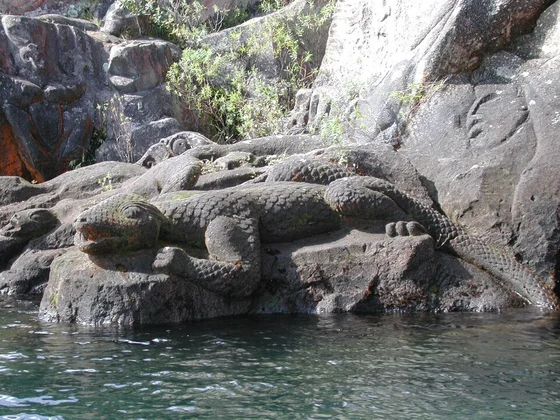
The Hawaiian word moʻo has several meanings, including lizard or reptile and water spirit; context therefore matters when reading a name. Moʻo akua belong to Hawaiian religious and narrative traditions and are frequently associated with fresh water. Their character cannot be supplied simply by borrowing the anatomy or behavior of a European dragon.
Marie Alohalani Brown’s study draws on Hawaiian-language newspapers, manuscripts and oral histories, and distinguishes named beings through their sources. This approach makes locality and narrative relationships central. A catalog entry should retain those relationships when discussing a particular moʻo, and should treat the tradition as living ancestral knowledge. This introductory entry avoids describing private observances or converting sacred places into adventure locations.
Westervelt’s 1915 appendix organizes named beings through a family led by Mo-o-inanea, who appears as woman or dragon and distributes relatives across the islands. Its local notices distinguish a river guardian in Waialua, an oyster-associated guardian at Ewa and two stone women at Nuʻuanu. Hau-ola is represented by an elongated smooth stone, Ha-puu by a rounder rough one; the quoted account identifies different plant offerings for each. These details belong to particular historical testimonies rather than a single standardized reptile anatomy.
The same appendix describes two Wailuku River beings as moving boards forming a bridge. Sometimes they permit safe passage; at other times they tip travelers into the water. It reports their destruction by Hiʻiaka, without supplying individual names. This dangerous crossing differs from Kihawahine’s role as a Maui royal guardian and from the oyster association of Kane-kua-ana. Westervelt’s “dragon” translation and broad classification are retained as his historical framing, alongside the later Hawaiian-language scholarship already cited.
Origins & earliest records
Brown’s 2022 research brings together earlier Hawaiian-language records and oral histories. It demonstrates a substantial documentary tradition, while leaving the antiquity of individual oral accounts open. A surviving record dates its documentation, not the beginning of an oral tradition; earlier transmission cannot be timed precisely from this witness alone.
Records & interpretation
Hawaiian-language usage, named narratives and community-informed scholarship attest to moʻo akua. An ordinary lizard’s biological classification cannot determine the religious identity or significance of a named water deity. This is evidence for cultural expression and recorded interpretation, rather than a zoological specimen or independently verified supernatural event.
In the literature
“the Kakea water god, a moo,”
Chapter XII, “The Punahou Spring”; paragraph beginning “One day the sister, Kauakiowao, told her brother that she wanted…” · Multiple contributors; section credits retained
Emma M. Nakuina’s contributed narrative identifies Kakea as a moʻo water deity.
“controlled all the water sources of Manoa and Makiki Valleys.”
Chapter XII, “The Punahou Spring”; paragraph beginning “One day the sister, Kauakiowao, told her brother that she wanted…” · Multiple contributors; section credits retained
The named moʻo controls water sources in these valleys in Nakuina’s narrative.
“This god was one of the ancestors of the children on the mother’s side,”
Chapter XII, “The Punahou Spring”; paragraph beginning “One day the sister, Kauakiowao, told her brother that she wanted…” · Multiple contributors; section credits retained
The narrative identifies a genealogical relationship between Kakea and the children.
Selected bibliography
Documented works and useful reading. This is not a list of every appearance.
- 01
Ka Poʻe Moʻo Akua: Hawaiian Reptilian Water Deities
Selected relevant primary or ethnographic work; the online source below is separate.
- 02
Legends of Gods and Ghosts, Appendix: The Dragon Ghost-Gods, pp. 255–258
Complete selected appendix section read; earlier quoted authorities remain mediated.
- 03
Hawaiian Folk Tales: A Collection of Native Legends
Chicago: A. C. McClurg & Co., 1907, publication 1 March 1907 on title-page verso.
Family & connections
A source-supported family tree or inspiration record has not yet been compiled for this profile. Related reading below indicates a connection in subject matter, not a proven lineage or creative influence.
Located primary passages
Specific passages supporting details in this entry, grouped by their published witness.
Primary source witness
Chicago: A. C. McClurg & Co., 1907, publication 1 March 1907 on title-page verso.
- Emma M. Nakuina’s contributed narrative identifies Kakea as a moʻo water deity.
- The named moʻo controls water sources in these valleys in Nakuina’s narrative.
- The narrative identifies a genealogical relationship between Kakea and the children.
- Kakea supplies lasting water to the channel requested by his young relative.
Historical translation or collector’s published version; not zoological evidence, a universal account or an assertion about all living communities.
References
Sources supporting this profile. Linked pages have their own scope and editorial standards.
- ReferenceUniversity of Hawaiʻi Press: Ka Poʻe Moʻo AkuaResearch access: 2026-10-05
- ReferencePukui–Elbert Hawaiian Dictionary (1986): moʻoResearch access: 2026-10-05
- Primary collected textWestervelt, The Dragon Ghost-Gods, pp. 255–258 (1915)Research access: 2026-10-05
Image credits
A sourced illustration has not yet been added. This gap is included in the coverage record.