Menehune
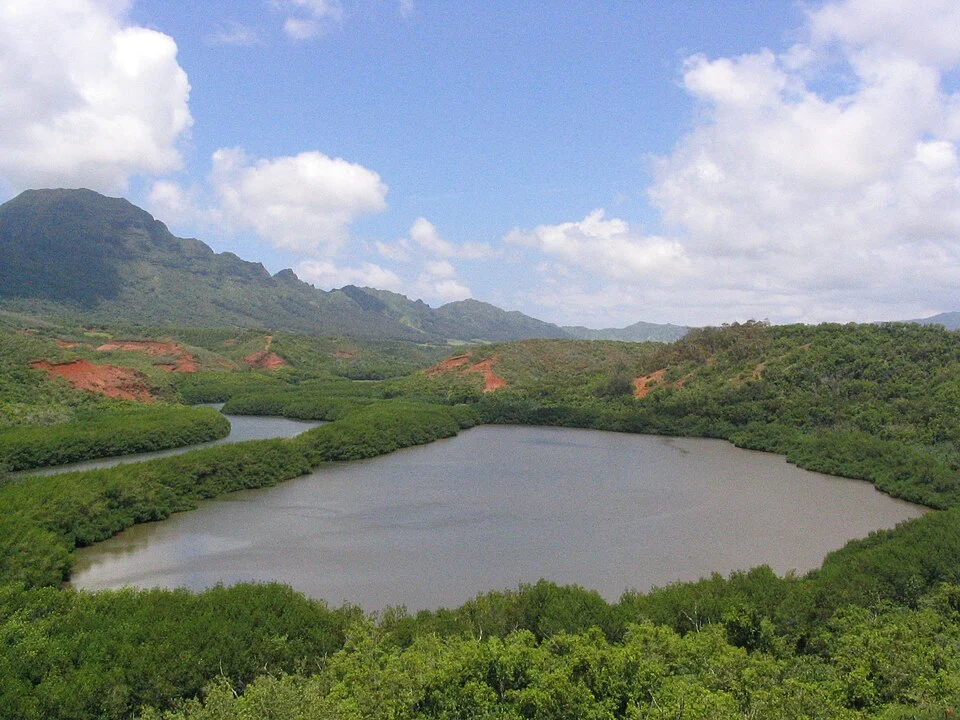
Photograph of Alekoko fishpond, associated with Menehune traditions; contextual site image, not a depiction of the beings.
Overview
Hawaiian stories associate menehune with remarkable construction, including works completed during a brief night of labor. Their collective ability matters more than a single monster’s strength: people discover what has been built and must account for skill beyond ordinary expectation. Descriptions and explanations differ, and historical uses of the name should not all be treated as one literal population.
The University of Hawaiʻi’s legends index points to several distinct collections rather than one definitive account. Mary Kawena Pukui and Caroline Curtis’s Tales of the Menehune offers a particularly useful Hawaiian literary route into the tradition. Reading individual stories preserves differences in place, task and encounter that a generic label for tiny builders would erase.
One specific construction episode appears before Kaupe’s story in Westervelt’s selected Honolulu collection. The menehune hear that Kahanai intends to establish a temple and gather after nightfall under their leader. Work is divided by material and purpose: flat stones for walls and raised places, smooth shore stones for the floor, and bamboo and ʻōhiʻa sticks for platforms. They also provide the thatched houses associated with the temple. By morning they have completed the work, shared a feast and dispersed into the forest. The chief then dedicates Ka-he-iki and installs Kahilona as priest and teacher. This is an attributed temple-building narrative, distinct from other menehune fishpond, road and canoe stories.
Moke Manu’s account in Thrum’s 1907 collection describes small, active people who work together and require an undertaking to be completed in a single night. If dawn finds it unfinished, they do not return to finish it. The account places them in mountains and hills, governed by a higher authority, and says relatives or connected descendants can see them while others only hear their voices. Thrum’s surrounding introduction offers different explanations and speculative comparisons with European brownies and racial ancestry. Those comparisons are the collector’s framing, distinct from the attributed account and from archaeological evidence.
Pi’s watercourse illustrates both success and failure under the night rule. At Waimea, Kauai, the workers gather and cut stones, build a dam and fit a channel around Kikiaola before dawn. Pi rewards them with shrimps, enough for each to receive a portion, and their returning voices explain a saying about Puukapele. A separate fishpond wall at the Huleia River remains incomplete when morning arrives. In Laka’s canoe episode, unseen workers repeatedly restore the tree he has felled. He hides beside it and captures Mokuhalii and Kapaaikee. They secure their release by promising a canoe if he provides a suitable shed and food. The finished canoe is carried by hand, with successive sounds marking its movement, and the workers receive taro, shrimps and oopu.
Kekupua’s canoe account gives a different result. His chief Kakae, described as a Menehune descendant, explains how to recognize the director and construction supervisors. Kekupua sees diminutive humanlike workers and directs the canoe’s route, but daylight overtakes them at Kaalaa. They leave it in a ditch and return to Waolani, so the chief’s wife never receives the canoe for her intended voyage. The collection also attributes Mookini’s construction to a line of workers passing stones from Pololu to Honoipu, and contrasts a Pepeekeo temple made from already assembled material. These accounts preserve named places, work organization, payment and unfinished projects; they do not reduce the community to an all-purpose promise that every requested building appears overnight.
Origins & earliest records
The University of Hawaiʻi index documents nineteenth- and twentieth-century printed witnesses, including Pukui and Curtis’s 1960 book. Those editions do not date the beginning of oral storytelling. A surviving record dates its documentation, not the beginning of an oral tradition; earlier transmission cannot be timed precisely from this witness alone.
Records & interpretation
Named narrated construction accounts and their publication histories document differing Menehune portrayals. Thrum preserves attributed oral material alongside his own speculative comparative framing. Surviving channels or temples are material sites associated with the stories; their existence alone does not independently establish the supernatural workers or Thrum’s ancestry theories.
In the literature
“small of stature and of great activity.”
Chapter X, “Hawaii the Original Home of the Brownies”, “Moke Manu’s Account”; paragraph beginning “The Menehunes were supposed to have been a wonderful people, small…” · Multiple contributors; section credits retained
Moke Manu’s account, printed in Thrum’s section, describes Menehune stature and activity.
“any work undertaken must be completed in one night,”
Chapter X, “Moke Manu’s Account”; paragraph beginning “The Menehunes were supposed to have been a wonderful people, small…” · Multiple contributors; section credits retained
The narrative rule permits one night for the work.
“were invisible to every one but their own descendants,”
Chapter X, “Moke Manu’s Account”; paragraph beginning “There is no reliable history of the Menehunes. No one knows…” · Multiple contributors; section credits retained
The account makes visibility dependent on kinship or connection, rather than universally claiming invisibility.
“food for the Menehunes, which consisted of shrimps”
Chapter X, “Pi’s Watercourse”; paragraph beginning “When the work was finished Pi served out food for the…” · Multiple contributors; section credits retained
Pi provides shrimp after the Menehune complete the watercourse.
Selected bibliography
Documented works and useful reading. This is not a list of every appearance.
- 01
Tales of the Menehune: And Other Short Legends of the Hawaiian Islands
Selected relevant primary or ethnographic work; the online source below is separate.
- 02
Legends of Old Honolulu (Mythology)
Selected chapter XIII, pp. 90–92, Ka-he-iki temple-building episode preceding the Kaupe account; not an exhaustive menehune bibliography.
- 03
Hawaiian Folk Tales, X: Stories of the Menehunes
pp. 107–117; complete Moke Manu account, Pi’s Watercourse, Laka’s Adventure, Kekupua’s Canoe and Heiau Builders.
- 04
Hawaiian Folk Tales: A Collection of Native Legends
Chicago: A. C. McClurg & Co., 1907, publication 1 March 1907 on title-page verso.
Family & connections
A source-supported family tree or inspiration record has not yet been compiled for this profile. Related reading below indicates a connection in subject matter, not a proven lineage or creative influence.
Located primary passages
Specific passages supporting details in this entry, grouped by their published witness.
Hawaiian Folk Tales, X: Stories of the Menehunes
Chicago: A. C. McClurg & Co., 1907, publication 1 March 1907 on title-page verso.
- Moke Manu’s account, printed in Thrum’s section, describes Menehune stature and activity.
- The narrative rule permits one night for the work.
- The account makes visibility dependent on kinship or connection, rather than universally claiming invisibility.
- Pi provides shrimp after the Menehune complete the watercourse.
- The account depicts a line of Menehune bearing stones to build the watercourse.
Historical translation or collector’s published version; not zoological evidence, a universal account or an assertion about all living communities.
Encyclopedia background
An additional attributed reference, separate from the editorial profile above.
Read the open encyclopedia overview
Menehune are a mythological race of dwarf-like people in Hawaiian tradition who are said to live in the deep forests and hidden valleys of the Hawaiian Islands, hidden and far away from human settlements.
The Menehune are described as superb craftspeople. They built temples (heiau), fishponds, roads, canoes, and houses. Some of these structures that Hawaiian folklore attributed to the Menehune still exist. They are said to have lived in Hawaiʻi before settlers arrived from Polynesia many centuries ago. Their favorite food is the maiʻa (banana), and they also like fish. Legend has it that the Menehune appear only during the night hours to build masterpieces, and if they fail to complete their work in the length of the night, they will leave it unoccupied. No one but their children and humans connected to them can see the Menehune.
Text from Wikipedia contributors, “Menehune”. CC BY-SA 4.0. Extracted introduction; formatting changed. Retrieved 5 October 2026. The source article may have changed since retrieval.
References
Sources supporting this profile. Linked pages have their own scope and editorial standards.
- ReferenceUniversity of Hawaiʻi at Mānoa: Hawaiian Legends Index—MenehuneResearch access: 2026-10-05
- Primary textWestervelt, Legends of Old Honolulu, XIII: The Cannibal Dog-Man, pp. 90–92 (1916 second edition)Research access: 2026-10-05
- Primary textThrum 1907, Stories of the Menehunes, pp. 107–117Research access: 2026-10-05
Image credits
Thematic illustrationMenehune
Photograph of Alekoko fishpond, associated with Menehune traditions; contextual site image, not a depiction of the beings.