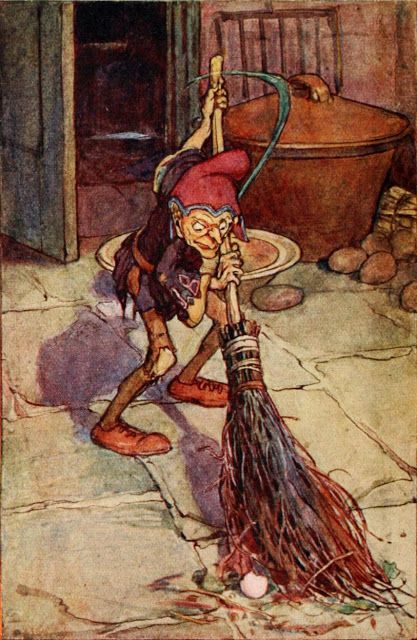
Brownie
Image associated with the exact linked encyclopedia article; consult credited file description for its interpretation.
Overview
Brownies belong to stories of household labour performed by a presence that is usually unseen. Campbell's Highland collection makes the category less uniform than later pictures of a kindly little servant. His account of Càra, an island off Kintyre, describes a spirit associated with an old Macdonald house. It puts the place in order before visitors arrive, drives dirty bedclothes out of the house and overturns water vessels left full overnight. It also slaps people who soil the rooms and can harm dogs kept indoors. These actions make cleanliness and the household's night routine important, but they belong to the Càra account rather than a universal brownie rule. Its dislike of Campbells likewise reflects a local story, not an ethnic property of all household spirits. The narrator says only glimpses have been seen, so a precise standard body cannot be recovered from this episode.
Campbell also records a much gentler visit to a servant woman's bedside in another Argyllshire castle: the spirit adjusts her covers and tells her to sleep. A Shetland correspondent describes night work at a handmill, where a brownie can grind large amounts of grain for the people to whom it is attached. A cloak and hood are left as a reward; they disappear, and the helper never returns. Campbell sets beside this a Tiree story of the invisible cattle-tender Gunna, who leaves after receiving trousers and shoes. The shared departure motif allows comparison without erasing the different names, tasks or locations. His discussion of the word's spread into Gaelic districts is a collector's historical interpretation, rather than proof that every local guardian derives from one originally identical creature.
Spence’s Shetland Folk-Lore gives the locally spelled Broonie a different place in the croft’s seasonal economy. A small separate stack of grain in the yard is described as an annual offering securing the household being’s services, especially protection of the corn-yard and thatched roofs during winter storms. Clothing is withheld: a short accompanying verse says that receiving a cloak or hood ends the helper’s service. This adds outdoor storage and storm protection to the comparison with Campbell’s handmill and household accounts; it does not turn the separate Tiree cattle-tender Gunna into Broonie or erase the local name and task. The physical offering and departure rule belong to Spence’s recorded historical description.
A Brand extract in Black and Thomas’s 1903 compilation follows households withdrawing their offerings. A minister’s informant remembers a brewer whose Bible reading is said to offend Brouny. He refuses further offerings: two brewings fail but the third succeeds, and the household is no longer troubled. A deceased Unst woman’s parallel account likewise moves from two failed batches to a successful third after she refuses payment. The extract also describes corn stacks attributed to Brouny that remain secure in storms despite lacking the ordinary bindings. These are reported interpretations of brewing and storage, with a minister and older household testimony forming the source chain.
Another extract, cited from Edmondston and Saxby’s The Home of a Naturalist, specifically calls Broonie king of Trowland. His appearance in a corn-yard signals protection, contrasting with the damage attributed to an ordinary trow. He moves from yard to yard in cold evenings, but resents being watched and scatters stacks when people interfere. Neighbours make him a cloak and hood out of concern for his exposure. He takes the gift as an offence and never returns. This witness adds royal status and a neighbourhood circuit to the older-core comparison; those features are not stated for every brownie in Campbell’s accounts.
Origins & earliest records
Scottish written notices and later folklore collections document brownies over several centuries. Campbell’s posthumously published 1900 collection preserves nineteenth-century oral material. The publication date is a witness to collecting and editing, not the beginning of the tradition; local names and neighboring household beings require separate consideration.
Records & interpretation
Accounts of completed chores and departing helpers are evidence of a domestic narrative tradition. Campbell records and interprets testimony, rather than observing a reproducible animal behavior. Literary adaptations and illustrations add evidence of reception, but they should not be treated as corroboration that an unseen household worker physically performed the tasks.
In the literature
“a Brownie that drank milk, made a terrific outcry when hurt”
Chapter III, section III, Brownie; paragraph beginning “In the islet of Càra, on the west of…” · John Gregorson Campbell
Reported Càra house brownie, not an invariant temperament.
“Take your sleep, poor creature”
Chapter III, section III, Brownie; paragraph beginning “In one of the castles in the centre of…” · John Gregorson Campbell
An Argyllshire brownie arranges a servant’s blankets.
“He was fed with warm milk by the dairy-maid.”
Chapter III, section III, Brownie; paragraph beginning “In character Brownie was harmless, but he made mischief…” · John Gregorson Campbell
A food offering in Campbell’s account.
“The articles were away in the morning, and Brownie never came back.”
Chapter III, section III, Brownie; paragraph beginning “A native of the Shetland Isles writes me that…” · John Gregorson Campbell
A Shetland informant connects its departure with a cloak and hood reward.
Selected bibliography
Documented works and useful reading. This is not a list of every appearance.
- 01
Superstitions of the Highlands & Islands of Scotland
Chapter III, Brownie, pp. 186–189; followed by the related Gunna account, pp. 189–190. Selected complete inspected 1900 witness.
- 02
Shetland Folk-Lore: Social Life in Olden Times, Broonie offering
Separate grain stack, corn-yard/thatch protection in winter, cloak-and-hood departure verse.
- 03
County Folk-Lore III: Examples of Printed Folk-Lore concerning the Orkney & Shetland Islands, Brouny and Broonie extracts
pp. 20–22. Brand pp. 112–113 and Edmondston/Saxby pp. 202–203 quoted through compilation; original earlier editions not independently collated.
Family & connections
A source-supported family tree or inspiration record has not yet been compiled for this profile. Related reading below indicates a connection in subject matter, not a proven lineage or creative influence.
Located primary passages
Specific passages supporting details in this entry, grouped by their published witness.
Primary source witness
Glasgow: James MacLehose and Sons, 1900.
- Reported Càra house brownie, not an invariant temperament.
Chapter III, section III, Brownie; paragraph beginning “In the islet of Càra, on the west of…”
- An Argyllshire brownie arranges a servant’s blankets.
Chapter III, section III, Brownie; paragraph beginning “In one of the castles in the centre of…”
- A food offering in Campbell’s account.
- A Shetland informant connects its departure with a cloak and hood reward.
Published witness, not zoological proof or an established earliest origin.
Encyclopedia background
An additional attributed reference, separate from the editorial profile above.
Read the open encyclopedia overview
A brownie or broonie (Scots), also known as a brùnaidh or gruagach (Scottish Gaelic), is a household spirit or hobgoblin from Scottish folklore that is said to come out at night while the owners of the house are asleep and perform various chores and farming tasks. The human owners of the house must leave a bowl of milk or cream or some other offering for the brownie, usually by the hearth. Brownies are described as easily offended and will leave their homes forever if they feel they have been insulted or in any way taken advantage of. Brownies are characteristically mischievous and are often said to punish or pull pranks on lazy servants.
Brownies originated as domestic tutelary spirits, very similar to the Lares of ancient Roman tradition. Descriptions of brownies vary regionally, but they are usually described as ugly, brown-skinned, and covered in hair. In the oldest stories, they are usually human-sized or larger. In more recent times, they have come to be seen as small and wizened. They are often capable of turning invisible, and they sometimes appear in the shapes of animals. They are always either naked or dressed in rags. If a person attempts to present a brownie with clothing or baptize it, it will leave forever.
Regional variants in England and Scotland include hobs, and ùruisgs. Variants outside England and Scotland are the Welsh Bwbach and the Manx Fenodyree. Brownies have also appeared outside of folklore, including in John Milton's poem L'Allegro. They became popular in works of children's literature in the late nineteenth century and continue to appear in works of modern fantasy. The Brownies in the Girl Guides are named after a short story by Juliana Horatia Ewing based on brownie folklore.
Text from Wikipedia contributors, “Brownie (folklore)”. CC BY-SA 4.0. Extracted introduction; formatting changed. Retrieved 5 October 2026. The source article may have changed since retrieval.
References
Sources supporting this profile. Linked pages have their own scope and editorial standards.
- Primary textJohn Gregorson Campbell: Superstitions of the Highlands & Islands of Scotland—Chapter III, Tutelary BeingsResearch access: 2026-10-05
- Primary textCampbell 1900: Brownie, pp. 186–189, and Gunna, pp. 189–190Research access: 2026-10-05
- Primary local folklore accountSpence 1899: Broonie in croft lifeResearch access: 2026-10-05
- Primary printed compilationBlack and Thomas 1903, Brouny/Broonie, pp. 20–22Research access: 2026-10-05
Image credits
Reference illustrationBrownie
Image associated with the exact linked encyclopedia article; consult credited file description for its interpretation.