Aos sí
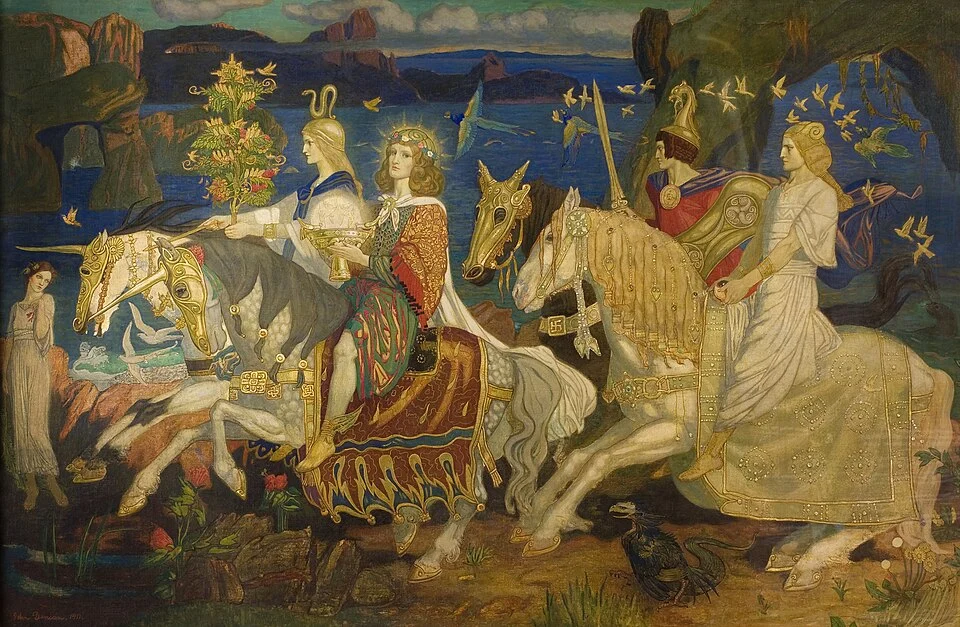
Image associated with the exact linked encyclopedia article; consult credited file description for its interpretation.
Overview
Irish fairy traditions describe an otherworldly society rather than simply a population of tiny winged sprites. Mounds, forts and other places can mark its presence, and human encounters may involve music, hospitality, theft, marriage or dangerous delay. Names and explanations change between sources; aos sí is a useful Irish designation, not a label for every European fairy.
Nineteenth-century collectors grouped many accounts under the English word fairy, sometimes linking them to earlier Irish literature. That editorial work makes fascinating connections but can also smooth out local differences. Read the encounters as stories about boundaries, obligation and respect, while recognizing that attitudes toward fairy places remain part of living cultural practice.
The anthology’s Legend of Knockgrafton, attributed to T. Crofton Croker, places fairy singers inside a mound beside Lusmore’s road home. He waits for a pause and adds a fitting phrase to their repeated tune. They bring him into a splendid hall, honour him above their musicians and remove the hump from his back, returning him outside in new clothes. Jack Madden’s attempted repetition fails because he interrupts without attending to the tune’s timing. The company angrily fixes Lusmore’s removed hump above Jack’s existing one and expels him; he later dies. Musical judgment and the exchange of bodily burdens belong to this particular tale. The narrative’s hostile gossip about Lusmore is contradicted by its own account of his harmlessness and skill, and neither human is classified as a supernatural being because of disability.
William Carleton’s Frank Martin and the Fairies offers a different kind of witness. The weaver describes small green-coated companions in his shop, including a wigged Jim Jam and a piping Nickey Nick, and says a prayer added at his baptism prevents them having power over him. Carleton presents their conversations as one-sided and interprets Martin through nineteenth-century language of illness. His account therefore preserves what Martin reports without claiming that Carleton sees the companions. A separate episode has neighbours hear sawing around Tonagh Forth without finding its source. Martin says the fairies are making a sick child’s coffin. Carleton remembers the child’s death and later coffin-making, but explicitly doubts the chronology of the supernatural explanation, which he thinks circulated only months afterwards. This qualified remembered testimony differs from an omniscient magical tale.
Letitia Maclintock’s A Donegal Fairy supplies another local social encounter: the speaker’s aunt sees a small being fall down her chimney and scald its leg in boiling water. Companions crowd in to rescue it and ask whether she caused the injury. On hearing that the being scalded itself, they decide against retaliation. The account’s emphasis is responsibility and collective protection rather than an indiscriminately hostile fairy population. These English-language anthology witnesses expand the selected Irish fairy material here; they do not establish that every speaker used the designation aos sí or described an identical society.
Origins & earliest records
Medieval Irish texts and later oral collections supply different kinds of attestation. Neither gives a single date when belief in otherworldly people began. Yeats’s anthology is a selected nineteenth-century witness, shaped by his sources and literary aims, rather than a complete account of Irish communities or their present views.
Records & interpretation
Texts, place traditions and collected testimony establish the cultural importance of otherworldly people. A mound’s archaeological existence and a story attached to it are separate claims, even when they share a location. This entry documents publicly circulated narratives without treating them as zoological evidence or dismissing their meaning for participants.
In the literature
“Fairies are deenee shee [ daoine sidhe ] (fairy people).”
The Trooping Fairies, editorial introduction; paragraph beginning “The Irish word for fairy is sheehogue [ sidheóg…”
The editor supplies period English renderings of Irish names.
“Fallen angels who were not good enough to be saved, nor bad enough to be lost”
The Trooping Fairies, editorial introduction; paragraph beginning “Who are they? "Fallen angels who were not good…”
A reported explanation attributed to the peasantry; adjacent text gives competing explanations.
“little milk for them on the window-sill over night.”
The Trooping Fairies, editorial introduction; paragraph beginning “On the other hand, there is much evidence to…”
An offering practice reported in the editor’s introduction, rather than a universal doctrine.
Selected bibliography
Documented works and useful reading. This is not a list of every appearance.
- 01
Fairy and Folk Tales of the Irish Peasantry
Selected witness for the entry; bibliography is not exhaustive.
- 02
Fairy and Folk Tales of the Irish Peasantry: The Legend of Knockgrafton, pp. 40–45
Selected full narrative; new clothes, musical timing and fatal second encounter retained.
- 03
Fairy and Folk Tales of the Irish Peasantry: Frank Martin and the Fairies, pp. 5–9
Named weaver’s reports distinguished from Carleton’s observer interpretation and chronology qualification.
- 04
Fairy and Folk Tales of the Irish Peasantry: A Donegal Fairy, p. 46
Unnamed speaker’s aunt is the internal witness; not assigned a fabricated personal name.
Family & connections
A source-supported family tree or inspiration record has not yet been compiled for this profile. Related reading below indicates a connection in subject matter, not a proven lineage or creative influence.
Located primary passages
Specific passages supporting details in this entry, grouped by their published witness.
Fairy and Folk Tales of the Irish Peasantry
Collection first published 1888; e-text represents an undated Walter Scott Publishing Co. reprint. Do not infer the reprint year.
- The editor supplies period English renderings of Irish names.
- A reported explanation attributed to the peasantry; adjacent text gives competing explanations.
- An offering practice reported in the editor’s introduction, rather than a universal doctrine.
Attests this published account; does not establish zoological existence, consensus belief or earliest origin.
Encyclopedia background
An additional attributed reference, separate from the editorial profile above.
Read the open encyclopedia overview
Aos sí or aos sídhe (pronounced [iːsˠ ˈʃiː]; English approximation: eess SHEE) is the Irish name for a supernatural race in Gaelic folklore, similar to elves. They are said to descend from the Tuatha Dé Danann or the gods of Irish mythology.
The term aos sí means "folk of the sí"; these are the mounds in which they are said to dwell, which are seen as portals to an Otherworld. Such abodes are referred to in English as "shees", "fairy mounds", "elf mounds" or "hollow hills". The aos sí interact with humans and the human world. They are variously said to be the ancestors, the spirits of nature, or goddesses and gods.
Text from Wikipedia contributors, “Aos Sí”. CC BY-SA 4.0. Extracted introduction; formatting changed. Retrieved 5 October 2026. The source article may have changed since retrieval.
References
Sources supporting this profile. Linked pages have their own scope and editorial standards.
- Primary textFairy and Folk Tales of the Irish PeasantryResearch access: 2026-10-05
- Primary attributed anthology narrativeFairy and Folk Tales of the Irish Peasantry: The Legend of Knockgrafton, pp. 40–45Research access: 2026-10-05
- Primary attributed anthology narrativeFairy and Folk Tales of the Irish Peasantry: Frank Martin and the Fairies, pp. 5–9Research access: 2026-10-05
- Primary attributed anthology narrativeFairy and Folk Tales of the Irish Peasantry: A Donegal Fairy, p. 46Research access: 2026-10-05
Image credits
Reference illustrationAos sí
Image associated with the exact linked encyclopedia article; consult credited file description for its interpretation.