Saci
Image associated with the exact linked encyclopedia article; consult credited file description for its interpretation.
Overview
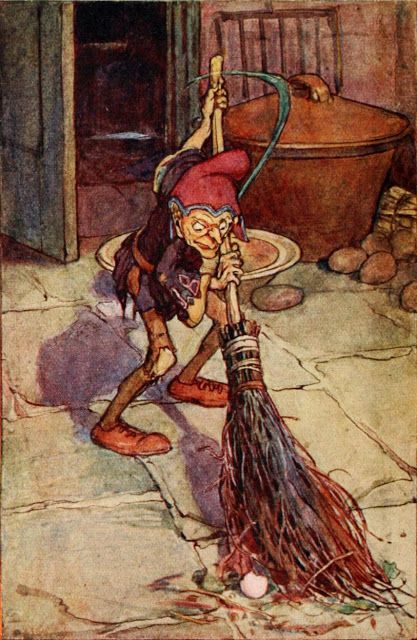
Saci is commonly portrayed with one leg, a red cap and a pipe, appearing amid small disturbances and practical jokes. Mischief can affect a household, a traveler or someone’s work. The recognizable image helps introduce the character, but it does not settle every regional description or every name used in older accounts.
Lobato’s collecting inquiry and later literary works helped shape public familiarity, while comics and television added their own forms. Those adaptations should not be confused with the entire oral tradition. The National Library’s discussion shows the character’s continuing place in Brazilian cultural life, providing a route into both older printed witnesses and modern celebrations without declaring a single moment of invention.
The contributors to the 1918 inquiry do not provide one consistent anatomy. Carlos Silveira, recalling childhood in Queluz, Silveiras and Pinheiros, describes a mischievous one-legged figure whose remaining leg is placed to one side rather than centrally. He remembers disagreement about clothing: two farmers distinguished a red-jacketed Sacy-trique from the being they called Sacy. His suggestion of an African origin for that named variant is explicitly tentative. It is evidence of his interpretation, not an established lineage or a universal system of Saci species.
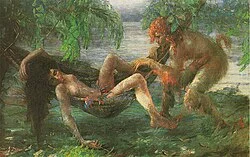
Silveira also recounts an encounter reported by a female relative resting in a hammock. The visitor politely greets her, frightens her by his presence and leaves with a farewell implying another visit; the anticipated return is never reported. J. Pires supplies a strikingly different childhood image in the same volume: Sacy-siriry is short, powerful and human-shaped, with two legs of unequal length and short strong arms. A bridge near his childhood home was said to be its dwelling. Pires recalls being frightened by another child’s story about an attack on a lamplighter, then crossing with an adult escort. He does not claim to witness that attack.
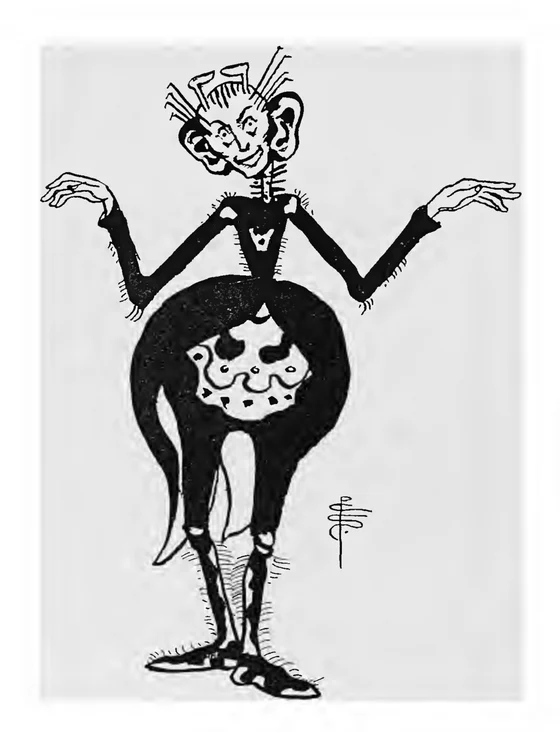
A contribution signed André Capeta uses Sacy-cererê and pererê within the same account. It describes a small, one-legged, pot-bellied figure with a clay pipe, bright eyes and pointed teeth, connected with demands for tobacco and nighttime disturbance of horses. These three contributions support comparison between reported forms and names; they do not justify silently combining every attribute into a single definitive creature. The historical collection’s racial terminology and speculative explanations are not adopted as biological classification.
Lobato’s children’s novel is a separate authored treatment. In the eighth edition of 1941, Tio Barnabé describes a one-legged mischief-maker with a pipe and red cap, attributing household disruptions and trouble among animals to sacis. The cap is a source of power, and the tale connects capture with a whirlwind, a sieve and a bottle marked with a cross. Barnabé’s testimony within the novel must be distinguished from the inquiry’s contributions by real correspondents. The shared motifs do not make the later fiction a verbatim ethnographic record.
In chapters VI–VII, Pedrinho’s captive negotiates his freedom in exchange for guiding the boy safely through the forest. Once released from the bottle, he is treated increasingly as a companion, and Pedrinho regrets having confined him. The guide shows him sacis growing inside the sections of large bamboo: this edition assigns seven years inside the stem and seventy-seven in the outer world, followed by transformation into poisonous mushrooms or bracket fungi. These are the novel’s supernatural life stages, not a scientific evolutionary tree, and no individual biological parents are supplied.
The later rescue of Narizinho develops the helpful side of this particular Saci. He identifies Cuca’s involvement, guides Pedrinho through danger and recognizes the trap in her demand for Iara’s hair. When Pedrinho ignores a warning and is overcome by Iara’s beauty, Saci restores him with leaves. At the conclusion, Pedrinho credits his companion’s knowledge and ingenuity for the rescue. Saci has disappeared before the household can thank him, but Narizinho finds forget-me-nots on her pillow. This affectionate ending belongs to the selected 1941 text; the first edition has not been collated here.
An earlier published comparison appears in Nery’s Folk-lore brésilien (1889), pages 256–257. Here the forest Sacy resembles a small, playful monkey and wears a red cap. He acknowledges Caapora as his superior but mocks other visitors, treating country people more lightly than townspeople. His tricks include tangling a traveller’s legs with vines and making a hunter hear an alarming groan. He normally performs the tricks unseen, then appears at night to frighten someone lost in the woods.
Nery explicitly compares this mischievous figure with Shakespeare’s Puck. That literary analogy does not prove that the Brazilian account originated in Shakespeare. The passage belongs to the São Paulo material footnoted to Jorge Velho’s Campos Novos, Santos, 1878; it is separate from Nery’s preceding account of an Amazon conversation in January 1885. This selected portrait does not describe the missing leg familiar from other versions.
Origins & earliest records
Lobato’s 1918 inquiry is a specifically dated collecting publication, preceded by nineteenth-century public notices. It records and reshapes material already circulating, rather than originating every Saci account. A surviving record dates its documentation, not the beginning of an oral tradition; earlier transmission cannot be timed precisely from this witness alone. The 1918 selected contributions were read in a 1998 facsimile; the later novel was checked in its explicitly identified eighth edition of 1941. Details of that edition are not backdated automatically to the first publication in 1921. Nery’s 1889 volume adds an earlier located published witness and credits the São Paulo material to Campos Novos (1878). That bibliographic credit is not a direct reading of the 1878 original.
Records & interpretation
The inquiry, printed portrayals and National Library materials document transmission and public reception. A bird with a related common name, literary character and supernatural tale figure require separate identification. This is evidence for cultural expression and recorded interpretation, rather than a zoological specimen or independently verified supernatural event. Complete selected contributions by Carlos Silveira (45–47), J. Pires (63–64) and André Capeta read in the facsimile OCR; the Silveira and Pires pages independently checked against the original page images. Complete 1941 chapters IV–VII, XIV and XXVI–XXXIII read in the facsimile-linked Portuguese transcription. Camargo’s university catalogue/abstract distinguishes the inquiry and novel; the full dissertation was not read. Root read the complete Nery pp. 253–257 passage with all footnotes and inspected every corresponding original scan. Zero-based PDF pages 274–278 show printed 253–257; the title and Archive bibliographic metadata were checked. The preceding 1885 Amazon conversation, the Velho-derived São Paulo accounts and the collector’s literary comparisons remain distinct.
Selected bibliography
Documented works and useful reading. This is not a list of every appearance.
- 01
O Sacy-pererê: resultado de um inquérito
1918 publication; selected complete Silveira45–47, Pires63–64 and André Capeta contributions read in1998 facsimile. Modern prefatory essay not used as primary1918 testimony.
- 02
O Saci — eighth edition, selected chapters
Complete IV–VII14–31, XIV49–53 and XXVI–XXXIII80–109 read. First novel publication1921 is bibliographic context; text not collated with first edition.
- 03
Folk-lore brésilien — São Paulo Sacy passage
Selected pp. 254 note 3 and 256–257; original printed pages inspected. Campos Novos, Santos 1878, is cited by Nery but its original text has not been independently read here.
Family, evolution & connections
Shakespeare’s Puck, as compared by Nery
Nery compares the playful Sacy of his São Paulo passage to Shakespeare’s Puck. This is the author’s stated comparison, not evidence that Shakespeare caused the tradition. The surrounding account cites Jorge Velho’s Campos Novos (Santos, 1878), separately from Nery’s January 1885 Amazon conversation.
Encyclopedia background
An additional attributed reference, separate from the editorial profile above.
Read the open encyclopedia overview
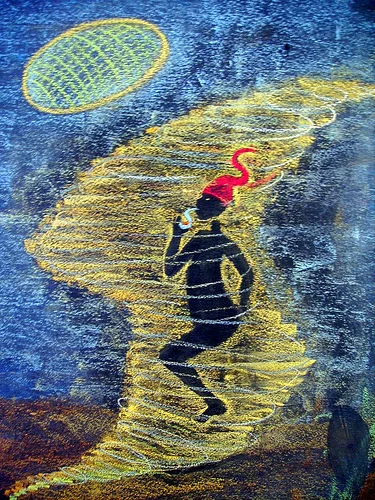
Saci (pronounced [saˈsi]) is a character in Tupi and Guarani folklore. He is a one-legged black boy, who smokes a pipe and wears a magical red cap that enables him to disappear and reappear wherever he wishes (usually in the middle of a dirt devil). Considered an annoying prankster in most parts of Brazil, and a potentially dangerous and malicious creature in others, he nevertheless grants wishes to anyone who manages to trap him or steal his magic cap. Legend says that a person can trap a Saci inside a bottle when he is in the form of a dust devil (see Fig. right where he is portrayed in the center of the whirlwind).
The Saci legend is seen as a combination of native Tupi lore with African-Brazilian and European myth or superstition combined into it. Also, much of the currently told folklore about the Saci is traceable to what writer Monteiro Lobato collected and published in 1917–1918, and the children's book version he created and published in 1921.
According to present-day folklore, this genie can be captured and trapped inside a corked bottle to grant the wishes of its master, or its magic can be acquired by stealing its cap (§ Capturing and subjugating), and the sulfuric smell about the black genie is emphasized, leading to criticism of racism.
Text from Wikipedia contributors, “Saci (folklore)”. CC BY-SA 4.0. Extracted introduction; formatting changed. Retrieved 5 October 2026. The source article may have changed since retrieval.
References
Sources supporting this profile. Linked pages have their own scope and editorial standards.
- ReferenceBiblioteca Nacional Digital: Folclore Brasileiro e Dia do SaciResearch access: 2026-10-05
- Research publication / institutional repositoryEvandro do Carmo Camargo, 2006: edition comparison of 1918 inquiry and 1921 O SaciResearch access: 2026-10-05
- Historical collecting publication, facsimileO Sacy Perêrê:1918 inquiry in1998 facsimile — selected signed contributionsResearch access: 2026-10-05
- Primary literary text; edition-specificO Saci1941: freedom bargain and literary life cycle, VI–VIIResearch access: 2026-10-05
- Primary literary text; edition-specificO Saci1941: final rescue and farewell, XXXIIIResearch access: 2026-10-05
- Historical French source; all five original pages and attribution footnotes inspectedF. J. de Santa-Anna Nery: Folk-lore brésilien (1889), pp. 253–257, especially p. 254 note 3Research access: 2026-10-05
Image credits
Reference illustrationSaci
Image associated with the exact linked encyclopedia article; consult credited file description for its interpretation.