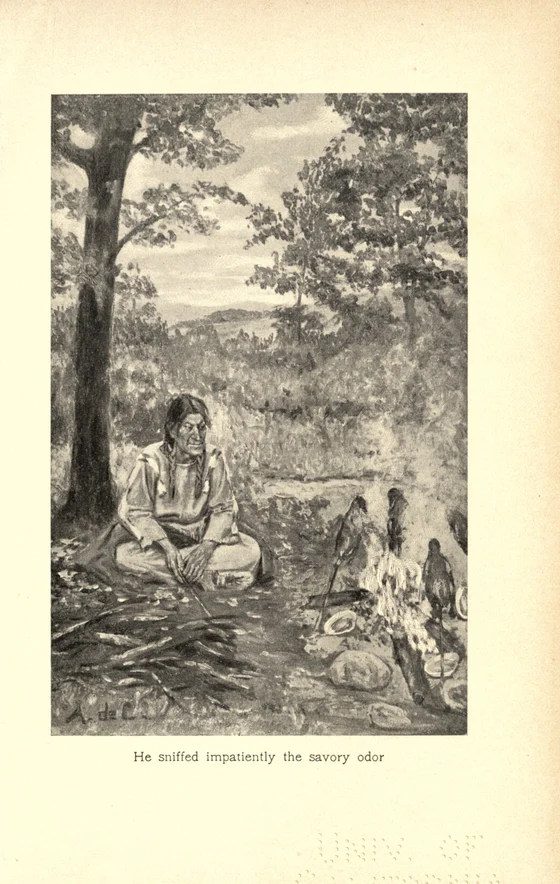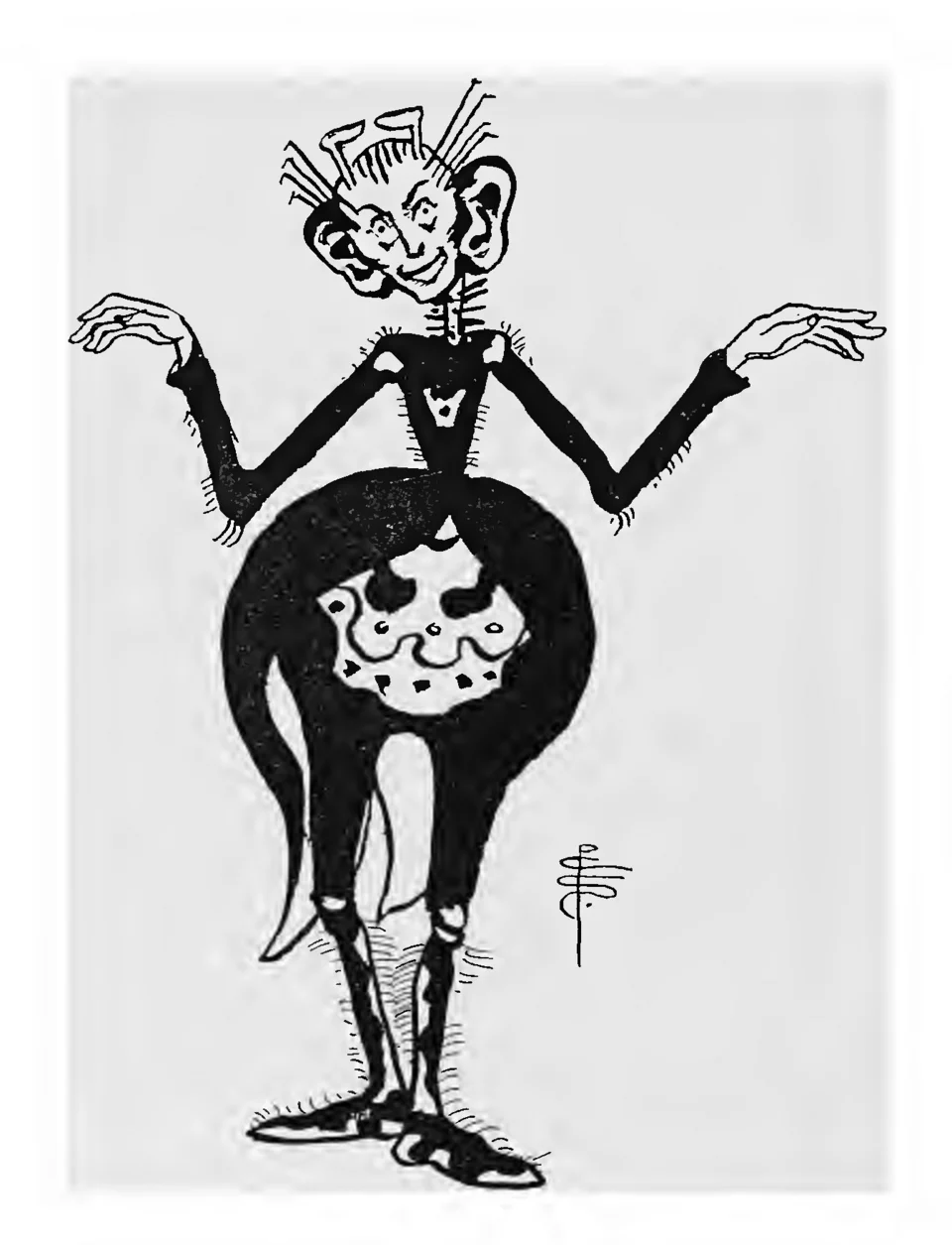
Illustration from Pamela Colman Smith’s Annancy Stories, 1899
Historical Jamaican Annancy tale illustration.
Overview
Anansi can be a spider, a person, or a figure who moves easily between those descriptions. His plots often begin with hunger, ambition or a wish to keep something valuable for himself. He may manipulate stronger neighbors through words and staged situations, but a plan’s collapse can leave him exposed to the same selfishness he exploits.
Akan storytelling and African Atlantic versions have their own languages, performers and social contexts. The Ghana-focused tales in Barker and Sinclair’s collection are one edited witness. Anansi’s survival across the Atlantic reflects creative transmission through profoundly unequal histories, but Caribbean stories deserve to be read as local cultural work as well as inheritance.
In the opening story of Barker and Sinclair’s 1917 collection, pages 29–31, Anansi asks Nyankupon to let the stories bear his name. The price is a jar of bees, a boa-constrictor and an animal the English retelling calls a tiger. He catches the bees by provoking them to prove they can fill his jar, ties the snake to a measuring stick, and tricks the final animal into having its eyes sewn shut. Nyankupon then grants the requested naming privilege. These are this edition’s particular tests, not a standardized list for all Anansi traditions. Its introduction explicitly says the stories were retold for a wider readership, so the English animal names and dialogue require attention to that editorial mediation.
A second story, How Wisdom Became the Property of the Human Race, makes the trickster’s son Kweku Tsin wiser than his father at a crucial moment. Anansi collects wisdom in a pot and tries to hide it high in a tree, but the pot hanging in front of him prevents his climb. His son advises carrying it behind him. Realizing that he has failed to monopolize wisdom, Anansi throws the pot onto a rock. It breaks and wisdom escapes into the world. The son’s practical insight is part of the contradiction that defeats the father’s claim.
Thunder and Anansi begins during famine. After six failed boats, Anansi reaches an offshore palm in the seventh; its nuts fall into the water, and his pursuit of the last takes him to an old man identified as Thunder. Thunder gives him a pot that supplies food for his family. Anansi instead hides it and eats alone, fearing its power will be exhausted. Kweku Tsin follows him in fly form and reveals the secret. The family uses the pot, but when Mrs Anansi tries to feed the village it overheats and melts. On his return Anansi reaches the island easily, deliberately throws nuts into the water and dives again. Thunder’s second gift is a stick that beats Anansi himself. He escapes by swimming home, bruised and wiser about the gift. This version does not make the stick punish the hungry family.
The later chapter Anansi, the Blind Fisherman gives a terminal outcome rather than a new triumph. Anansi has grown old and blind. After he repeatedly insults two helpers, they falsely tell him their boat has reached the shore. He jumps into open water, cannot see land, swims until exhausted and drowns. The collection does not reconcile this ending with every other adventure as one chronological biography.
Martha Warren Beckwith’s Jamaica Anansi Stories preserves differently situated performances. In story 30a, told by George Parkes of Mandeville, Anansi pretends illness and disguises himself as a doctor to divert his wife’s pig into a meal for himself. The troublesome Go-long-go demands the food. Anansi later uses oil, plant trash and fire against him; the ending leaves the burning figure crying out without explicitly narrating a final death. Story 30b, told by Ezekiel Williams of Harmony Hall, concerns Dry-head. After they obtain and cook a fat pig, Anansi insists that both eat with spoons. The head has no hands, and Anansi consumes the meal. These are separate named tellers’ variants, not interchangeable incidents assigned to one antagonist.
The collection histories also differ. Barker and Sinclair say they obtained material from experienced teachers admitted to a training institution at Accra, compared versions and retold stories for a wider readership. The selected chapters do not individually name those teachers. Beckwith records six weeks of fieldwork in summer 1919 and five in winter 1921; Helen Roberts recorded music during the second visit. Beckwith also notes how dictation loses aspects of performance. These editorial and performance settings help explain what each printed witness preserves. The collectors’ colonial judgments are not adopted as descriptions of the communities represented.
Origins & earliest records
Selected witnesses are Barker and Sinclair’s West African Folk-Tales (1917), drawing on teachers associated with Accra, and Beckwith’s Jamaica Anansi Stories (1924), from Jamaican fieldwork in 1919 and 1921. Neither is claimed as the first Anansi story or the beginning of oral transmission. Named Jamaican tellers are attached to their individual versions.
Records & interpretation
Complete Barker and Sinclair introduction and chapters I, II, IV and XI read; complete Beckwith30a–c and the located opening fieldwork statement read. The texts document narrated actions, editing and performance provenance. Different endings remain source-specific, with no claim of zoological evidence or a single continuous Anansi life history.
In the literature
“There once lived, in Fanti-land, a man named Father Anansi. He possessed all the wisdom in the world.”
Part I, tale II, “How Wisdom Became the Property of the Human Race”, p. 33
A collected Anansi wisdom tale. The human designation is part of this narrator’s formulation, not a claim that Anansi is never spider-shaped.
“Spider, who was very conceited, wanted the stories to be told about him.”
I. HOW WE GOT THE NAME ‘SPIDER TALES’; paragraph beginning “In the olden days all the stories which men…”
“How We Got the Name Spider Tales” connects the spider with ownership of stories.
“the first was a jar full of live bees, the second was a boa-constrictor, and the third a tiger.”
I. HOW WE GOT THE NAME ‘SPIDER TALES’; paragraph beginning “Accordingly, one day he went to Nyankupon and asked…”
The three tasks in the story-ownership bargain; collector’s animal labels preserved.
“Nothing and Anansi proposed, one day, to go to the neighbouring town to get some wives.”
III. ANANSI AND NOTHING; paragraph beginning “Near Anansi’s miserable little hut there was a fine…”
Story III, “Anansi and Nothing”, introduces the two characters’ marriage expedition.
“we shall call them Spider-stories.”
How It Came About That the Sky-god’s Stories Came to Be Known as Spider-stories; p. 59; Sky-god’s final pronouncement · R. S. Rattray
The Sky-god transfers his stories to Ananse after acknowledging the payment.
Selected bibliography
Documented works and useful reading. This is not a list of every appearance.
- 01
West African Folk-Tales — I: How We Got the Name Spider Tales, pp.29–31
Complete story and collection introduction read; retains Nyankupon and this edition’s three tests.
- 02
West African Folk-Tales — II: How Wisdom Became the Property of the Human Race, pp.33–34
Complete pot-of-wisdom story; Kweku Tsin’s advice is a distinct episode.
- 03
West African Folk-Tales — IV: Thunder and Anansi, pp.39–44
Complete food-pot and beating-stick narrative; the second gift attacks Anansi.
- 04
West African Folk-Tales — XI: Anansi, the Blind Fisherman, pp.73–75
Complete story ending in the blind fisherman’s drowning.
- 05
Jamaica Anansi Stories — 30: The Head, versions a–c
Complete30a–c read. Article compares30a Go-long-go/Parkes/Mandeville and30b Dry-head/Williams/Harmony Hall.30c Brother Dead/Johnson/Brownstown remains a separately located variant. Beckwith’s source note explicitly says she corrected Johnson’s30c from Jekyll pp.48–49, making Dry-head the bag-trick victim; this is an edited version, not an untouched transcript.
- 06
West African Folk-Tales
London: George G. Harrap, MCMXVII title-page edition.
- 07
Akan-Ashanti Folk-Tales — How It Came About That the Sky-god’s Stories Came to Be Known as Spider-stories
Oxford: Clarendon Press, first published 1930. Inspected scan is a later lithographic reprint; its reprint year is not established here. Twi and English occupy facing pages. English quotation page numbers were read visually from the facsimile, rather than inferred from OCR page breaks. Selected witness: English pp. 55–59.
- 08
Jamaica Anansi Stories
New York: American Folk-Lore Society, 1924, Memoirs XVII. Title, full preface, complete30a–c and complete corresponding comparative note independently read; no whole-collection review claimed.
Family, evolution & connections
Textual genealogy: Anansi and Kweku Tsin in Thunder and Anansi
One explicitly named parent-child relationship in story IV of the 1917 collection.
Scroll sideways to see all branches. With a keyboard, focus the tree and use the arrow keys.
Retain the story’s explicit identification of Kweku Tsin as Anansi’s eldest son. Selected textual kinship, not biological evolution. Other children and the wife are present but unnamed here; this is not a complete family tree. The collectors selected and retold contributor versions, and their colonial framing is not treated as a modern account of Akan communities or all diaspora traditions.
Spiders
The cited West African tale collection labels its Anansi section as spider tales, supporting a spider identity within that recorded storytelling corpus. Living spiders supply the zoological comparison, but Anansi’s speech, trickery and social roles are narrative attributes. The link should not flatten distinct Akan and diaspora traditions into one fixed character biography or identify a real spider species.
Located primary passages
Specific passages supporting details in this entry, grouped by their published witness.
West African Folk-Tales
London: George G. Harrap, MCMXVII title-page edition.
- “How We Got the Name Spider Tales” connects the spider with ownership of stories.
- The three tasks in the story-ownership bargain; collector’s animal labels preserved.
- Story III, “Anansi and Nothing”, introduces the two characters’ marriage expedition.
III. ANANSI AND NOTHING; paragraph beginning “Near Anansi’s miserable little hut there was a fine…”
Published witness, not zoological proof or an established earliest origin.
West African Folk-Tales
Exact contiguous excerpt checked against the linked primary e-text on 2026-10-05; only whitespace normalized. London: George G. Harrap, MCMXVII title page. English arrangement of collected oral traditions.
- A collected Anansi wisdom tale. The human designation is part of this narrator’s formulation, not a claim that Anansi is never spider-shaped.
Part I, tale II, “How Wisdom Became the Property of the Human Race”, p. 33
Barker and Sinclair’s1917 English arrangement is a collected literary witness, not a universal account of Anansi or independent proof of original oral wording. Matching stays within the specified literary profile and does not cross franchise, culture or animal-species boundaries.
Akan-Ashanti Folk-Tales — How It Came About That the Sky-god’s Stories Came to Be Known as Spider-stories
Oxford: Clarendon Press, first published 1930. Inspected scan is a later lithographic reprint; its reprint year is not established here. Twi and English occupy facing pages. English quotation page numbers were read visually from the facsimile, rather than inferred from OCR page breaks.
- The Sky-god demands Python, Leopard, Fairy and Hornets for his stories. With Aso’s advice, Ananse ties Python along a palm branch and induces Hornets to shelter from simulated rain inside a gourd.
- Ananse traps Leopard in a pit, strikes him while offering help, and captures a fairy with a latex-coated wooden doll baited with mashed yams.
- Ananse also brings his mother Ya Nsia. The Sky-god publicly acknowledges the payment before assembled chiefs and gives the stories the name Spider-stories.
Complete selected English episodes read. Named individual narrator is not established by the selected heading. The narrative is a located historical witness, not a universal assertion about current Akan belief. No ritual formula or song refrain reproduced.
West African Folk-Tales
London: George G. Harrap, 1917. Complete selected tales and full introduction independently read; introduction describes English-speaking Accra teacher-trainees supplying variant stories, followed by public-facing selection and retelling.
- Anansi earns the naming of the stories by meeting Nyankupon’s three conditions.
Part I, I, How We Got the Name Spider Tales, pp.29–31, complete tale
- Kweku Tsin’s practical advice defeats his father’s attempt to monopolize wisdom.
Part I, II, How Wisdom Became the Property of the Human Race, pp.33–34, complete tale
- Anansi’s concealment of a food-producing gift ends in the loss of that gift and punishment.
- Anansi’s repeated abuse of two assisting fishermen leads to his drowning.
Part I, XI, Anansi the Blind Fisherman, pp.73–75, complete tale
Animal labels preserved from this witness, without substituting leopard or hornets from Rattray’s different telling. No capture procedure copied. No individual narrator for this tale identified; English retelling, not a verbatim oral transcript. Colonial racial and diffusionist claims in the introduction remain historical author opinions, not adopted explanations. The story calls Father Anansi a man; this does not fix a universal human-only identity. No individual narrator for this tale identified; English retelling, not a verbatim oral transcript. Colonial racial and diffusionist claims in the introduction remain historical author opinions, not adopted explanations. Kweku Tsin’s transformation belongs to this particular telling; no spoken activation formula reproduced. No individual narrator for this tale identified; English retelling, not a verbatim oral transcript. Colonial racial and diffusionist claims in the introduction remain historical author opinions, not adopted explanations. Actual terminal outcome retained rather than silently restoring the recurring character. No individual narrator for this tale identified; English retelling, not a verbatim oral transcript. Colonial racial and diffusionist claims in the introduction remain historical author opinions, not adopted explanations.
Jamaica Anansi Stories — 30: The Head, versions a–c
New York: American Folk-Lore Society, 1924, Memoirs XVII. Title, full preface, complete30a–c and complete corresponding comparative note independently read; no whole-collection review claimed.
- Anansi’s private feast ends in retaliation against a threatening intruder.
30a, Go-long-go, p.37, complete story; George Parkes, Mandeville
- Anansi exploits Dry-head’s lack of hands to exclude him from a meal.
30b, Dry-head, p.38, complete story; Ezekiel Williams, Harmony Hall
- A substituted hawk carries Brother Dead away, in an explicitly editorially adjusted telling.
Go-long-go identity is not silently merged with30b’s explicitly handless Dry-head. Preface records1919/1921 fieldwork and slow dictation losses; Roberts’s musical work separately credited. No song, formula or performance instructions copied. This version’s comic food exclusion does not include30a’s burning or30c’s hawk removal. Preface records1919/1921 fieldwork and slow dictation losses; Roberts’s musical work separately credited. No song, formula or performance instructions copied. Beckwith explicitly says she corrected Johnson’s version using Jekyll48–49, changing the bag trick’s victim to Dry-head. Jekyll is a bibliographic comparison here, not an independently read witness; no untouched-transcript claim. Preface records1919/1921 fieldwork and slow dictation losses; Roberts’s musical work separately credited. No song, formula or performance instructions copied.
Encyclopedia background
An additional attributed reference, separate from the editorial profile above.
Read the open encyclopedia overview
Anansi or Ananse ( ə-NAHN-see; literally translates to spider) is a character in Akan religion and folklore associated with stories, wisdom, knowledge, wit, mischievousness, cunning, and trickery, most commonly depicted as a spider. Anansi is a character who reflects the culture that he originates from. The Akan people are a close-knit people from present-day southern Ghana who rely on social order, which translates through the stories that come out of their culture. In many ways, Anansi is a paradoxical character whose actions defy this social order, but in incorporating rebellion and doubt into faith, his folkloric presence strengthens it.
Taking the role of a trickster, he is also one of the most important characters of West African, African-American and Caribbean folklore. These spider tales were spread to the Americas via the Atlantic slave trade.
Anansi is best known for his ability to outsmart and triumph over more powerful opponents through his use of cunning, creativity and wit. Despite taking on a trickster role, Anansi often takes centre stage in stories and is commonly portrayed as both the protagonist and antagonist.
Text from Wikipedia contributors, “Anansi”. CC BY-SA 4.0. Extracted introduction; formatting changed. Retrieved 5 October 2026. The source article may have changed since retrieval.
References
Sources supporting this profile. Linked pages have their own scope and editorial standards.
- Primary textWest African Folk-TalesResearch access: 2026-10-05
- Primary passageWest African Folk-Tales, story I, pages 29-31Research access: 2026-10-05
- Historical edited English collectionBarker and Sinclair, Introduction and stories I, II, IV, XIResearch access: 2026-10-05
- Historical collection with individual teller attributionBeckwith, Jamaica Anansi Stories, preface and30a–cResearch access: 2026-10-05
Image credits
Historical illustrationIllustration from Pamela Colman Smith’s Annancy Stories, 1899
Historical Jamaican Annancy tale illustration.