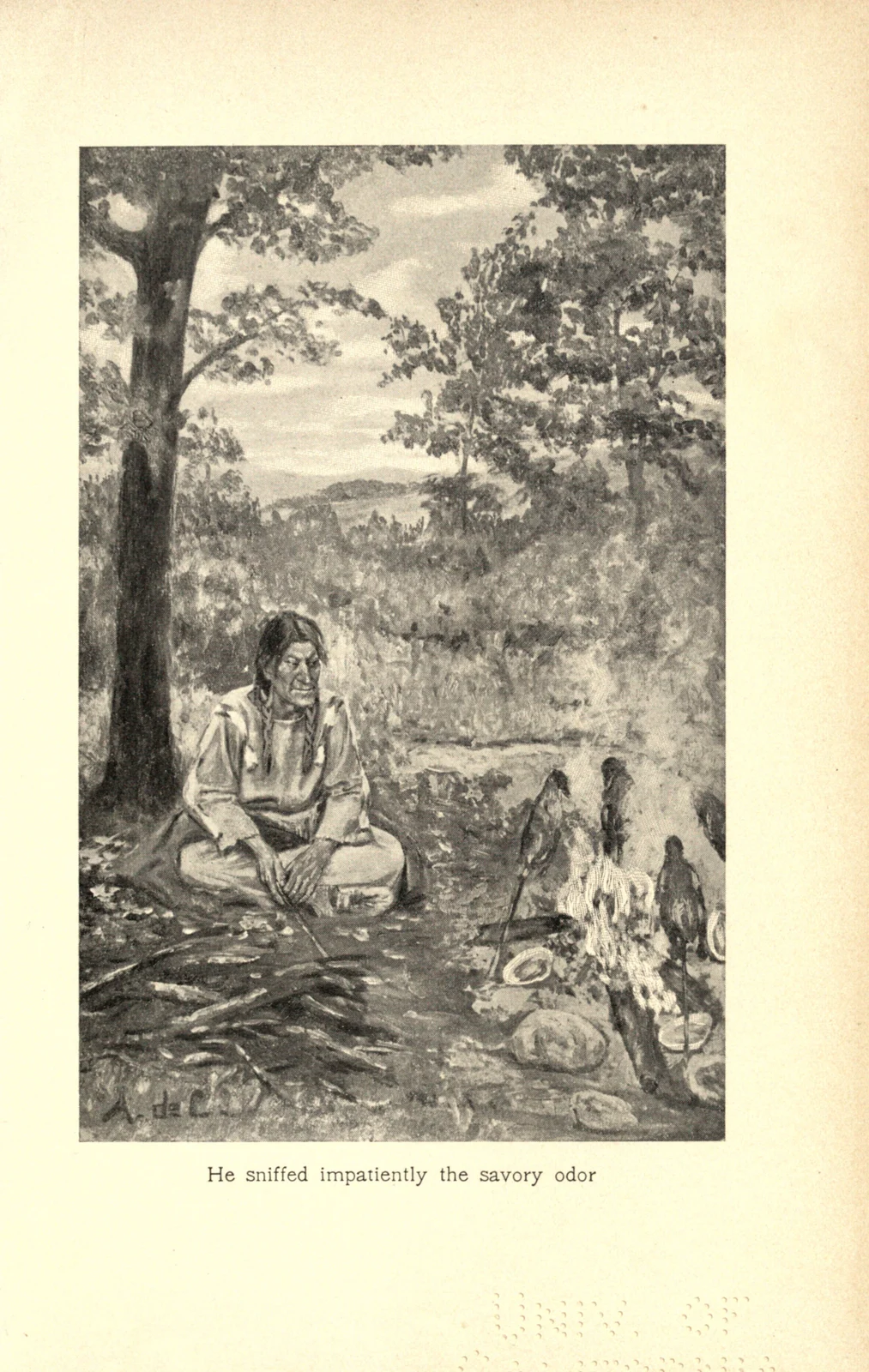
Angel De Cora’s Iktomi waits beside roasting ducks, Old Indian Legends,1902 edition
De Cora depicts Iktomi in humanlike dress beside the ducks he has caught, with dishes beneath the roasting birds. The caption identifies the moment when he smells their cooking. This belongs to Zitkala-Ša’s Iktomi and the Ducks account; the monochrome print does not establish the colours described in the text, or a single form for every Iktomi tradition.
Overview
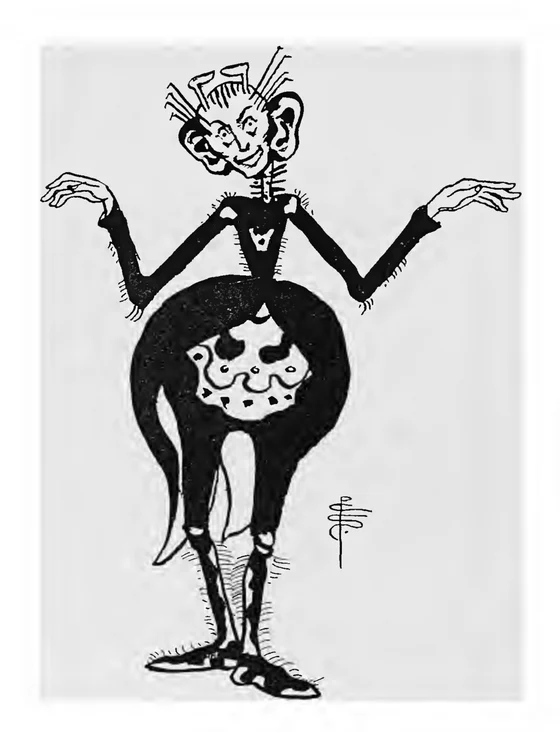
Zitkala-Ša presents Iktomi as a small, oddly dressed figure whose cunning plans regularly run into trouble. Ducks, a muskrat and other beings become participants in episodes driven by hunger and manipulation. The comic action can be severe, and the consequences of a trick matter as much as its clever construction.
The author’s work is an Indigenous literary retelling for publication, not simply an anonymous transcript without artistic choices. Following her individual episodes preserves that authorship and keeps Dakota material distinct from every Lakota or other Plains account using a related name. Spider associations provide another comparison, but they do not make Iktomi and Anansi the same being.
In her preface to Old Indian Legends, Zitkala-Ša recalls hearing Dakota storytellers in both North and South Dakota. She recognizes the same stories across tellings while observing differences in individual incidents, and describes her English work as an effort to carry their spirit into another language. This makes the book an authored, comparative retelling with its own voice. Its English labels, including spider fairy and Great Spirit, belong to that presentation. They should not be treated as a zoological identification or as interchangeable terminology for every neighboring tradition.
Iktomi and the Ducks opens with a detailed costume: fringed deerskin leggings, beaded moccasins and jacket, black hair bound with red bands, and red, yellow and black facial paint. He fills a blanket with grass and claims to carry songs. Curious ducks enter his enclosed dance house and obey his instruction to keep their eyes shut while dancing. He kills dancers until Skiska peeps and warns the others. Their escape also fulfills the song’s threat that opened eyes will become red. At home, however, Iktomi traps his foot in a cracked tree limb. His own shouted warnings alert wolves first to the roasting ducks and then to those hidden in the ashes; they eat the whole meal before the wind releases him.
Iktomi’s Blanket continues that hunger. He appeals to Inyan, the great rock addressed as grandfather, and leaves his blanket as an offering. He finds a freshly wounded deer and prepares meat for roasting. When the evening turns cold he takes the blanket back, arguing that stone needs it less than he does. Returning to the fire site, he finds only dry bones. His regret concerns failing to eat first, rather than withdrawing his gift; the narrator explicitly judges that response selfish. The address grandfather expresses the relationship in this episode, without supplying a literal biological pedigree.
The Muskrat episode centers on hospitality. Instead of sharing cooked fish, Iktomi proposes an unequal race: winning would let him keep everything, whereas Muskrat would receive only half for a victory. He agrees to carry a stone to compensate for his speed. Muskrat swims while Iktomi runs around the lake; by the time Iktomi discards the stone and returns, the food has gone. Mistaking a reflection for his visitor underwater, he finally hears laughter overhead. Muskrat is in a tree and drops a fish bone that nearly chokes him, ending with an explicit reminder to feed a visiting friend.
In Iktomi and the Coyote, apparent death is a deception. Iktomi carries a seemingly lifeless coyote home as food, while the animal enjoys the ride and watches secretly. When thrown onto the fire, Coyote leaps out, scattering embers onto Iktomi and extinguishing his own burning fur in the grass. He then mocks Iktomi’s assumption and runs away. The episode describes a feigned corpse, not a resurrection or a spirit emerging from the fire.
Iktomi and the Fawn follows three desires to become something else. Peacock changes him into another peacock on condition that he not try to fly as other birds do; breaking the condition restores his former shape. An arrow magician changes him into an arrow that must travel straight; imitating frolicking fawns breaks that condition too. He then accepts a fawn’s story that fire will create attractive markings and helps prepare the pit in which he is burned. The fawns speculate about his escape at the ending. The subsequent Tree-Bound tale expressly calls him immortal and recovered from the burns, resolving that uncertainty within this sequence.
The Tree-Bound and Shooting of the Red Eagle form a connected deception and exposure. Iktomi wants the reward intended for the archer who can kill a threatening eagle. He coaxes that archer into a tree, takes his equipment and uses a spoken charm to bind him to the bark. A woman cuts the bark free and carries the truth to the chief. Iktomi’s stolen arrows fail to kill the eagle; the community binds and humiliates him, then releases and drives him away. The genuine archer succeeds and marries the chief’s daughter. The marriage and victory belong to the archer, not to Iktomi.
The Turtle tale gives Iktomi an unnamed group of children. He wins a jumping contest against Patkasa for a deer, but Patkasa removes the meat while he fetches them. Iktomi again mistakes a tree’s reflection for an underwater scene and dives in. His children take the surfacing dark spots for the promised extinguished coals; the narrator identifies them as their father’s toes and explicitly states that he drowned. This ending remains distinct from the earlier declaration of immortality. The collection does not insert a resurrection scene to reconcile them.
Iktomi appears again in The Warlike Seven, where he interprets the surviving warriors’ challenge. When Iya drinks the lake to capture Fish and Turtle, Iktomi is accidentally swallowed with the water. He cuts upward from inside; the released water drowns the villagers and returns to its basin, allowing Fish and Turtle to leave as victors. Across the collection, escape, humiliation, injury and death belong to different episodes rather than one consistently narrated life history.
Origins & earliest records
The 1901 public collection is the specific witness expanded here. Its preface identifies Dakota oral tellings heard in North and South Dakota and explains the author’s retelling in English. It is neither a first oral attestation nor a complete record of Iktomi traditions.
Records & interpretation
Preface and nine complete relevant tales read: the six with Iktomi in their titles, The Tree-Bound, Shooting of the Red Eagle and The Warlike Seven. Named chapter links locate the primary text. The Fawn ending was checked against the later explicit recovery, and the Turtle’s drowning retained separately. No full independent Dakota translation or biological evidence claimed.
In the literature
“Often his own conceit leads him hard against the common sense of simpler people.”
IKTOMI AND THE DUCKS
Narrator’s introductory characterization before the duck deception.
“Now it chanced that immortal Iktomi, fully recovered from the brown burnt spots, overheard the people talking.”
THE TREE-BOUND
Explicit recovery in this later episode, contrasted with the Turtle ending.
“He was drowned.”
IKTOMI AND THE TURTLE
Narrator explicitly identifies the surfacing spots as Iktomi’s toes and states death; no revival follows in this tale.
Selected bibliography
Documented works and useful reading. This is not a list of every appearance.
- 01
Old Indian Legends
Selected primary witness; not an exhaustive bibliography.
- 02
Old Indian Legends — Iktomi and the Ducks
Complete tale read. The dance deception, escape and complete loss of the meal.
- 03
Old Indian Legends — Iktomi’s Blanket
Complete tale read. Inyan offering, withdrawal and vanished venison.
- 04
Old Indian Legends — Iktomi and the Muskrat
Complete tale read. Unfair race, underwater shortcut and hospitality rebuke.
- 05
Old Indian Legends — Iktomi and the Coyote
Complete tale read. Feigned death followed by escape from the fire.
- 06
Old Indian Legends — Iktomi and the Fawn
Complete tale read. Peacock and arrow transformations, fire pit and the fawns’ closing uncertainty.
- 07
Old Indian Legends — The Tree-Bound
Complete tale read. Explicit recovery after the burns and binding of the genuine archer.
- 08
Old Indian Legends — Shooting of the Red Eagle
Complete tale read. Impostor exposed; genuine archer wins the marriage.
- 09
Old Indian Legends — Iktomi and the Turtle
Complete tale read. Children, misleading reflection and explicit drowning.
- 10
Old Indian Legends — The Warlike Seven
Complete tale read. Interpreter role, swallowing by Iya and flood release.
- 11
Old Indian Legends — selected Iktomi episodes and author’s preface
Zitkala-Ša, Old Indian Legends, authored English retelling, first published/copyright 1901; the selected Gutenberg transcription does not identify its precise print impression. A separate physical 1902 edition is recorded by the root/imagery review, not newly inspected here.
Family & connections
A source-supported family tree or inspiration record has not yet been compiled for this profile. Related reading below indicates a connection in subject matter, not a proven lineage or creative influence.
Located primary passages
Specific passages supporting details in this entry, grouped by their published witness.
Old Indian Legends — Iktomi and the Ducks
Zitkala-Ša, Old Indian Legends, authored English retelling, first published/copyright 1901; the selected Gutenberg transcription does not identify its precise print impression. A separate physical 1902 edition is recorded by the root/imagery review, not newly inspected here.
- Human-like dress and repeated deception introduce this authored presentation; the duck dance trap succeeds before tree entrapment and wolves consume all his cooked food.
Source-specific English literary retelling; no first oral attestation, whole Dakota corpus, universal biography, or separately authenticated Indigenous-language translation claimed. Narrative contradictions are preserved; songs, prayers and charm wording are not copied.
Old Indian Legends — Iktomi’s Blanket
Zitkala-Ša, Old Indian Legends, authored English retelling, first published/copyright 1901; the selected Gutenberg transcription does not identify its precise print impression. A separate physical 1902 edition is recorded by the root/imagery review, not newly inspected here.
- An offering is withdrawn and the deer meat vanishes; the narrator condemns regret centered on missed food.
Source-specific English literary retelling; no first oral attestation, whole Dakota corpus, universal biography, or separately authenticated Indigenous-language translation claimed. Narrative contradictions are preserved; songs, prayers and charm wording are not copied.
Old Indian Legends — Iktomi and the Muskrat
Zitkala-Ša, Old Indian Legends, authored English retelling, first published/copyright 1901; the selected Gutenberg transcription does not identify its precise print impression. A separate physical 1902 edition is recorded by the root/imagery review, not newly inspected here.
- An unfair food race turns against the host who declines hospitality.
Source-specific English literary retelling; no first oral attestation, whole Dakota corpus, universal biography, or separately authenticated Indigenous-language translation claimed. Narrative contradictions are preserved; songs, prayers and charm wording are not copied.
Old Indian Legends — Iktomi and the Coyote
Zitkala-Ša, Old Indian Legends, authored English retelling, first published/copyright 1901; the selected Gutenberg transcription does not identify its precise print impression. A separate physical 1902 edition is recorded by the root/imagery review, not newly inspected here.
- The supposed corpse is a living coyote feigning death and enjoying transport.
Source-specific English literary retelling; no first oral attestation, whole Dakota corpus, universal biography, or separately authenticated Indigenous-language translation claimed. Narrative contradictions are preserved; songs, prayers and charm wording are not copied.
Old Indian Legends — Iktomi and the Fawn
Zitkala-Ša, Old Indian Legends, authored English retelling, first published/copyright 1901; the selected Gutenberg transcription does not identify its precise print impression. A separate physical 1902 edition is recorded by the root/imagery review, not newly inspected here.
- Peacock and arrow transformations are conditional; breaking each rule restores Iktomi, before a fawn deceives him into a fire pit.
Source-specific English literary retelling; no first oral attestation, whole Dakota corpus, universal biography, or separately authenticated Indigenous-language translation claimed. Narrative contradictions are preserved; songs, prayers and charm wording are not copied.
Old Indian Legends — The Tree-Bound
Zitkala-Ša, Old Indian Legends, authored English retelling, first published/copyright 1901; the selected Gutenberg transcription does not identify its precise print impression. A separate physical 1902 edition is recorded by the root/imagery review, not newly inspected here.
- Iktomi is expressly immortal and recovered from burning, then steals a prospective eagle-slayer’s equipment through tree binding.
Source-specific English literary retelling; no first oral attestation, whole Dakota corpus, universal biography, or separately authenticated Indigenous-language translation claimed. Narrative contradictions are preserved; songs, prayers and charm wording are not copied.
Old Indian Legends — Shooting of the Red Eagle
Zitkala-Ša, Old Indian Legends, authored English retelling, first published/copyright 1901; the selected Gutenberg transcription does not identify its precise print impression. A separate physical 1902 edition is recorded by the root/imagery review, not newly inspected here.
- Iktomi’s imposture fails; the freed genuine archer kills the bird and wins the marriage.
Source-specific English literary retelling; no first oral attestation, whole Dakota corpus, universal biography, or separately authenticated Indigenous-language translation claimed. Narrative contradictions are preserved; songs, prayers and charm wording are not copied.
Old Indian Legends — Iktomi and the Turtle
Zitkala-Ša, Old Indian Legends, authored English retelling, first published/copyright 1901; the selected Gutenberg transcription does not identify its precise print impression. A separate physical 1902 edition is recorded by the root/imagery review, not newly inspected here.
- A later episode expressly drowns Iktomi after he mistakes a reflected tree scene for an underwater household.
Source-specific English literary retelling; no first oral attestation, whole Dakota corpus, universal biography, or separately authenticated Indigenous-language translation claimed. Narrative contradictions are preserved; songs, prayers and charm wording are not copied.
Old Indian Legends — The Warlike Seven
Zitkala-Ša, Old Indian Legends, authored English retelling, first published/copyright 1901; the selected Gutenberg transcription does not identify its precise print impression. A separate physical 1902 edition is recorded by the root/imagery review, not newly inspected here.
- Iktomi interprets the survivors’ war challenge and, accidentally swallowed by Iya, cuts open the lake-filled stomach.
Source-specific English literary retelling; no first oral attestation, whole Dakota corpus, universal biography, or separately authenticated Indigenous-language translation claimed. Narrative contradictions are preserved; songs, prayers and charm wording are not copied.
Primary source witness
Zitkala-Ša, Old Indian Legends, authored English retelling, first published/copyright 1901; the selected Gutenberg transcription does not identify its precise print impression. A separate physical 1902 edition is recorded by the root/imagery review, not newly inspected here.
- The author recalls hearing repeated Dakota tellings in North and South Dakota and describes retelling their spirit into English.
The hosting title label 1901 identifies the work date, not a newly inspected physical print impression; author’s rhetorical terminology is kept attributed.
Encyclopedia background
An additional attributed reference, separate from the editorial profile above.
Read the open encyclopedia overview
In Lakota mythology, Iktómi is a spider-trickster spirit, and a culture hero for the Lakota people. Alternate names for Iktómi include Ikto, Ictinike, Ksa, Inktomi, Unktome, and Unktomi. These names are due to the differences in languages between different indigenous nations, as this spider deity was known throughout many of North America's tribes.
His appearance is that of a spider, but he can take any shape, including that of a human. When he is a human he is said to wear red, yellow and white paint, with black rings around his eyes.
Text from Wikipedia contributors, “Iktomi”. CC BY-SA 4.0. Extracted introduction; formatting changed. Retrieved 5 October 2026. The source article may have changed since retrieval.
References
Sources supporting this profile. Linked pages have their own scope and editorial standards.
- Primary textOld Indian LegendsResearch access: 2026-10-05
- Indigenous-authored historical literary retellingZitkala-Ša: nine complete selected talesResearch access: 2026-10-05
- Indigenous-authored historical literary retellingZitkala-Ša: preface on Dakota tellings and English retellingResearch access: 2026-10-05
Image credits
Historical illustrationAngel De Cora’s Iktomi waits beside roasting ducks, Old Indian Legends,1902 edition
De Cora depicts Iktomi in humanlike dress beside the ducks he has caught, with dishes beneath the roasting birds. The caption identifies the moment when he smells their cooking. This belongs to Zitkala-Ša’s Iktomi and the Ducks account; the monochrome print does not establish the colours described in the text, or a single form for every Iktomi tradition.