Curupira
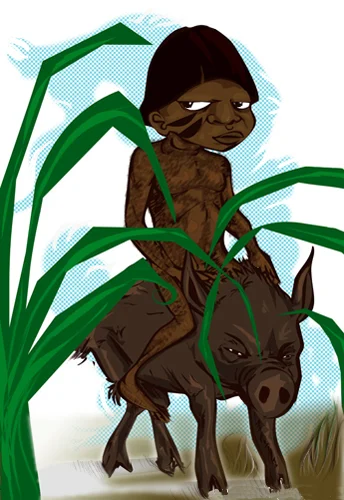
Image associated with the exact linked encyclopedia article; consult credited file description for its interpretation.
Overview
Curupira’s reversed feet make tracks misleading, turning an ordinary sign used by hunters into a source of confusion. Familiar retellings give the being red hair and a youthful or small form. Its actions commonly oppose wasteful hunting and damage to the forest, but details and relationships with other forest beings differ among regions.
A sixteenth-century missionary mention does not describe every feature of today’s popular image. Colonial observers interpreted Indigenous accounts through their own religious vocabulary, while later writers and public education reshaped the figure again. Reading those stages separately allows appreciation of the guardian motif without falsely assigning one standardized appearance to all Indigenous peoples or all earlier versions.
João Barbosa Rodrigues’s Poranduba amazonense gives a particular Rio Solimões encounter in tale II, printed beside an interlinear rendering and a continuous Portuguese translation. A lost hunter shelters beneath a tree and hears Corupira detect a human smell. When the being demands his hands and heart as food, the man substitutes those of a monkey. He then asks for Corupira’s own heart. The being accepts a knife, stabs its chest and dies. Months later, the hunter returns to take its almost blue teeth as beads for his daughter. Striking the teeth with an axe awakens Corupira, who interprets the act as affection rather than an attempted theft.
Corupira rewards him with a bow and an arrow that catches prey even when shot in the wrong direction, but warns against shooting flocking birds. The hunter eventually forgets and shoots an Aracuan; its companions tear him apart. Corupira gathers wax, warms it and uses it to reunite the man’s flesh. This restoration comes with another restriction: he must not eat hot food. After resuming his successful hunting, he forgets again, eats hot tacacá supplied by his wife and melts. The episode presents a dangerous eater, reciprocal giver and conditional healer, rather than simply the familiar forest-protection image. Its nearly blue teeth and bodily self-sacrifice belong to this recorded version; the passage does not supply reversed feet or red hair.
Origins & earliest records
Anchieta’s 1560 letter is a dated colonial witness to the name, written through a missionary perspective. The backward-footed popular depiction must be traced through later accounts rather than assumed from that mention. A surviving record dates its documentation, not the beginning of an oral tradition; earlier transmission cannot be timed precisely from this witness alone.
Records & interpretation
Colonial writing, collected stories and modern public retellings document a changing forest-being tradition. The missionary’s classification is evidence of his interpretation, not a neutral Indigenous definition or zoological observation. This is evidence for cultural expression and recorded interpretation, rather than a zoological specimen or independently verified supernatural event. The 1890 Rio Solimões narrative records a distinct encounter with an eating demand, revived being, restricted hunting gift and wax-restored hunter; the editor’s text and translation are historical mediated witnesses.
Selected bibliography
Documented works and useful reading. This is not a list of every appearance.
- 01
Carta de São Vicente
Selected relevant primary or ethnographic work; the online source below is separate.
- 02
Poranduba amazonense, tale II: O Corupira e o Caçador (Rio Solimões), pp. 35–38
Interlinear Indigenous-language/Portuguese text and continuous Portuguese translation read on all four printed pages; no individual teller named in the tale heading.
Family & connections
A source-supported family tree or inspiration record has not yet been compiled for this profile. Related reading below indicates a connection in subject matter, not a proven lineage or creative influence.
Encyclopedia background
An additional attributed reference, separate from the editorial profile above.
Read the open encyclopedia overview
The Curupira, Currupira or Korupira (Portuguese pronunciation: [kuɾuˈpiɾɐ]) is a forest spirit in the myth of the Tupí-Guaraní speaking areas in the Brazil, Paraguay and Guyanas. It is a guardian of the forests that punishes humans for overcutting.
It looks like a backwards-footed, short-statured tapuio or caboclo (civilized indigene or one of mixed race), or like a bald but otherwise shaggy man (though the women have flowing hair). Some say it has blue or green teeth. The red-haired image has become fixture, perhaps due to conflation with the caipora.
The Curupira according to early Jesuits in São Paulo was a feared being known to leave gruesomely scarred bodies, to be appeased by offerings. But it underwent a mutation via European influence, and was recast into more of a mischievous trickster type spirit, often bungling and letting humans outsmart it, though it could still cause misfortune and death.
Text from Wikipedia contributors, “Curupira”. CC BY-SA 4.0. Extracted introduction; formatting changed. Retrieved 5 October 2026. The source article may have changed since retrieval.
References
Sources supporting this profile. Linked pages have their own scope and editorial standards.
- ReferenceMultiRio: CurupiraResearch access: 2026-10-05
- Primary collected narrativeBarbosa Rodrigues 1890: Rio Solimões Corupira encounter, pp. 35–38Research access: 2026-10-05
Image credits
Reference illustrationCurupira
Image associated with the exact linked encyclopedia article; consult credited file description for its interpretation.