Caipora
Image associated with the exact linked encyclopedia article; consult credited file description for its interpretation.
Overview
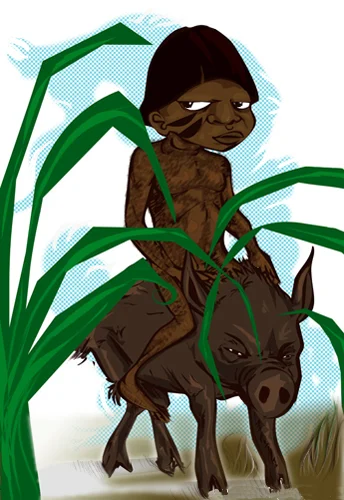
Caipora’s role often concerns access to game and the consequences of hunting without respect. Familiar portrayals may show a small humanlike guardian or a rider associated with a wild pig, but appearance is not uniform. The important narrative relationship is among forest, animals and the person seeking to take from them.
Caipora and Curupira can be distinguished in some sources and partly overlap in others. A rigid national chart claiming that every narrator makes the same separation would misrepresent that variation. Public folklore celebrations preserve the animal-protector association, while fuller research should prioritize particular local accounts and Indigenous-language histories instead of assigning the being to one undifferentiated Brazilian mythology.
Couto de Magalhães’s O Selvagem, printed in Rio de Janeiro in 1876, supplies both a tale and his own interpretation. Part I, tale XI, presents a Nheengatu text alongside Portuguese wording under the title Jabuti e Gigante. The giant is named Cahapora. On hearing a tortoise’s flute, he challenges the smaller creature to a contest of strength. The tortoise secretly fastens the pulling vine to a whale, as the Portuguese text identifies the other animal, and watches the two powerful opponents struggle. After Cahapora admits exhaustion, the tortoise releases the whale and pretends the contest has required no effort. The giant concedes and leaves; he is not killed.
The collector interprets this episode as intellect overcoming physical strength. His introductory discussion also carries nineteenth-century colonial and Christian judgments about Indigenous people; those judgments are part of the document’s framing, not the compendium’s explanation of their abilities or morality. The adjacent provenance note names Rio Negro, Tapajós and Juruá narrators for groups of tortoise tales, but its count of ten episodes does not map cleanly onto the printed XI heading. A specific narrator or community is therefore not assigned to this episode without further collation. The Portuguese wording has been checked; no independent Nheengatu translation is claimed.
In Part II, pages 130 and 137, Magalhães describes a large, hairy rider on a huge forest pig. The figure is generally taciturn, occasionally crying out to drive the herd, and an encounter is associated with misfortune. The author explains the hunting taboo as protection against destroying an entire animal family. That is his explicit interpretation of the tradition, rather than evidence that all communities taught one uniform conservation doctrine. The description is distinct from the contest narrative and from his neighbouring account of the dolphin-associated Uauyará.
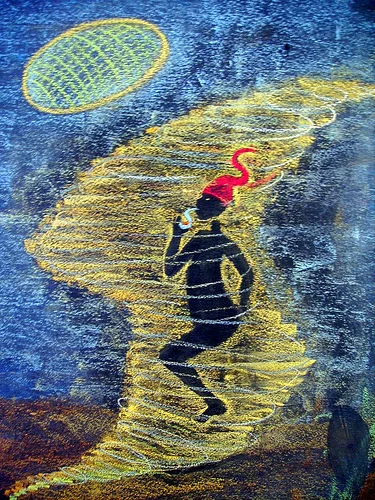
A contribution signed Zé Caipora in the 1918 Sacy inquiry recalls childhood stories in Ceará after an interval of about fifteen years. The writer equates his remembered Caipora with Saci but says he had not heard the one-legged description. This red-capped figure rides an enormous caetetú; both rider and mount may be invisible. Tobacco can secure assistance in hunting, and the being’s whistle summons game. The contributor acknowledges fading memory and reports what believers told him, rather than claiming a personally witnessed supernatural encounter.
Saul Delphino, another contributor in the same volume, explicitly distinguishes Caipora from Saci. His account depicts an elderly Black woman associated with herbs and spells, explaining her condition through a former enslaver’s curse. Its hostile portrayal is evidence of that narrator’s racialized and moralizing story, not a factual characterization of Black women or formerly enslaved people. Placing the two signed accounts together demonstrates why the anthology cannot be reduced to a single consistent anatomy, sex or identity.
The 1941 eighth edition of O Saci supplies another authored version. Chapter XXVI describes the Capora as a hairy, partly human and partly ape-like being who demands tobacco. The particular rider encountered travels on a formidable queixada. This version belongs to Lobato’s forest adventure and should not be silently substituted for either 1918 contributor’s account.
Nery’s 1889 São Paulo passage presents a different Caapora: a tall forest ruler with a single eye in the middle of his forehead, a spear in his right hand, and a large, lean, red wild pig as his mount. These are this account’s particular features. They do not replace the appearances in Magalhães, the signed 1918 recollections or Lobato’s later fiction, and the explicit comparison with Cyclopes does not establish a historical line of descent from Greek myth.
The accompanying encounter is indirect even within Nery’s source. A resident speaking to Jorge Velho says that he has never personally met Caapora but that an uncle did. Lost overnight, the uncle lights a fire; Caapora joins him and asks to smoke. The man fires his gun into the visitor’s mouth as though offering a cigar. Caapora calmly comments on the weak tobacco, flicks the man and vanishes. The uncle remains as if lifeless until the following day; the account does not say he died and was resurrected. The passage is credited to Velho’s Campos Novos (1878), not to Nery’s separate 1885 Amazon interview.
Origins & earliest records
Cascudo’s dictionary provides a selected ethnographic witness, supplemented here by a public municipal folklore description. Earlier usages and changing local names require further comparison rather than a single origin claim. A surviving record dates its documentation, not the beginning of an oral tradition; earlier transmission cannot be timed precisely from this witness alone. Direct selected documentation now extends to Magalhães’s 1876 book, followed by separately signed 1918 contributions and a specified 1941 literary edition. These are dated witnesses, not a claim of the name’s first-ever use. Nery’s 1889 volume adds an earlier located published witness and credits the São Paulo material to Campos Novos (1878). That bibliographic credit is not a direct reading of the 1878 original.
Records & interpretation
The sources establish a guardian motif and its modern public circulation. They document cultural relationships with animals and hunting, not proof that a humanlike forest being has been zoologically identified. This is evidence for cultural expression and recorded interpretation, rather than a zoological specimen or independently verified supernatural event. Read complete O Selvagem I.XI215–218 and adjacent provenance219, plus complete Caipora paragraphs in II130/137. Title, I215–218 and II130/137 inspected in original scan pixels. Complete Zé Caipora209–211 and Saul Delphino245–246 read in the 1998 facsimile of the 1918 inquiry, with all five original pages visually checked. Complete 1941 chapterXXVI read in Portuguese transcription. Cascudo’s full entry remains unread in this expansion. Root read the complete Nery pp. 253–257 passage with all footnotes and inspected every corresponding original scan. Zero-based PDF pages 274–278 show printed 253–257; the title and Archive bibliographic metadata were checked. The preceding 1885 Amazon conversation, the Velho-derived São Paulo accounts and the collector’s literary comparisons remain distinct.
Selected bibliography
Documented works and useful reading. This is not a list of every appearance.
- 01
Dicionário do folclore brasileiro
Bibliographic reference retained; full dictionary entry not inspected in this pass.
- 02
O Selvagem
I: XI215–218, note219; II: Caipora paragraphs130/137. Portuguese interlinear wording checked, not independent Nheengatu translation.
- 03
O Sacy-Perêrê: resultado de um inquerito
Complete209–211 and245–246 in1998facsimile; modern introductory essay excluded as primary1918 testimony.
- 04
O Saci — eighth edition, chapter XXVI
Complete chapter read; authored Capora encounter distinguished from inquiry testimony.
- 05
Folk-lore brésilien — São Paulo Caapora account
Selected pp. 254–256; original printed pages inspected. Campos Novos, Santos 1878, is cited by Nery but its original text has not been independently read here.
Family & connections
A source-supported family tree or inspiration record has not yet been compiled for this profile. Related reading below indicates a connection in subject matter, not a proven lineage or creative influence.
Encyclopedia background
An additional attributed reference, separate from the editorial profile above.
Read the open encyclopedia overview
Caipora (Portuguese pronunciation: [kajˈpɔɾɐ]) or Caapora (Kaapora) is a forest spirit or humanoid and guardian of wildlife or game in Brazilian folklore.
The word "Caipora" comes from Tupi and means "inhabitant of the forest" and perhaps may be traced to Kaagere (also meaning "forest dweller" and an alias of anhanga) of the Tupi-Guaraní mythology, but this is far from definite.
Caipora is variously represented as a dark-skinned, small Native American girl (caboclinha) or boy (caboclinho), a dwarf or large-sized hairy humanoid or beast. It is often said to ride an animal such as the peccary and is armed with a stick or whip made of certain plants. It takes bribes of tobacco and alcohol and sometimes also has a pipe.
Its description varies greatly depending on the region or source. It is sometimes confused with Curupira, which is another mythological creature who protects the forest, but it is also amenable to comparison with other mythical creatures (Saci, Pé de garrafa) with which it may share certain traits.
Text from Wikipedia contributors, “Caipora”. CC BY-SA 4.0. Extracted introduction; formatting changed. Retrieved 5 October 2026. The source article may have changed since retrieval.
References
Sources supporting this profile. Linked pages have their own scope and editorial standards.
- ReferencePrefeitura de Palmares Paulista: Dia do FolcloreResearch access: 2026-10-05
- Primary collecting publication, original scanO Selvagem 1876: tale XI and Part II Caipora paragraphsResearch access: 2026-10-05
- Primary historical collecting publication in facsimile1918 Sacy inquiry: two signed Caipora accountsResearch access: 2026-10-05
- Primary literary text; edition-specificO Saci 1941: XXVI, Novos prodígiosResearch access: 2026-10-05
- Historical French source; all five original pages and attribution footnotes inspectedF. J. de Santa-Anna Nery: Folk-lore brésilien (1889), pp. 253–257, especially p. 254 note 3Research access: 2026-10-05
Image credits
Reference illustrationCaipora
Image associated with the exact linked encyclopedia article; consult credited file description for its interpretation.