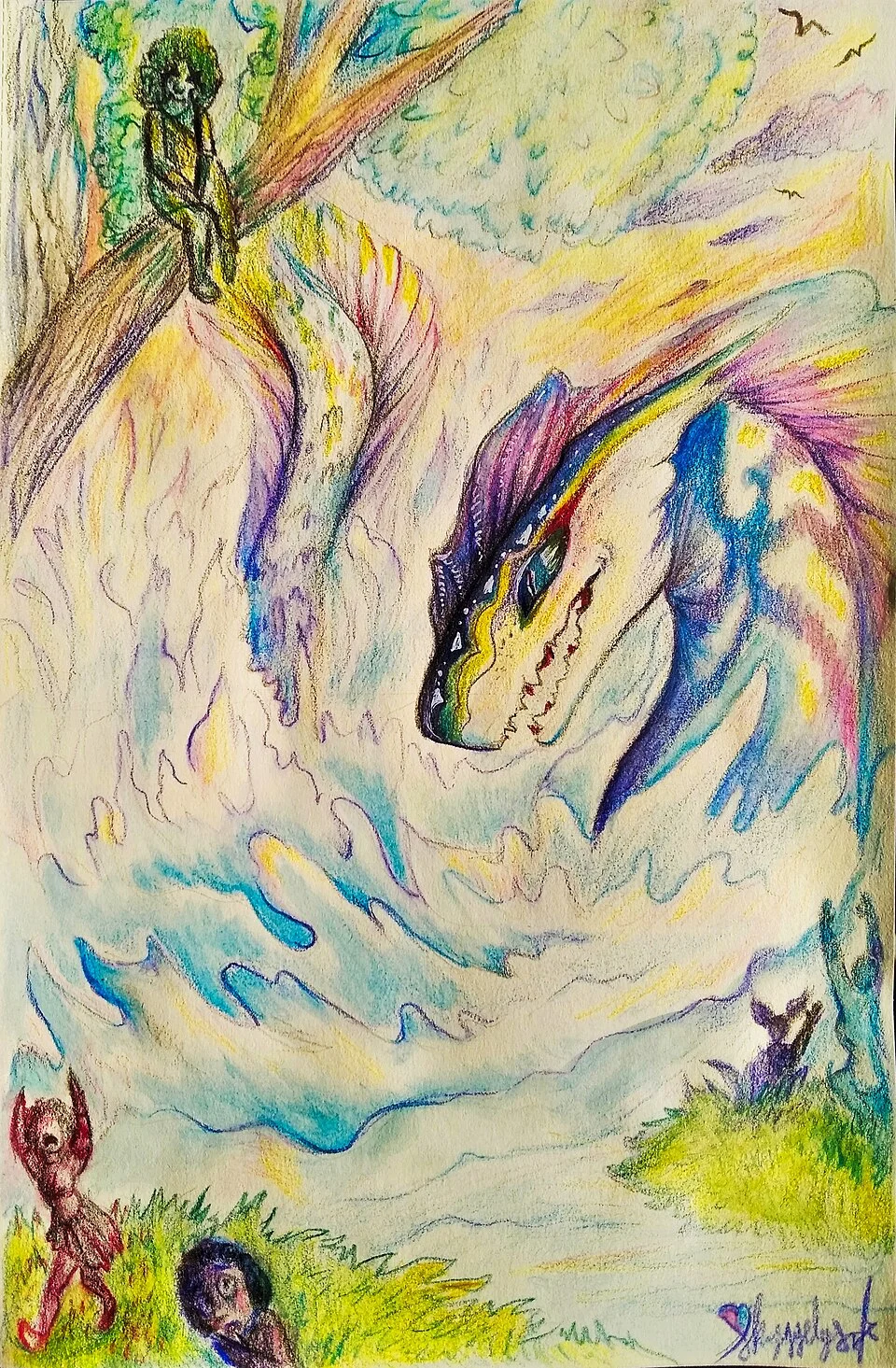
Abaia artistic interpretation by Skyggelys
Modern artistic interpretation made in 2022; not historical Melanesian art or a photograph of a living creature. Original file explicitly identifies Abaia and the artist pseudonym, with uploader-issued CC BY-SA 4.0.
Overview
Dixon’s account begins with people discovering a lake full of fish. They catch them in large numbers, and a woman briefly seizes the great eel dwelling beneath the water. Abaia escapes, but the taking of his fish and the attempt to capture him provoke his anger. Rain and rising lake water then overwhelm the people.
One old woman survives because she has not eaten the fish and takes refuge in a tree. The narrative gives the lake a powerful inhabitant whose response sets limits on human harvesting. Dixon’s broad regional attribution does not identify enough community detail to represent every New Guinea tradition. This entry therefore follows the documented episode and keeps that source limitation visible.
Annie Ker’s fuller 1910 narrative names the lake Wapogi and the fishing party as people of Gavi. Young eels carry Abaia’s message to rivers and bring Water Spirits to the lake. Women fish with hand nets while men smoke the surplus on wooden platforms. The surviving woman recognises the catch as belonging to Abaia and refuses it, also trying to prevent her dogs from eating.
One dog nevertheless swallows a fishbone. In her treetop refuge, she casts that dog into the rising flood, which then stops advancing. Sparks from a fire stick reveal the water’s eventual retreat. At dawn the lake exposes the drowned people’s feet, confirming their fate. The woman returns to the children left in Gavi, initially conceals the disaster, then cares for them as they rebuild the population. Ker’s ending connects the episode with avoidance of Wapogi and fish; it preserves a collected claim about local practice, without establishing its present observance.
Origins & earliest records
Dixon 1916, Part II, chapter I, p. 120 and note 59, identifies Ker p. 52 as his source. Ker’s Papuan Fairy Tales (London: Macmillan, 1910), pp. 52–56, provides the fuller Gavi/Wapogi account. Her introduction describes collection chiefly at an unnamed northeastern Papuan village; this tale’s individual narrator is unnamed.
Records & interpretation
Direct complete Ker narrative and Dixon source note inspected. Named setting, messenger eels and survivor sequence supplement the abbreviated later synthesis.
Selected bibliography
Documented works and useful reading. This is not a list of every appearance.
- 01
Oceanic Mythology
Selected primary witness; not an exhaustive bibliography.
- 02
Papuan Fairy Tales: Why the Men of Gavi will not eat Fish, pp. 52–56
Complete tale read; source identified through Dixon note 59.
Family & connections
A source-supported family tree or inspiration record has not yet been compiled for this profile. Related reading below indicates a connection in subject matter, not a proven lineage or creative influence.
Encyclopedia background
An additional attributed reference, separate from the editorial profile above.
Read the open encyclopedia overview
Abaia is a huge, magical eel in Melanesian mythology.
According to Melanesian mythology the Abaia is a type of large eel which dwells at the bottom of freshwater lakes in the Fiji, Solomon and Vanuatu Islands. The beast is said to consider all creatures in the lake its children and protects them furiously against anyone who would harm or disturb them. It is said that those who are foolish enough to try to catch the fish from a lake containing the Abaia are immediately overwhelmed by a large wave caused by the thrashing of the Abaia's powerful tail.
Another version of the legend states that if someone were to harm a creature living in the Abaia's home, the Abaia would cause a great rain storm flooding the land and drowning those who had caused the harm. One example of this ability is illustrated in the following story:
One day a man discovered a lake in which were many fish, and at the bottom of the lake lived a magic eel, but the man knew it not. He caught many fish and returned the next day with the people of his village whom he had told of his discovery, and they also were very successful, while one woman even laid hold of the great eel, Abaia, who dwelt in the depths of the lake, though he escaped her.
Now Abaia was angry that his fish had been caught and that he himself had been seized, so he caused a great rain to fall that night, and the waters of the lake also rose, and all the people were drowned except an old woman who had not eaten of the fish and who saved herself in a tree.
Although it would seem that the magical powers of the Abaia are the byproduct of human imagination and its fear of the unknown, it has been suggested that the legend behind the creature may have stemmed from encounters with an actual undiscovered species of giant eel living at the bottom of these remote lakes.
Text from Wikipedia contributors, “Abaia”. CC BY-SA 4.0. Extracted introduction; formatting changed. Retrieved 5 October 2026. The source article may have changed since retrieval.
References
Sources supporting this profile. Linked pages have their own scope and editorial standards.
- Primary textOceanic Mythology: Part II, Chapter I—Myths of Origins and the DelugeResearch access: 2026-10-05
- Primary collected textKer 1910: Gavi/Wapogi eel narrativeResearch access: 2026-10-05
Image credits
Exact subjectAbaia artistic interpretation by Skyggelys
Modern artistic interpretation made in 2022; not historical Melanesian art or a photograph of a living creature. Original file explicitly identifies Abaia and the artist pseudonym, with uploader-issued CC BY-SA 4.0.