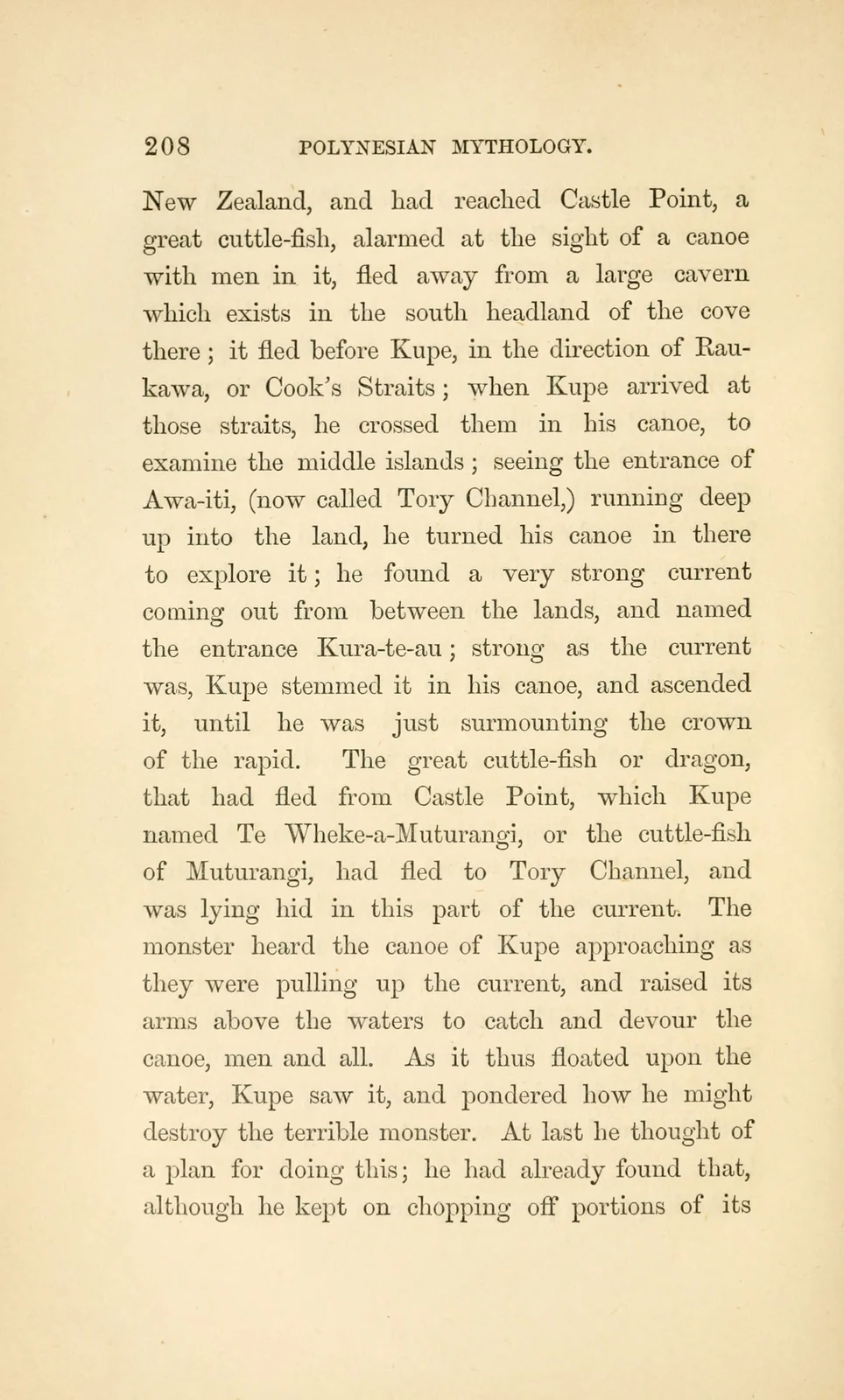
Muturangi and the great cuttle-fish, historical printed chapter opening; documentary source-page facsimile
Primary text witness to Muturangi and the great cuttle-fish in the 1855 edition. Documentary text facsimile, not creature artwork; historical terminology and collector interpretations belong to the original publication.
Overview
The octopus is associated with Muturangi and interferes with fishing in Hawaiki. In the account summarized by Te Ara, Kupe sets out with family and companions to pursue it. The chase becomes part of a voyage to Aotearoa, giving the creature a role in traditions of discovery and relationships with places encountered along the route.
The story’s importance extends beyond the animal’s extraordinary size. A conflict over fishing leads into a remembered journey, and the pursuit gives a recognizable shape to movements across the ocean. Kupe traditions differ among iwi, so this account is a selected narrative rather than a universal migration history. The being is also named Te Wheke-a-Muturangi in other spellings.
A contemporary iwi-authored witness places the octopus in continuing cultural expression. Ngāti Apa ki te Rā Tō publishes the ngeri He Aha kei Tua o Motuara Rā?, composed by Te Taepa Kameta at a Ngāti Tarakaipa hapū wānanga following visits to Tōtaranui and Meretoto. Its accompanying explanation emphasizes cultural pride, resilience and occupation before Cook’s arrival. The published translation recalls Kupe killing Te Wheke a Muturangi and links the named being with Ngā Whatu Kaipono. This local performance context remains distinct from a single nationwide discovery chronology.
Origins & earliest records
Percy Smith’s 1910 compilation is one historical printed witness to Kupe traditions. Te Ara presents the octopus episode as tradition, not a dated biological or navigational discovery. A surviving record dates its documentation, not the beginning of an oral tradition; earlier transmission cannot be timed precisely from this witness alone.
Records & interpretation
Te Ara supplies the selected voyage overview. Ngāti Apa ki te Rā Tō’s own bilingual ngeri page separately documents a named contemporary composition, its hapū wānanga context and local place associations. The historical Smith bibliography remains a listed compilation, not a claim that its complete Kupe chapter has been collated here.
Selected bibliography
Documented works and useful reading. This is not a list of every appearance.
- 01
History and Traditions of the Maoris of the West Coast North Island of New Zealand prior to 1840
Selected relevant primary or ethnographic work; the online source below is separate.
- 02
He Aha kei Tua o Motuara Rā? — ngeri and contextual explanation
Composed at a Ngāti Tarakaipa hapū wānanga. Published bilingual words and accompanying community explanation; no independent Māori translation or audio analysis asserted.
Family, evolution & connections
Octopuses
Te Ara identifies Te Wheke a Muturangi as the giant octopus encountered by Kupe and illustrates the battle through Cliff Whiting’s artwork. Real octopuses offer an animal comparison, while the named tradition retains its own geographic and narrative significance. This is not evidence that a living giant species was identified or that every Kupe account is identical.
Encyclopedia background
An additional attributed reference, separate from the editorial profile above.
Read the open encyclopedia overview
In Māori mythology, Te Wheke-a-Muturangi is a monstrous octopus destroyed in Whekenui Bay, Tory Channel or at Pātea by Kupe the navigator.
The octopus was a pet or familiar of Muturangi, a powerful tohunga of Hawaiki. The wheke was nonetheless a wild creature and a guardian.
When Kupe reached New Zealand, he encountered the beast off Castlepoint. The giant octopus then fled across Cook Strait, and was chased by Kupe through Tory Channel. Here a great battle took place, and when the octopus appeared to be about to flee, Kupe cut off its arms with his adze, killing it (Tregear 1891: 184, 620).
In the traditions of the Ngāti Ranginui people of Tauranga, Te Wheke-a-Muturangi was killed by their ancestor Tamatea, and is not associated with Kupe. New Zealand ethnologist David Simmons has suggested that this may be the more authentic tradition, and that the association with Kupe is found only in problematic sources (Simmons 1976).
Another theory for Te Wheke-a-Muturangi states that the name actually refers to the many navigation paths centered on Raiatea with tentacles reaching out across the Pacific at least as far as the edges of the Polynesian Triangle (Tetahiotupa 2009). In French Polynesian oral tradition this octopus is also known as "Taumata-Feʻe-Faʻatupu-Hau" (Great Kraken of Prosperity) and "Tumu-Raʻi-Fenua" (Beginning-of-Heaven-and-Earth).
Text from Wikipedia contributors, “Te Wheke-a-Muturangi”. CC BY-SA 4.0. Extracted introduction; formatting changed. Retrieved 5 October 2026. The source article may have changed since retrieval.
References
Sources supporting this profile. Linked pages have their own scope and editorial standards.
- ReferenceTe Ara: Octopus in New Zealand—Te Wheke-o-MuturangiResearch access: 2026-10-05
- Iwi-authored cultural sourceNgāti Apa ki te Rā Tō: He Aha kei Tua o Motuara Rā?Research access: 2026-10-05
Image credits
Historical text facsimileMuturangi and the great cuttle-fish, historical printed chapter opening; documentary source-page facsimile
Primary text witness to Muturangi and the great cuttle-fish in the 1855 edition. Documentary text facsimile, not creature artwork; historical terminology and collector interpretations belong to the original publication.