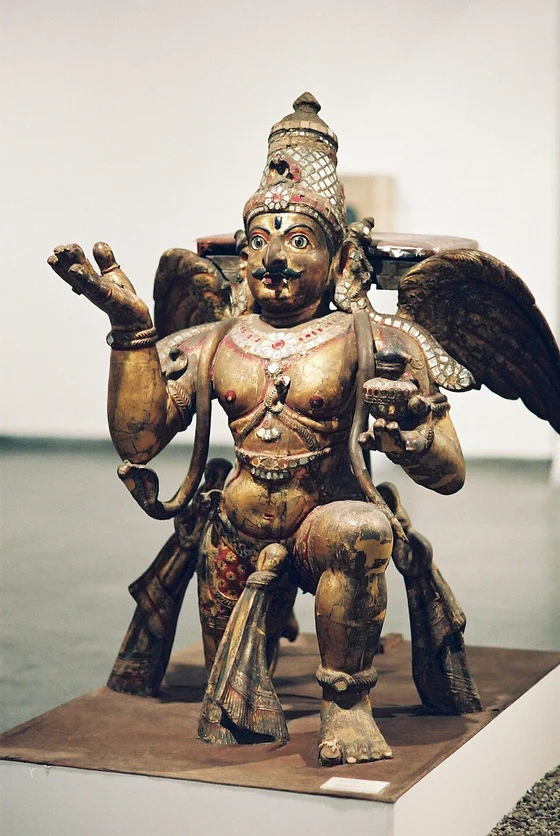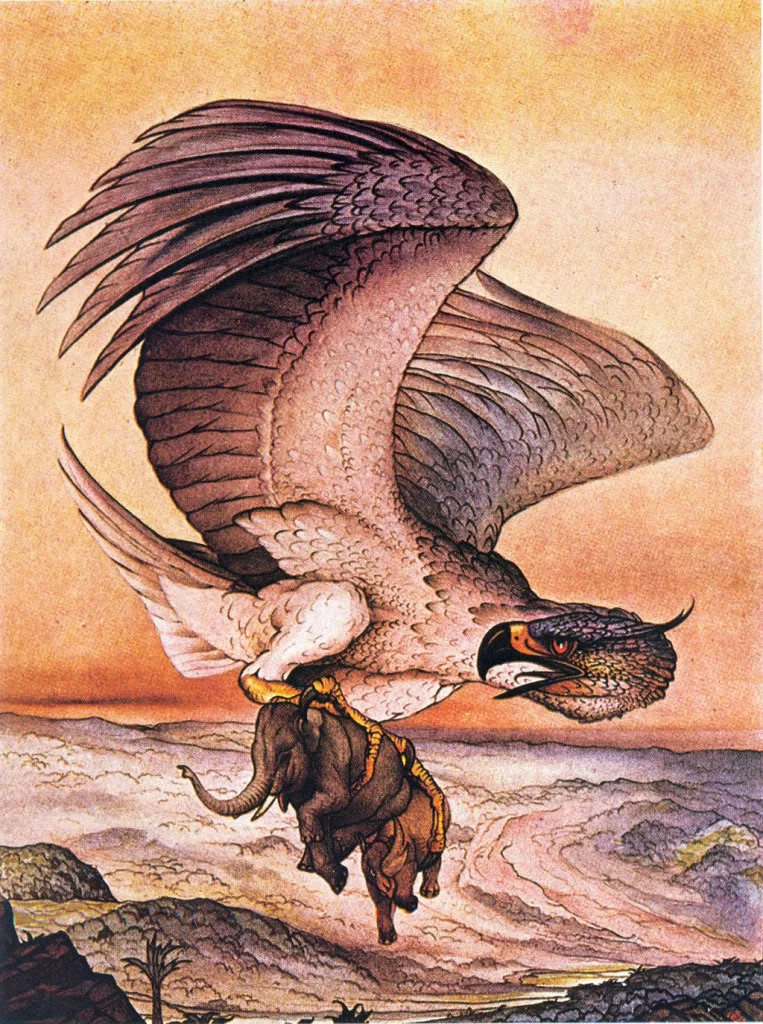
Roc
Image associated with the exact linked encyclopedia article; consult credited file description for its interpretation.
Overview
Roc, rukh and ruc are spellings used in the selected English witnesses for an enormous bird associated with dangerous voyages, giant eggs and extraordinary carrying power. Its role changes with the narrative: it transports a stranded traveller, avenges a destroyed nest, or appears in reported marvels of distant islands. These accounts do not establish one uniform species or make every giant sacred bird in other traditions the same being.
In Lang’s second Sindbad voyage, the traveller is left behind after falling asleep on an island. A smooth white object, at least fifty paces around, initially seems inexplicable. A bird that darkens the sky settles over it, revealing it as an egg. Sindbad binds himself to its foot with his turban and is carried away at dawn. After landing he releases himself; the roc kills and carries off a huge snake. The escape has brought him into a diamond valley inhabited by other enormous serpents. His eventual flight out of that valley uses meat and an eagle attracted by the merchants’ diamond-gathering method. The two aerial journeys involve differently named birds in this edition, so the second carrier should not simply be called another roc.
Later in that same voyage, Sindbad describes a rhinoceros carrying an impaled elephant and becoming helpless; a roc then carries both animals away to feed its young. This is a narrated marvel, not a reliable account of rhinoceros or elephant behaviour. Lang’s fifth voyage gives a different consequence of human contact. Merchants break a nearly hatched egg and cook the chick despite Sindbad’s warning. Two parent rocs pursue the departing vessel with boulders. The helmsman evades the first, but the second breaks the ship, leaving Sindbad to survive on floating wreckage. The attack follows the destruction of the nest and is not presented as an unexplained habit of sinking passing ships.
The Third Calender’s story in the same selection uses a roc as deliberately arranged transport. His hosts sew him into a sheep skin and provide a knife. The bird takes the supposed sheep to a mountaintop; when he cuts free and appears in his own clothes, it flies away. He then walks to the magnificent palace. The passage calls the bird white and able to carry an elephant. Its flight ends before the subsequent palace adventures, and those later events do not describe another roc transformation.
Burton’s second voyage shares the egg, turban and giant-serpent sequence but has its own details. The rukh lands on a high hill, and Sindbad reaches a peak overlooking the valley. The diamond merchants’ method involves eagles and vultures; an eagle carries Sindbad out. In the fifth voyage the merchants strike the egg with stones, whereas Lang’s selection uses hatchets. Burton explicitly distinguishes the male parent’s missed boulder from the female’s larger, ship-destroying rock. These are useful differences between the inspected English witnesses, not measurements of a single original Arabic text or proof that one translator invented every variation.
Marco Polo’s Madeigascar chapter reports what other travellers told him about a bird in islands farther south. It resembles a gigantic eagle, rather than the lion-and-bird griffin familiar to European pictures, and is said to lift and drop elephants before feeding on them. The inspected Yule–Cordier text also reports an immense feather brought to the Great Khan, with a hearsay qualification in brackets. Its notes discuss differences between textual versions and question the geography of the chapter. Such reports and their later editorial interpretation must remain distinct from a preserved, authenticated feather or Polo’s own observation of a living roc.
The same historical commentary suggests that Madagascar’s enormous fossil eggs may have helped localise the story there. That is an attributed explanatory hypothesis. Real elephant birds are independently evidenced by skeletal remains and eggs in museum collections, and Grealy and colleagues’ 2023 study recovered ancient genetic evidence from eggshell. They were flightless birds; their existence does not verify the flying, elephant-carrying animal of the tales or prove that these particular stories originated from them.
Origins & earliest records
The selected witnesses are the Sindbad and Calender narratives in two English treatments and Marco Polo’s medieval travel narrative. Lang’s original 1898 selection and inspected 1918 printing belong to modern reception, while the hosted Burton volume is an undated Shammar reprint. These editions do not establish the motif’s first oral or written appearance. Arabic manuscript history and earlier witnesses remain to be compared.
Records & interpretation
Literary episodes and attributed travel reports document the roc’s cultural history. An alleged immense feather in a narrative is not an authenticated specimen. Fossil elephant-bird remains and eggshell DNA provide a separate kind of evidence for real flightless birds; the proposed connection to the roc remains a historical hypothesis about stories.
In the literature
“A fowl of monstrous size, called a roc, will appear in the air, taking you to be a sheep.”
“The Story of the Third Calender, Son of a King” · English adaptation after Antoine Galland’s French version; individual English translator not credited in this e-text
The one-eyed young men explain how a roc can transport the Calender to a mountain.
“for this great white bird is so strong”
“The Story of the Third Calender, Son of a King”; paragraph beginning “After the young gentlemen had been at the trouble of sewing the…” · English adaptation after Antoine Galland’s French version; individual English translator not credited in this e-text
The retelling describes the roc as a great white bird.
“he has been known to carry even an elephant to his nest in the hills.”
“The Story of the Third Calender, Son of a King”; paragraph beginning “After the young gentlemen had been at the trouble of sewing the…” · English adaptation after Antoine Galland’s French version; individual English translator not credited in this e-text
The literary roc’s enormous carrying ability is a narrated marvel.
Selected bibliography
Documented works and useful reading. This is not a list of every appearance.
- 01
The Arabian Nights Entertainments: Sindbad, Second Voyage
Complete selected voyage read. Island egg, turban flight, snake prey, separate eagle escape and rhinoceros-elephant report.
- 02
The Arabian Nights Entertainments: Sindbad, Fifth Voyage
Complete selected voyage read; roc episode concerns chick destruction and two retaliatory boulders.
- 03
The Arabian Nights Entertainments: The Story of the Third Calender, Son of a King
Located sheep-skin transport episode and surrounding arrival context read; not a claim to have reread the entire Calender story.
- 04
The Book of the Thousand Nights and a Night, Volume VI: Second and Fifth Voyages
Second voyage pp.14–22 and fifth-voyage roc encounter pp.48–50 read. Reprint identified by its title pages; exact reprint year not asserted.
- 05
The Travels of Marco Polo, Book III, Chapter XXXIII: Madeigascar
Chapter pp.411–413 and selected editorial notes1,5,6 distinguish report, geographical doubt and later interpretation.
- 06
The Arabian Nights Entertainments (selected and edited by Andrew Lang)
Exact contiguous excerpt checked against the linked primary e-text on 2026-10-05; only whitespace normalized. Gutenberg identifies Longmans, Green 1918 (1898); preface explicitly describes translation from Galland and abridgment.
Family, evolution & connections
Aepyornis and Madagascar elephant birds
Yule–Cordier’s note proposes that reports of immense fossil eggs helped localize the roc to Madagascar. This is an editorial hypothesis, not established transmission or creative testimony. Grealy and colleagues study actual elephant-bird eggshell and identify the birds as flightless; their biological evidence does not validate a flying elephant-carrying roc.
Located primary passages
Specific passages supporting details in this entry, grouped by their published witness.
The Arabian Nights Entertainments: Sindbad, Second Voyage
Exact contiguous excerpt checked against the linked primary e-text on 2026-10-05; only whitespace normalized. Gutenberg identifies Longmans, Green 1918 (1898); preface explicitly describes translation from Galland and abridgment.
- The retelling describes the roc as a great white bird.
- The literary roc’s enormous carrying ability is a narrated marvel.
- The one-eyed young men explain how a roc can transport the Calender to a mountain.
The passage documents this literary version, not zoological existence, earliest attestation or a universal statement of living tradition. Lang’s selected1918 English adaptation is mediated through Galland’s French version and abridgment; it is not a direct medieval Arabic manuscript reading. The1898 first-work date does not replace the selected1918 witness. Matching stays within the specified literary profile and does not cross franchise, culture or animal-species boundaries.
Encyclopedia background
An additional attributed reference, separate from the editorial profile above.
Read the open encyclopedia overview
The roc is a legendary bird of prey which featured in popular mythology of the Middle East, consistently depicted with an enormous size, allowing it to dispatch elephants with minimal effort.
The roc appears in Arab geographies and natural history, popularized in Arabian fairy tales and sailors' folklore. The roc features in the story collection One Thousand and One Nights, which includes the bird in two tales; "Abd al-Rahman the Maghribi's Story of the Rukh" and "Sinbad the Sailor".
Text from Wikipedia contributors, “Roc (mythology)”. CC BY-SA 4.0. Extracted introduction; formatting changed. Retrieved 5 October 2026. The source article may have changed since retrieval.
References
Sources supporting this profile. Linked pages have their own scope and editorial standards.
- Historical literary adaptationLang selection: Second and Fifth Voyages and Third CalenderResearch access: 2026-10-05
- Historical literary translationBurton Volume VI, Shammar reprintResearch access: 2026-10-05
- Historical travel narrative and later commentaryYule–Cordier, Marco Polo III.33 and editorial notesResearch access: 2026-10-05
- Peer-reviewed researchGrealy et al. 2023, fossil eggshell and elephant-bird lineagesResearch access: 2026-10-05
- Author-hosted research paperGrealy et al. 2023, author-hosted paper at ColumbiaResearch access: 2026-10-05
- Museum collection evidenceNatural History Museum: fossil bird collection, ratite materialResearch access: 2026-10-05
Image credits
Reference illustrationRoc
Image associated with the exact linked encyclopedia article; consult credited file description for its interpretation.