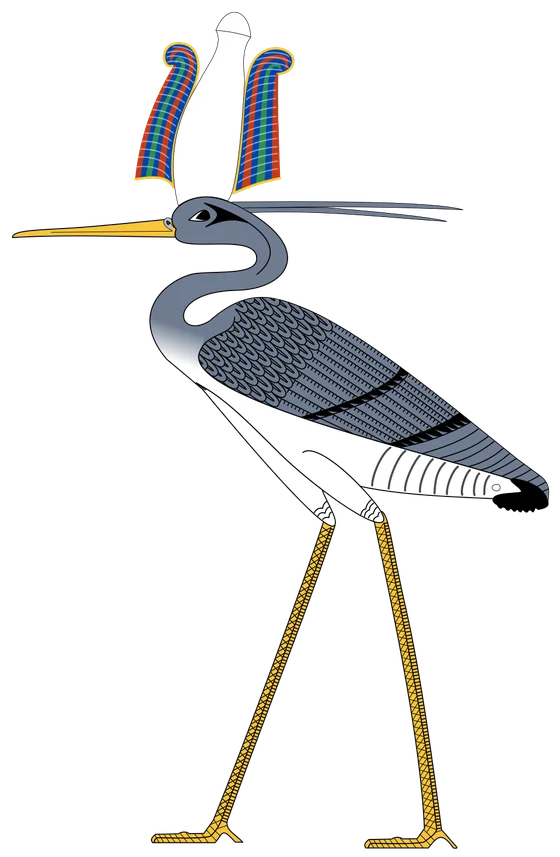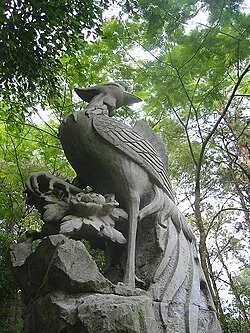
Phoenix
Image associated with the exact linked encyclopedia article; consult credited file description for its interpretation.
Overview
Herodotus’s Histories II.73 describes a sacred bird associated with Heliopolis in Egypt. He had seen only its painted likeness: predominantly red and gold, with an eagle’s outline and size. His informants give five hundred years between appearances and say the visitor arrives when its father dies. It tests the weight of an egg-shaped lump of myrrh, hollows it, encloses its father’s remains and seals the opening. The completed burden supposedly weighs the same as before. It then carries this to the Sun’s temple from Arabia. Herodotus explicitly disbelieves the transport story. His account contains filial burial, rather than a description of self-incineration.
In Ovid’s Metamorphoses XV, the phoenix appears within Pythagoras’s speech about changing forms. Unlike creatures generated from something else, it renews itself. It feeds on frankincense and amomum, then constructs a nest in an oak or palm after five ages of life. Cassia, spikenard, cinnamon and myrrh make its deathbed. A young bird emerges from the parent’s body; once strong enough, it carries the nest, both its birthplace and its parent’s resting place, to Hyperion’s temple. This passage describes aromatic death and renewal without explicitly setting the nest alight.
Pliny’s Natural History X.2 supplies a different appearance: eagle-sized, with gold around the neck, a purple body, an azure tail mixed with rose-coloured feathers, and ornamental crest and head plumage. He doubts whether the solitary Arabian bird exists. Citing Manilius, he reports a 540-year life, an aromatic nest, a worm arising from the dead bird’s bones and marrow, and its development into a successor that carries the nest to the Sun’s altar near Panchaia. Manilius connects its lifespan with a recurring astronomical cycle. Pliny also records Cornelius Valerianus’s reported flight from Arabia to Egypt and a supposed phoenix exhibited at Rome during Claudius’s censorship, in the city’s eight-hundredth year. Although public annals recorded that exhibition, Pliny says the displayed bird was accepted as false. A recorded display therefore does not establish the exhibited animal’s claimed identity.
Tacitus, Annals VI.28, places a reported Egyptian appearance in the consulship of Paulus Fabius and Lucius Vitellius. He contrasts the usual five-hundred-year interval with a 1,461-year version and lists earlier visits under Egyptian and Ptolemaic rulers. The short interval since the third Ptolemy prompted doubts about this particular visitor. In the reproductive story he relates, a young bird arises from a life-giving substance placed in a nest, practises carrying myrrh, then transports its father to the Sun’s altar for cremation. Tacitus calls the details uncertain and embellished while accepting occasional Egyptian appearances. That is the historian’s judgment within the account, not modern zoological confirmation.
Aberdeen’s manuscript of about 1200 juxtaposes two renewal mechanisms. On folios 55r–55v, an aged Arabian phoenix prepares aromatic branches, faces the sun and fans its own funeral fire with its wings; it rises from the ashes on the ninth day. The compiler compares it with Christ and with the eventual resurrection of the righteous, while separately giving the Christian third-day resurrection. Folio 56r instead describes death inside an aromatic container, followed by a worm developing from bodily fluid and regaining the bird’s form. The illustrations present wings, sunlight and flames; the university’s commentary allows the flaming image to represent destruction or return. Textual variation and pictorial interpretation remain visible even within one manuscript.
These accounts connect the phoenix with solar worship, exceptional longevity, parental duty and renewal through different narrative mechanisms. They do not form an observed biological lifecycle. Egyptian Bennu, Chinese Fenghuang and Persian Simurgh traditions can be compared through their own witnesses, but this selected Greek, Roman and European history does not make those birds interchangeable or establish a single evolutionary family.
Origins & earliest records
Herodotus II.73 is a surviving fifth-century BCE Greek witness to an Egyptian-associated report. It is not an established date of invention or the first sacred-bird tradition worldwide. Ovid, Pliny and Tacitus preserve different Roman-era accounts; the medieval Aberdeen manuscript gives explicit fiery renewal alongside another mechanism. Neither a shared solar association nor later use of the English name proves every sacred bird derives from this textual sequence.
Records & interpretation
The evidence consists of transmitted literary passages, a surviving illustrated medieval manuscript and reported historical displays. Herodotus distinguishes a picture from personal encounter; Pliny doubts the creature and rejects the Roman exhibit; Tacitus separates uncertain details from his own acceptance of visits. Those differing assessments belong to the sources. They provide no independently observed five-century lifespan, self-renewal or authenticated phoenix specimen.
In the literature
“From the body of the parent bird a young Phoenix issues forth”
Chapter XXIX, “The Phoenix”, opening paragraph
Excerpt from Bulfinch’s English rendering of an account attributed to Ovid. Translator of the nested Ovid passage is not separately credited.
“I did not myself see except in painting”
Histories II.73; complete sacred-bird account · G. C. Macaulay
Herodotus expressly says he saw only a painting. He reports Heliopolitan five-hundred-year visits, eagle-like shape, gold/red feathers and the transport of a father’s corpse enclosed in myrrh, while explicitly doubting that burial story. This is not his witnessed burning-and-rebirth account.
“there is one bird which renews and reproduces itself”
Metamorphoses XV, speech of Pythagoras; printed p.532, phoenix paragraph within the page’s line range389–414 · Henry Thomas Riley
Ovid’s speaker describes a spice-and-myrrh nest, death amid scents, a young phoenix arising from its parent’s body and transport of the nest to Hyperion’s temple. No explicit ignition is supplied in this paragraph. Pythagoras is the dramatic speaker, not an independently inspected historical bird observer.
“though I am not quite sure that its existence is not all a fable”
Natural History X.2, Volume II pp.479–481; complete chapter plus note2889 · John Bostock and H. T. Riley
Pliny doubts the bird’s reality while attributing colour, singularity and a five-hundred-and-forty-year lifespan to reports including Manilius. The replacement first appears as a worm from bones and marrow and becomes a bird. The exhibited Claudian specimen is labelled fictitious. The1855 editors separately record manuscript variation in lifespan, so540 is not treated as a universal source consensus.
Selected bibliography
Documented works and useful reading. This is not a list of every appearance.
- 01
Histories II.73
Complete selected paragraph read: painted appearance, reported five-century visit and myrrh burial, with authorial doubt.
- 02
Metamorphoses XV, phoenix passage in the speech of Pythagoras
Aromatic nest, death, successor and transport to Hyperion’s temple; selected passage, not a newly reviewed whole poem.
- 03
Natural History X.2
Complete chapter, pp. 479–481; Manilius and Valerianus are mediated through Pliny.
- 04
Annals VI.28
Complete selected chapter; lifespan alternatives, disputed visitor and filial cremation.
- 05
Aberdeen Bestiary, University Library MS24, folios 55r–56r
Selected renewal passages and institutional image commentary inspected; two mechanisms and their Christian interpretation kept distinct.
- 06
Bulfinch’s Mythology: The Age of Fable (revised by E. E. Hale)
Exact contiguous excerpt checked against the linked primary e-text on 2026-10-05; only whitespace normalized. Work first published 1855; date of the Hale revision used by this e-text is not specified.
Family & connections
A source-supported family tree or inspiration record has not yet been compiled for this profile. Related reading below indicates a connection in subject matter, not a proven lineage or creative influence.
Located primary passages
Specific passages supporting details in this entry, grouped by their published witness.
Bulfinch’s Mythology: The Age of Fable (revised by E. E. Hale)
Exact contiguous excerpt checked against the linked primary e-text on 2026-10-05; only whitespace normalized. Work first published 1855; date of the Hale revision used by this e-text is not specified.
- Excerpt from Bulfinch’s English rendering of an account attributed to Ovid. Translator of the nested Ovid passage is not separately credited.
Literary witness only. Bulfinch is a nineteenth-century reteller rather than the ancient origin text. Matching is limited to the specified profile and does not cross franchise, culture or animal-species boundaries.
Histories II.73
G. C. Macaulay translation, selected1890 Macmillan edition per preparer’s note; complete II.73 independently read. Ancient author’s report and stated scepticism retained.
- Herodotus expressly says he saw only a painting. He reports Heliopolitan five-hundred-year visits, eagle-like shape, gold/red feathers and the transport of a father’s corpse enclosed in myrrh, while explicitly doubting that burial story. This is not his witnessed burning-and-rebirth account.
Not empirically established natural history or exact earliest attestation. Existing root-owned bibliography retained; no duplicate standalone work added.
Metamorphoses XV, phoenix passage in the speech of Pythagoras
Henry Thomas Riley prose translation1851, selected1893 George Bell reprint, BooksVIII–XV; title/transcriber’s edition note independently read. Passage alone inspected; precise single-verse boundary not claimed.
- Ovid’s speaker describes a spice-and-myrrh nest, death amid scents, a young phoenix arising from its parent’s body and transport of the nest to Hyperion’s temple. No explicit ignition is supplied in this paragraph. Pythagoras is the dramatic speaker, not an independently inspected historical bird observer.
Not empirically established natural history or exact earliest attestation. Existing root-owned bibliography retained; no duplicate standalone work added.
Natural History X.2
John Bostock and H. T. Riley, The Natural History of Pliny, VolumeII, London: HenryG.Bohn1855; selected title page, full X.2 and note2889 read.
- Pliny doubts the bird’s reality while attributing colour, singularity and a five-hundred-and-forty-year lifespan to reports including Manilius. The replacement first appears as a worm from bones and marrow and becomes a bird. The exhibited Claudian specimen is labelled fictitious. The1855 editors separately record manuscript variation in lifespan, so540 is not treated as a universal source consensus.
Natural History X.2, Volume II pp.479–481; complete chapter plus note2889
Not empirically established natural history or exact earliest attestation. Existing root-owned bibliography retained; no duplicate standalone work added.
Annals VI.28
LacusCurtius hosted Loeb Classical Library1937 text; translator not identified on the actual inspected page and therefore not guessed. Complete VI.28 independently read.
- Tacitus juxtaposes500-year and1461-year traditions, reported earlier royal-era appearances and doubts about the Tiberian specimen. The offspring’s final action is to carry and burn its father’s corpse at the solar altar. Uncertain details heightened by fable are acknowledged; the paragraph does not describe the young bird itself being born from those flames.
Not empirically established natural history or exact earliest attestation. Existing root-owned bibliography retained; no duplicate standalone work added.
Primary source witness
Aberdeen Bestiary, MS24, medieval Latin text, University of Aberdeen digital transcription/translation; ff.55r–56r independently read2026-10-05. Modern translator credit and translation publication year not established here.
- The medieval text on55r gives a self-made aromatic pyre, sun-facing wings and self-burning. On55v the bird returns on the ninth day, while Christ’s third-day resurrection belongs to a distinct comparison. On56r a second description gives a fragrant container and flesh-fluid worm growing wings. The layered accounts are not collapsed into one universal three-day bird mechanism.
Selected three folios, not complete manuscript or earliest phoenix account; ninth and third-day clauses kept distinct. Underlying Latin is historical; modern rendered prose not treated as public domain. No duplicated root bibliography.
References
Sources supporting this profile. Linked pages have their own scope and editorial standards.
- Primary textHerodotus, Histories II.73, Macaulay translationResearch access: 2026-10-05
- Primary textOvid, Metamorphoses XV, Riley translationResearch access: 2026-10-05
- Primary textPliny, Natural History X.2, Bostock and Riley 1855Research access: 2026-10-05
- Primary textTacitus, Annals VI.28, Loeb 1937 transcriptionResearch access: 2026-10-05
- Primary textAberdeen Bestiary,phoenix folio55rResearch access: 2026-10-05
- Primary textAberdeen Bestiary,phoenix folio55vResearch access: 2026-10-05
- Primary textAberdeen Bestiary,phoenix folio56rResearch access: 2026-10-05
Image credits
Reference illustrationPhoenix
Image associated with the exact linked encyclopedia article; consult credited file description for its interpretation.