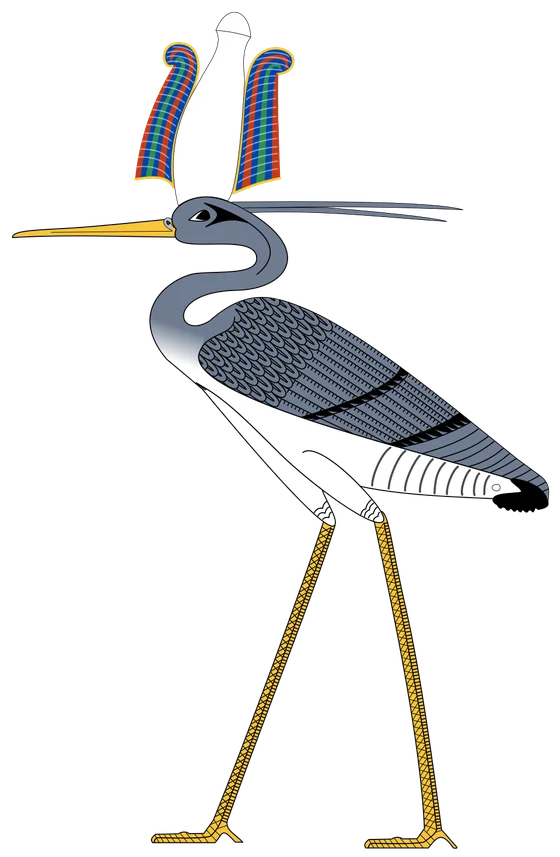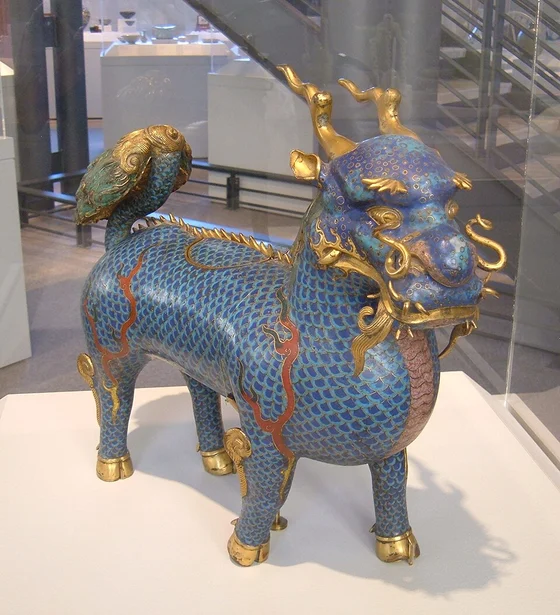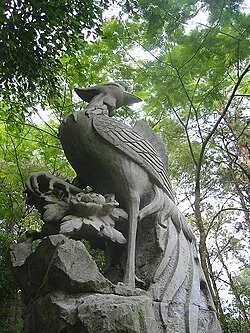
Fenghuang
Image associated with the exact linked encyclopedia article; consult credited file description for its interpretation.
Overview
Fenghuang appears in Chinese literature and decorative arts as an exceptional bird with elaborate plumage. Courtly interpretations can connect its appearance with good order and virtuous rule. Its visual form changes across artists and media, so a modern multicolored bird is not a precise template for every ancient or imperial representation.
The English translation phoenix creates a familiar bridge but can also import the wrong story. A bird burning itself and returning from ashes is not the defining Chinese account selected here. The Met’s textile discussion offers a concrete example of the motif’s use in woven art, where composition, pairing and material workmanship matter alongside the bird’s broader associations.
In the southern mountains section of the Classic of Mountains and Seas, the bird belongs to the account of Danxue Mountain. Gold and jade occur there, and the Dan River flows south toward the sea named Bohai in the text. The bird is called 鳳皇 and compared in shape to a chicken, with patterned plumage in five colors. These are features of a received literary geography. The entry does not identify a modern nesting site, establish that the creature was a chicken species, or give it a cycle of fiery death and rebirth.
That account connects particular body markings with moral qualities. The head bears virtue (德), the wings righteousness (義), the back ritual propriety (禮), the breast benevolence (仁), and the belly trustworthiness (信). The bird sings and dances of itself, and its appearance accompanies peace throughout the world. This combination makes its body more than decorative anatomy: the text presents it as a visible arrangement of valued conduct and auspicious order.
A second passage in the same compilation, in Hainei jing, has a different arrangement. It associates the head with virtue, the wings with compliance or harmony (順), the breast with benevolence, and the back with righteousness. It does not repeat the first passage’s full five-part list. The nearby wording also distinguishes a singing luan bird from a dancing feng bird. These small differences matter when identifying a particular illustration or explaining a passage; one standardized modern list should not overwrite both witnesses.
The poem Juan A in the Book of Songs places flying and calling feng birds alongside praise of worthy people serving a ruler. Its later stanzas describe their moving wings and ascent, then a bird calling on a high ridge and flourishing wutong trees on a sunny slope. The poem’s traditional Mao preface interprets it as counsel to King Cheng about seeking worthy people. That is an attributed reading of a political praise poem, not a narrative of a bird creating a dynasty or a record of a captured specimen.
Analects 9.9 supplies a contrasting use of the omen. Confucius is represented lamenting that the feng bird has not arrived and that the river has not produced its chart, connecting their absence with his own sense of an ending. The brief saying presupposes the significance of the signs without describing a sighting, giving the bird an anatomy, or narrating its birth. It therefore belongs in the literature record as a different kind of witness from the descriptive mountain entry.
A surviving eighteenth-century silk tapestry provides a later material example: The Met’s Panel with five phoenixes in a garden, object25.109.2. The museum links its yellow ground and production context with the imperial court, and explains the birds through peace and prosperity. Its recorded medium is kesi silk tapestry. This object demonstrates the motif’s use in a particular historical artwork; it cannot by itself establish the date when the much older bird traditions began.
The source record thus includes literary description, a moral and political omen, poetic imagery and a later courtly artwork. The shared English name phoenix remains a comparison between traditions. The selected Chinese passages do not make the bird a relative of the Greek phoenix or Egyptian Bennu, and they do not provide an evolutionary tree. Broader claims about fixed male and female roles, first prehistoric depictions, or direct influence on another tradition require additional dated evidence beyond these witnesses.
Origins & earliest records
Located received-text witnesses include the Danxue passage in Shanhai jing, its separate Hainei jing bird passage, the Shijing poem Juan A, and Analects9.9. Their ancient textual settings are distinct from the eighteenth-century Met tapestry. This review does not fix the composition date of each passage or establish the first oral or archaeological appearance of the motif.
Records & interpretation
Selected complete Danxue and Hainei jing bird passages read in Chinese transcription, with the adjacent commentary distinguished from base text; complete Juan A poem and its displayed traditional preface, and complete Analects9.9 saying with neighboring context inspected. Modern Met object record read. These are textual and art-historical witnesses, not zoological verification. No manuscript-image collation or whole-corpus reading is claimed.
Selected bibliography
Documented works and useful reading. This is not a list of every appearance.
- 01
Shanhai jing (Classic of Mountains and Seas) — Nan shan jing and Hainei jing
Complete selected Danxue bird paragraph and distinct Hainei jing bird paragraph in Chinese transcription. Body-marking lists differ; commentary and primary passage kept separate.
- 02
Shijing (Book of Songs) — Juan A, in the Greater Odes
Complete ten-stanza poem and displayed traditional preface read. Feng-bird stanzas7–9 are discussed within its praise of worthy people.
- 03
Analects — Zi Han, 9.9
Complete short saying concerning the absent feng bird and river chart, with neighboring context. No complete commentary tradition examined.
Family, evolution & connections
Phoenix
The Chinese fenghuang and the classical phoenix are often connected through English naming, but their histories, imagery and cultural functions should remain distinct. The museum's Chinese textile discussion and Herodotus's account provide separate evidence bases. This edge enables comparison of auspicious or extraordinary birds without claiming that the traditions are interchangeable or proving a simple transmission route.
Encyclopedia background
An additional attributed reference, separate from the editorial profile above.
Read the open encyclopedia overview
Fenghuang ( fung-HWAHNG) are mythological birds featuring in traditions throughout the Sinosphere. Fenghuang are understood to reign over all other birds: males and females were originally termed feng and huang respectively, but a gender distinction is typically no longer made, and fenghuang are generally considered a feminine entity to be paired with the traditionally masculine Chinese dragon.
In the West, they are commonly called Chinese phoenixes, although mythological similarities with the Western/Persian phoenix are superficial.
Text from Wikipedia contributors, “Fenghuang”. CC BY-SA 4.0. Extracted introduction; formatting changed. Retrieved 5 October 2026. The source article may have changed since retrieval.
References
Sources supporting this profile. Linked pages have their own scope and editorial standards.
- MuseumThe Met textile-conservation newsletter, fall 2022: phoenix tapestry discussionResearch access: 2026-10-05
- Received Chinese primary text in transcriptionShanhai jing: complete Danxue bird passageResearch access: 2026-10-05
- Received Chinese primary text in transcriptionShanhai jing: separate Hainei jing bird passageResearch access: 2026-10-05
- Received Chinese primary text in transcriptionShijing: Juan A, complete poem and traditional prefaceResearch access: 2026-10-05
- Received Chinese primary text in transcriptionAnalects9.9: the absent feng birdResearch access: 2026-10-05
- Custodial object recordThe Met: Panel with five phoenixes in a garden, object25.109.2Research access: 2026-10-05
Image credits
Reference illustrationFenghuang
Image associated with the exact linked encyclopedia article; consult credited file description for its interpretation.