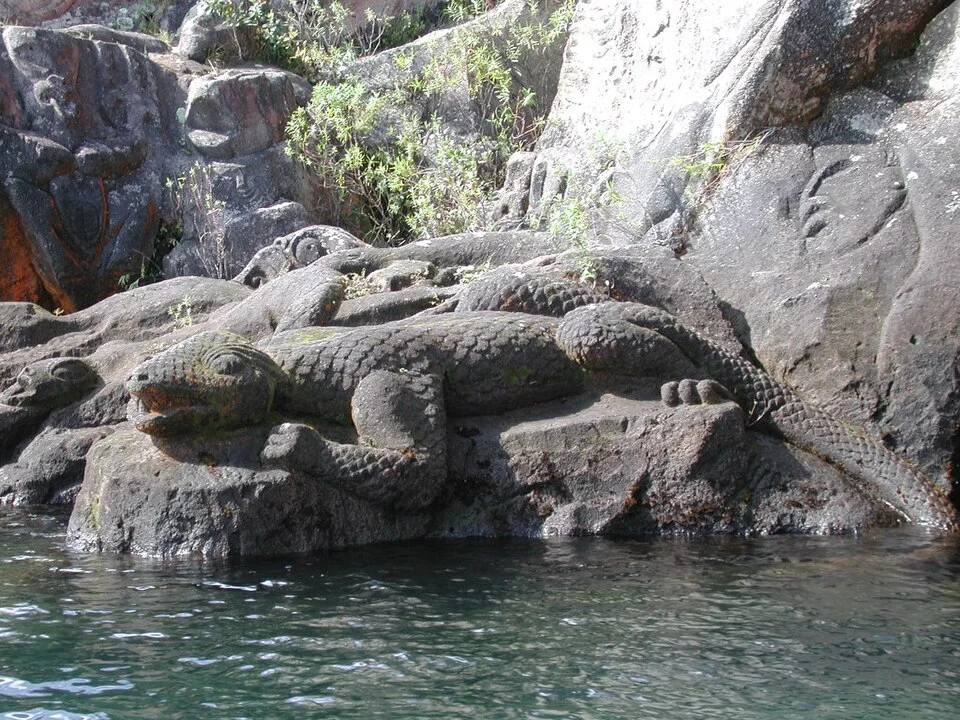
Modern Maori taniwha rock carving at Lake Taupo
Modern sculptural interpretation photographed in 2010; not an ancient illustration or evidence of a living creature. Photographer releases this photograph into the public domain on the original Commons record.
Overview
Taniwha cannot be reduced to a single dragon-shaped animal. Public accounts describe beings associated with rivers, lakes and the sea, sometimes appearing as reptiles, sharks, whales or other forms. Some are threatening; others are kaitiaki whose relationship with particular communities makes protection central to their identity. A dangerous waterway and a protective presence can belong to the same cultural landscape.
An account should therefore identify its place and people before assigning a creature design or moral role. The name also occurs figuratively in language about chiefs, which complicates literal readings of every reference. This entry gives an introduction to publicly shared traditions and leaves specific local knowledge with its holders.
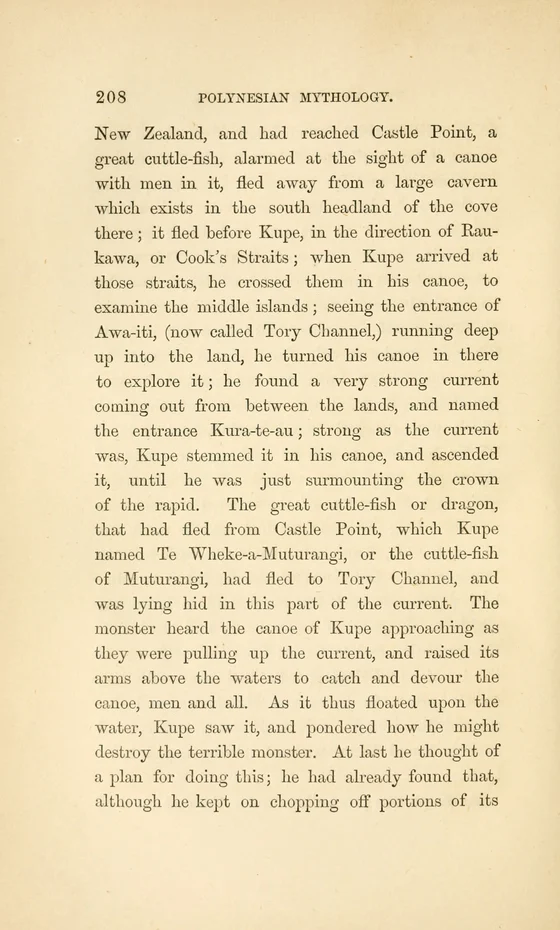
William Colenso’s paper in volume 11 of the Transactions and Proceedings of the New Zealand Institute preserves two extended slaying narratives. It was read on 12 August 1878; Colenso describes his texts as translations from Māori material he received. In the Hotupuku account, unexplained disappearances between Taupō and Rotorua initially suggest human attackers. Survivors instead report a huge creature near Kapenga. A party of 170 prepares ropes from cabbage-tree leaves, approaches with attention to the wind and uses a small party to lure the creature through a snare. Those holding the ropes constrict its body, while others attack its head and tail. The account concludes with examination of the body, burial of swallowed victims, preparation of the creature’s flesh and fat, and the party’s return to Rotorua.
The Hotupuku description moves between comparisons rather than providing a consistent zoological identification: its approach resembles a moving hill, its spines evoke sea creatures, and its dead body is compared with a whale and with lizards. Colenso also explains that his English rendering of ika as fish has a wider contextual sense. These similes are evidence for the telling and its translation. They do not establish that the narrator meant one scientifically identified animal, or that a resemblance proves the tradition originated in an encounter with that animal.
The following Pekehaua narrative relocates the danger to Te Awahou and the deep pool called Te Warouri in Colenso’s text. The party makes a woven trap from supplejack, binds it with a trailing plant and equips it with ropes, stones and pigeon feathers. Pitaka and companions descend while those above recite karakia; the narrative attributes the softening of the creature’s spines and the lifting of its great weight to these acts. Pitaka fastens the rope, and his companions pull it to signal the people above. After the creature is drawn ashore and killed, the account describes swallowed remains, clothing and weapons, burial of the dead, and preservation of flesh and fat. Its ending places the temporary camp at Mangungu. This is one collected account of Pekehaua, with its own sequence and conclusion.
Great Te Arawa Stories explicitly acknowledges a different Ngāti Rangiwewehi account alongside its educational retelling of the slaying. These accounts should not be joined into a single biography. The iwi’s 2021 Te Mana o Te Wai report is linked in the bibliography; its cultural account is not reproduced here because the report reserves reuse of its traditional knowledge to its holders.
Basil Keane’s Te Ara freshwater survey supplies another protective example, Hine-kōrako at Te Rēinga waterfall. After marrying Tāne-kino and bearing Taurenga, she withdraws following insults from his relatives. When a canoe is later endangered by a flood, an appeal recalls her community ties and she pushes it back upstream. This particular relationship and rescue should not be applied automatically to every named taniwha.
Origins & earliest records
The located Colenso paper was read in 1878 and appears in volume 11 of the New Zealand Institute transactions. Its two complete narratives are historical documentation, not a demonstrated beginning of taniwha traditions. Great Te Arawa Stories explicitly identifies a contrasting local account. This entry does not assign all named taniwha a single origin date, narrator or place.
Records & interpretation
Historical translated narratives and attributed reference accounts document different kinds of knowledge and representation. Colenso’s English choices and editorial framing remain part of that witness. Neither narrative similes nor the description of swallowed remains supply independently examined zoological specimens; community accounts are attributed on their own terms. The iwi report is retained as a bibliographic lead with its reuse notice, rather than as a reproduced cultural narrative.
Selected bibliography
Documented works and useful reading. This is not a list of every appearance.
- 01
The Slaying of Hotupuku, in Contributions towards a better Knowledge of the Maori Race
Complete tale, printed pp. 87–92, including body examination, burial, consumption and return. Selected introductory statements on pp. 77 and 86 read; no claim to have identified a named original narrator.
- 02
The Killing of Pekehaua, in Contributions towards a better Knowledge of the Maori Race
Complete tale, printed pp. 92–94, including hauling, aftermath and Mangungu conclusion. This slaying narrative is separately attributed from the iwi’s continuing guardian account.
- 03
Ngāti Rangiwewehi Te Mana o Te Wai Case Study
Bibliographic link only. Printed p. 4 reserves reuse of the report and replication of its mātauranga Māori and traditional knowledge to express permission from the identified iwi authority and holders. Its cultural narrative and digital story are not reproduced here.
- 04
Taniwha: What are taniwha? and Freshwater taniwha
Te Ara overview and separately located Hine-kōrako account. These reference pages do not establish the first telling of each tradition.
- 05
Pītaka and the Taniwha Pekehaua
Complete educational telling and explicit contrasting Ngāti Rangiwewehi notice read. The historical article is by Colenso; Hector’s editorial name on this resource is not adopted as the tale’s author.
- 06
Contributions towards a better Knowledge of the Maori Race — PartI, §2 Hotupuku and Pekehaua
Transactions and Proceedings of the New Zealand Institute, volume11 (annual1878), ArticleV Contributions towards a better Knowledge of the Maori Race, PartI, printed77–106; paper read12August1878. Selected introductory77/86 and complete Hotupuku87–92/Pekehaua92–94 independently read. Annual date is not a separately verified print-imprint date; no whole article/volume claim.
Family & connections
A source-supported family tree or inspiration record has not yet been compiled for this profile. Related reading below indicates a connection in subject matter, not a proven lineage or creative influence.
Located primary passages
Specific passages supporting details in this entry, grouped by their published witness.
Contributions towards a better Knowledge of the Maori Race — PartI, §2 Hotupuku and Pekehaua
Transactions and Proceedings of the New Zealand Institute, volume11 (annual1878), ArticleV Contributions towards a better Knowledge of the Maori Race, PartI, printed77–106; paper read12August1878. Selected introductory77/86 and complete Hotupuku87–92/Pekehaua92–94 independently read. Annual date is not a separately verified print-imprint date; no whole article/volume claim.
- After travellers between Rotorua and Taupo disappear, an investigating party encounters Hotupuku at Kapenga and retreats in confusion, suffering further deaths.170 heroes prepare cabbage-tree ropes, arrange nooses and lure it away from its cave. They trap its body and strike tail and head in alternating attacks until it dies. Examination compares its general lizard-like form and spiny ridges with whale size. Its stomach contains people and their clothes, ornaments and weapons. The dead are removed and buried; the conquerors cut up the creature, clarify its oil for food and return to Rotorua.
- News of the first victory brings a request to defeat Pekehaua at Te Awahou. The same170 heroes make weighted basket traps and ropes, then approach Te Warouri. Pitaka and companions descend while their associates above perform narrated protective acts; the monster’s crest becomes flaccid. Pitaka binds it, signals through the rope and is hauled up with companions and captive. On shore the heroes beat it and examine a body compared in bulk with a whale calf. Its opened stomach reveals victims with clothes and weapons. They bury the dead, preserve the monster’s flesh and oil, and depart from the temporary camp named Mangungu.
Colenso says he translates received Māori narratives without additions86; this is his methodological assertion, not independently established transcription fidelity. The father Tamaihutoroa of five named heroes87 is not Hotupuku’s parent. Whale/lizard comparisons and translated fish/ika terminology do not establish actual animal ancestry or scientific identification. The message is attributed to Hororita or another chief, not a certain exclusive named sender. The text alternates Pikata/Pitaka spellings; no separate heroes invented. The contemporary Ngāti Rangiwewehi guardian account is not harmonised with this collected slaying narrative. No formula, karakia or universal taniwha behaviour reproduced.
Encyclopedia background
An additional attributed reference, separate from the editorial profile above.
Read the open encyclopedia overview
In Māori mythology, taniwha (Māori pronunciation: [ˈtaniɸa]) are large supernatural beings that live in deep pools in rivers, dark caves, or in the sea, especially in places with dangerous currents or deceptive breakers (giant waves).
They may be considered highly respected kaitiaki (protective guardians) of people and places, or in some traditions as dangerous, predatory beings, which for example would kidnap women to have as wives.
Text from Wikipedia contributors, “Taniwha”. CC BY-SA 4.0. Extracted introduction; formatting changed. Retrieved 5 October 2026. The source article may have changed since retrieval.
References
Sources supporting this profile. Linked pages have their own scope and editorial standards.
- Attributed reference overviewBasil Keane: Taniwha—What are taniwha? (Te Ara)Research access: 2026-10-05
- Historical collected narratives in English translationColenso, Contributions towards a better Knowledge of the Maori Race, vol. 11, pp. 77–106; selected pp. 86–94Research access: 2026-10-05
- Bibliographic lead; traditional-knowledge reuse restrictedNgāti Rangiwewehi, Te Mana o Te Wai Case Study (July2021), bibliographic link and p4 reuse noticeResearch access: 2026-10-05
- Attributed reference accountBasil Keane: Taniwha—Freshwater taniwha (Te Ara)Research access: 2026-10-05
- Educational retelling with explicit variant noticeGreat Te Arawa Stories: Pītaka and the Taniwha Pekehaua, including contrasting local accountResearch access: 2026-10-05
Image credits
Exact subjectModern Maori taniwha rock carving at Lake Taupo
Modern sculptural interpretation photographed in 2010; not an ancient illustration or evidence of a living creature. Photographer releases this photograph into the public domain on the original Commons record.