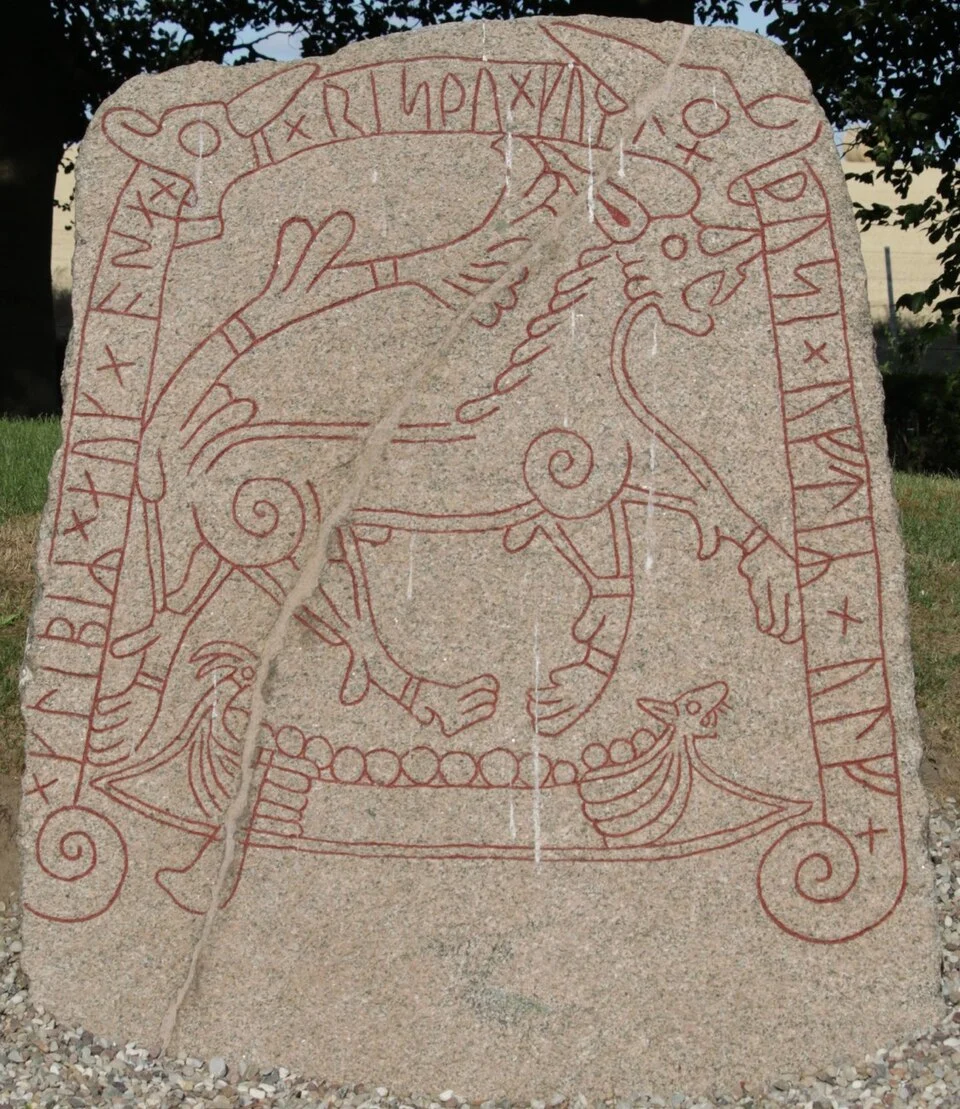
Fenrir
Image associated with the exact linked encyclopedia article; consult credited file description for its interpretation.
Overview
Snorri’s account makes Fenrir a child of Loki and Angrboda whom the gods bring into their own sphere. As he grows, they attempt to bind him and discover that ordinary restraints cannot hold him. A remarkably slight-looking bond, Gleipnir, succeeds where stronger-looking fetters fail, but the wolf demands a pledge before accepting the test.
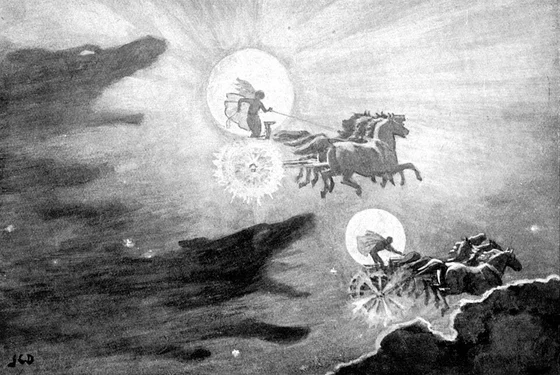
Týr places his hand in Fenrir’s mouth and loses it when the gods refuse to free the wolf. The episode gives the restraint a cost in trust and injury. At Ragnarök Fenrir breaks loose and kills Odin before Víðarr avenges his father. This is a named wolf in a specific family and prophecy, distinct from other Eddic wolves that pursue the sun or moon.
Gylfaginning XXXIV gives the successive tests their names and stakes. Týr alone dares feed the growing wolf. Fenrir breaks Lædingr on his first effort, then violently shatters the stronger Drómi. Skírnir obtains Gleipnir from dwarves: a soft, smooth ribbon made from six impossible or absent things, including a cat’s footfall, a woman’s beard and a rock’s roots. On Lyngvi, an island in Ámsvartnir, Fenrir suspects magic and objects that breaking such a slender band would bring little glory. His demand for a hand in his mouth is a safeguard against deceit, rather than an unprovoked attack on Týr.
Once the restraint holds, the gods anchor its chain through a rock and a deeper fastening stone. Fenrir’s snapping jaws are propped apart with a sword, and his flowing saliva becomes the river Ván. The dialogue explicitly explains why the gods did not simply kill him: they would not stain their sanctuary with his blood. These details make the imprisonment a located episode involving promises, sacred space and engineered restraint, rather than merely a statement that the wolf is chained.
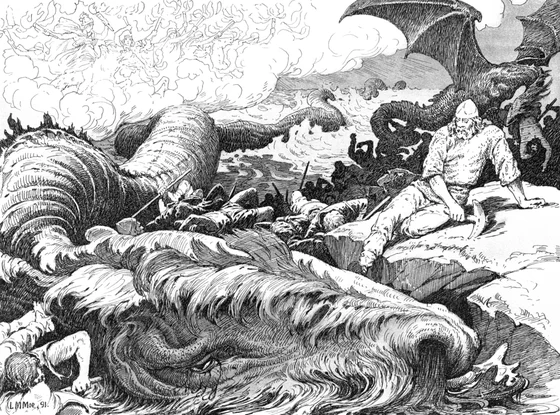
In section LI the released wolf advances with his lower jaw against the earth and upper jaw against heaven; fire blazes from his eyes and nostrils. Odin confronts him while Thor is occupied by the serpent. After Fenrir swallows Odin, Víðarr braces one foot against the lower jaw and pulls the upper jaw apart, killing him. This is the prose narrator’s particular account of the avenging action; its leather shoe and torn jaws should not replace differently described poetic witnesses without a separate citation.
Origins & earliest records
This entry follows Gylfaginning, sections XXXIV; LI, in Snorri Sturluson’s Prose Edda, composed around 1220 and translated here by Arthur Gilchrist Brodeur in 1916. The medieval work incorporates older poetic traditions, but its compilation date does not establish the beginning of a being’s oral history or every earlier attestation.
Records & interpretation
Located Gylfaginning episodes in Arthur Gilchrist Brodeur’s 1916 translation preserve the named being’s actions and the prose narrator’s qualifications. Chapter numbering and printed page references belong to this edition, rather than to every manuscript or modern translation.
In the literature
“Thus he broke loose out of Drome.”
The Fooling of Gylfe, chapter IX, section 35 · Rasmus Björn Anderson
Fenrir breaks the second fetter, before the gods commission Gleipnir.
“The wolf swallows Odin, and thus causes his death;”
The Fooling of Gylfe, chapter XVI, section 56 · Rasmus Björn Anderson
Fenrir’s role at Ragnarök is distinguished from the earlier binding episode.
Selected bibliography
Documented works and useful reading. This is not a list of every appearance.
- 01
Prose Edda: Gylfaginning XXXIV, pp. 42–45; LI, pp. 78–80
Brodeur’s located 1916 prose translation; episode outcomes and explicitly competing fishing accounts retained where applicable.
- 02
The Younger Edda
Chicago: Scott, Foresman and Company, 1901; translation copyright 1879, with translator’s preface dated September 1879.
Family, evolution & connections
Textual genealogy: Loki and Angrboda in Gylfaginning
Three children explicitly named in Gylfaginning chapter XXXIV.
Scroll sideways to see all branches. With a keyboard, focus the tree and use the arrow keys.
- Parents: Loki and Angrboda
- Hel (the named daughter)
Read the named parental pair and its enumerated children in Brodeur's translation. A joint-parent node represents two parents, not a single ancestor. A relationship in this medieval narrative, not a biological phylogeny or a synthesis of every Norse source. Hel is a named figure here, distinct from uses of Hel as a place. Other children of Loki are outside this selected branch.
Jörmungandr
Gylfaginning names Fenrir and Jörmungandr among Loki and Angrboda’s children, alongside Hel. This explicitly connects the wolf and serpent as siblings in that narrative despite their different forms. It is a mythic family relationship, not a claim about biological descent between real wolves and snakes.
Located primary passages
Specific passages supporting details in this entry, grouped by their published witness.
Primary source witness
Chicago: Scott, Foresman and Company, 1901; translation copyright 1879, with translator’s preface dated September 1879.
- Fenrir breaks the second fetter, before the gods commission Gleipnir.
This documents Snorri’s literary account in Anderson’s translation, not zoological existence or a universal account of all Norse traditions.
Primary source witness
Chicago: Scott, Foresman and Company, 1901; translation copyright 1879, with translator’s preface dated September 1879.
- Fenrir’s role at Ragnarök is distinguished from the earlier binding episode.
This documents Snorri’s literary account in Anderson’s translation, not zoological existence or a universal account of all Norse traditions.
Primary source witness
Rasmus Björn Anderson translation, Chicago: Scott, Foresman and Company, 1901; translation copyright 1879.
- The gods send Skirnir to dwarfs in Svartalfheim for Gleipnir.
- Gleipnir tightens under Fenrir’s effort to break it.
- The gods gag the bound wolf with a sword between his jaws.
- Fenrir’s flowing saliva becomes the river Ván.
Version-specific detail in the translated literary narrative; not an earliest-attestation or real-fauna claim.
Primary source witness
Rasmus Björn Anderson translation, Chicago: Scott, Foresman and Company, 1901; translation copyright 1879.
- At Ragnarök the freed wolf’s mouth spans earth and heaven.
Version-specific detail in the translated literary narrative; not an earliest-attestation or real-fauna claim.
Encyclopedia background
An additional attributed reference, separate from the editorial profile above.
Read the open encyclopedia overview
Fenrir (Old Norse 'fen-dweller') or Fenrisúlfr (Old Norse "Fenrir's wolf", often translated "Fenris-wolf"), also referred to as Hróðvitnir (Old Norse "fame-wolf") and Vánagandr (Old Norse 'monster of the [River] Ván'), is a monstrous wolf in Norse mythology. In Old Norse texts, Fenrir plays a key role during the events of Ragnarök, where he is foretold to assist in setting the world aflame, resulting in the collapse of humanity and society, and killing the god Odin.
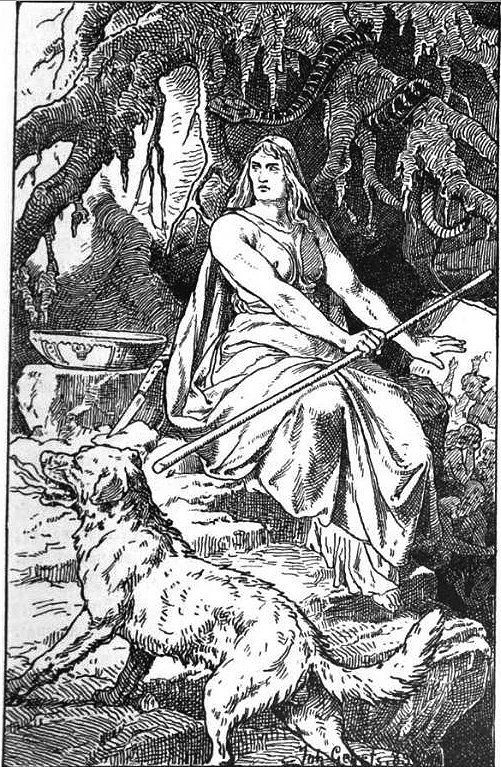
Fenrir, along with Hel and Jörmungandr, is a child of Loki and female jötunn Angrboða. He is attested in the Poetic Edda, compiled in the 13th century from earlier traditional sources, and the Prose Edda and Heimskringla, composed in the 13th century. In both the Poetic Edda and Prose Edda, Fenrir is the father of the wolves Sköll and Hati Hróðvitnisson, is a son of Loki and is foretold to kill the god Odin during the events of Ragnarök, but will in turn be killed by Odin's son Víðarr.
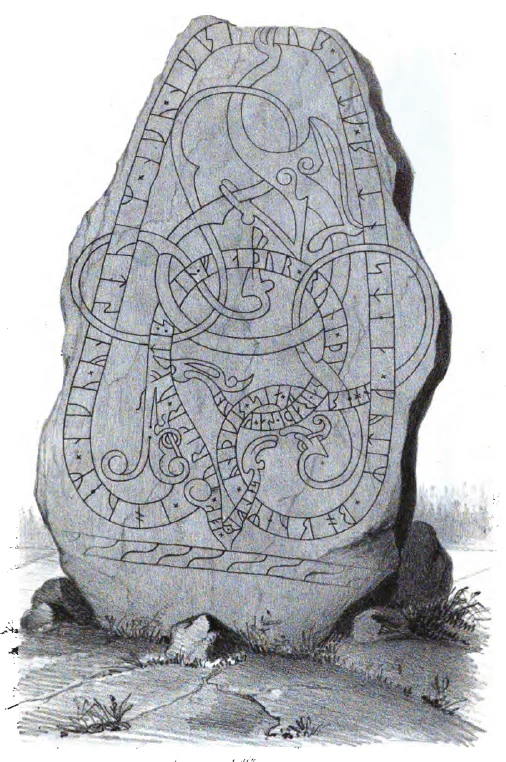
In the Prose Edda, additional information is given about Fenrir, including that, due to the gods' knowledge of prophecies foretelling great trouble from Fenrir and his rapid growth, the gods bound him and as a result Fenrir bit off the right hand of the god Týr. Depictions of Fenrir have been identified on various objects and scholarly theories have been proposed regarding Fenrir's relation to other canine beings in Norse mythology. Fenrir has been the subject of artistic depictions and he appears in literature.
Text from Wikipedia contributors, “Fenrir”. CC BY-SA 4.0. Extracted introduction; formatting changed. Retrieved 5 October 2026. The source article may have changed since retrieval.
References
Sources supporting this profile. Linked pages have their own scope and editorial standards.
- Primary textThe Prose Edda: Gylfaginning XXXIV; LI (Brodeur translation)Research access: 2026-10-05
Image credits
Reference illustrationFenrir
Image associated with the exact linked encyclopedia article; consult credited file description for its interpretation.