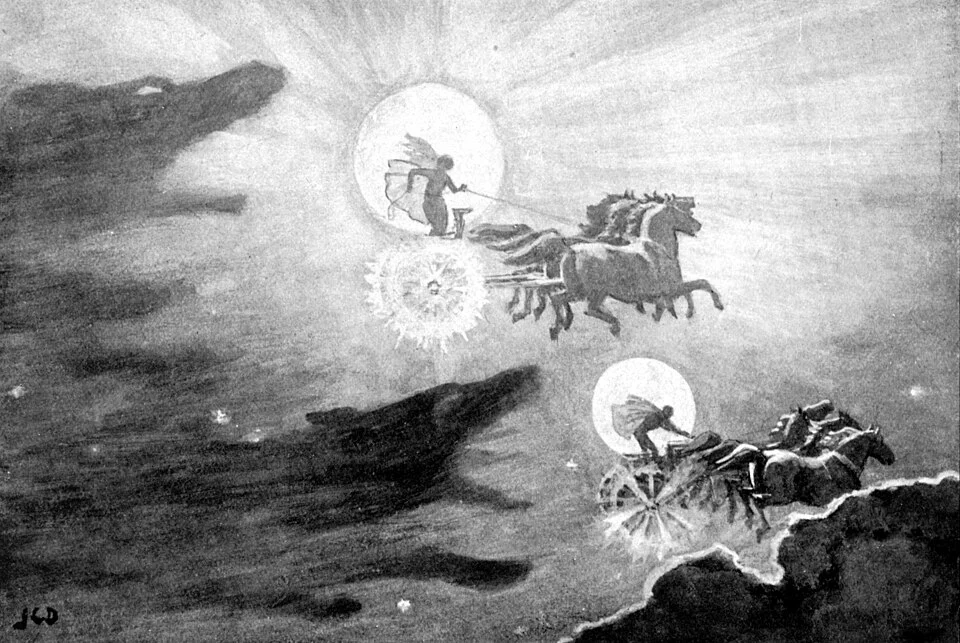
Sköll
Image associated with the exact linked encyclopedia article; consult credited file description for its interpretation.
Overview
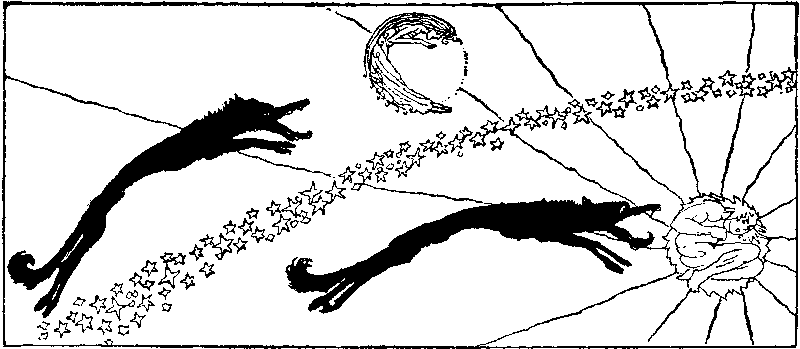
Snorri’s questioner notices that the sun moves as though afraid and asks what threatens her. The answer names Sköll as a wolf following her, with eventual capture predicted. A parallel wolf, Hati Hróðvitnisson, seeks the moon. Their pursuit belongs to an account of the moving heavens and the catastrophe in which their order will fail.
The brief narrative gives Sköll a named position and purpose rather than an independent cycle of adventures. The figure should remain distinct from Fenrir, whose binding and confrontation with Odin form other episodes, even though Eddic wolf identities and poetic names invite scholarly comparison. This entry follows the explicit solar pursuit in Snorri’s prose and does not turn it into a measured astronomical or eclipse theory.
Gylfaginning XII answers a further question about the wolves’ race by placing an old witch and other troll-women in Ironwood east of Midgard. Her many giant sons have wolf shapes, and the account traces the celestial pursuers to that stock. The same discussion then introduces a mightiest member called Moon-Hound, associated with swallowing the moon and bloody darkness. It does not explicitly state that this title is simply another name for Sköll, so those actions are not transferred into his personal biography.
The Lay of Grimnir, verse 39 in Thorpe’s version, separately names Sköll chasing a radiant female deity towards the ocean. Nearby verses describe the horses drawing the sun and its protective shield, situating the chase in a poetic account of the heavens. Brodeur’s Gylfaginning LI predicts a wolf swallowing the sun and another seizing the moon as the stars vanish; neither is named in that sentence. Comparing the passages preserves the named pursuer of XII without claiming every later unnamed wolf must have one settled identity.
Origins & earliest records
Selected witnesses are Snorri Sturluson’s Gylfaginning XII and LI, composed around 1220 and read in Arthur Gilchrist Brodeur’s 1916 translation, and The Lay of Grimnir 37–39 in Benjamin Thorpe’s translation, hosted in the Norrœna Society 1906 edition. These are separate prose and poetic presentations, not dates for the beginning of oral belief.
Records & interpretation
Gylfaginning XII names the pursuers, gives their prose targets and discusses Ironwood wolf stock; LI forecasts celestial destruction using unnamed wolves. The Lay of Grimnir 39 supplies a separate poetic chase and Hati’s patronymic. These literary identities are compared without equating every title or turning the narrative into a measured eclipse theory.
In the literature
“The one hight Skol, he runs after her;”
The Fooling of Gylfe, chapter V, section 12 · Rasmus Björn Anderson
Sköll pursues the sun in the translation’s account; the antecedent “her” is Sun.
Selected bibliography
Documented works and useful reading. This is not a list of every appearance.
- 01
Prose Edda: Gylfaginning, sections XII; LI
Complete Brodeur XII and LI read; XII’s named wolves are distinguished from Moon-Hound and LI’s unnamed catastrophe wolves.
- 02
The Lay of Grimnir, verses 37–39, especially 39
Thorpe’s verse 39 names Sköll and Hati; the bright-maiden wording is not silently rewritten as Snorri’s prose lunar statement.
- 03
The Younger Edda
Chicago: Scott, Foresman and Company, 1901; translation copyright 1879, with translator’s preface dated September 1879.
Family, evolution & connections
Hati Hróðvitnisson
Younger Edda section 12 describes Skol pursuing Sun and Hate trying to catch the moon. It places both within an explanation of Ironwood’s wolf-shaped offspring. This comparison keeps their targets separate and does not equate them with every wolf in the Ragnarok account. Neither the shared pursuit motif nor their common setting supplies a natural wolf species identification.
Located primary passages
Specific passages supporting details in this entry, grouped by their published witness.
Primary source witness
Chicago: Scott, Foresman and Company, 1901; translation copyright 1879, with translator’s preface dated September 1879.
- Sköll pursues the sun in the translation’s account; the antecedent “her” is Sun.
This documents Snorri’s literary account in Anderson’s translation, not zoological existence or a universal account of all Norse traditions.
Primary source witness
Rasmus Björn Anderson translation, Chicago: Scott, Foresman and Company, 1901; translation copyright 1879.
- The prediction says Sköll will eventually overtake the sun.
Version-specific detail in the translated literary narrative; not an earliest-attestation or real-fauna claim.
Encyclopedia background
An additional attributed reference, separate from the editorial profile above.
Read the open encyclopedia overview
In Norse mythology, Sköll, or Skoll (Old Norse: Skǫll), is a wolf that, according to Snorri Sturluson's Prose Edda, chases the Sun (personified as a goddess, Sól) riding her chariot across the sky. Hati Hróðvitnisson chases the Moon (personified, as Máni) during the night. Sköll and Hati are the sons of the wolf Fenrir, and an unnamed giantess. It is foretold the wolves will chase the Sun and Moon across the skies until Ragnarök, at which point the wolves catch up and devour the celestial beings.
Text from Wikipedia contributors, “Sköll”. CC BY-SA 4.0. Extracted introduction; formatting changed. Retrieved 5 October 2026. The source article may have changed since retrieval.
References
Sources supporting this profile. Linked pages have their own scope and editorial standards.
- Primary textThe Prose Edda: Gylfaginning XII; LI (Brodeur translation)Research access: 2026-10-05
- Primary textThorpe: The Lay of Grimnir 37–39, Norrœna 1906Research access: 2026-10-05
Image credits
Reference illustrationSköll
Image associated with the exact linked encyclopedia article; consult credited file description for its interpretation.