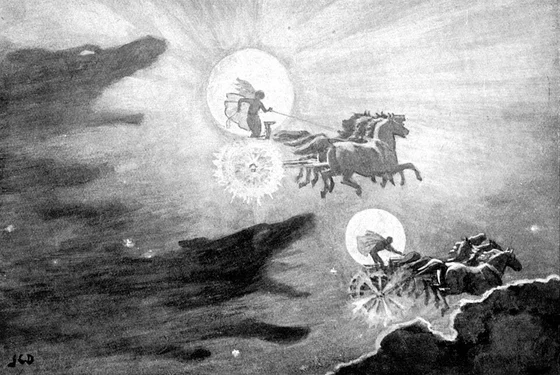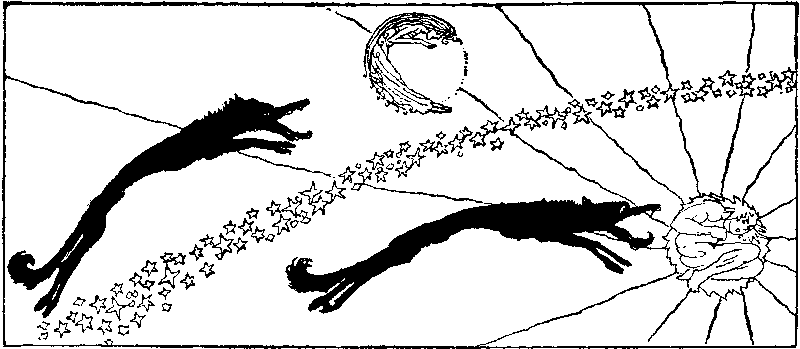
Hati Hróðvitnisson
Image associated with the exact linked encyclopedia article; consult credited file description for its interpretation.
Overview
The Gylfaginning names Hati Hróðvitnisson alongside Sköll but assigns him a different target: he seeks to seize the moon. The passage places the wolves within a larger explanation of the heavens, their motion and their eventual destruction. His name and role give him an identity beyond an interchangeable image of a ravenous wolf.
Sköll’s pursuit of the sun offers a useful comparison, but it should not erase the separate target given to Hati in the selected prose account. Broader Eddic discussions of wolf parentage and celestial destruction require attention to individual poetic witnesses. The short passage does not provide a detailed personal history or ordinary habitat. A profile should preserve that limitation instead of expanding a few narrated actions into unsupported behavior.
Thorpe’s Lay of Grimnir, verse 39, gives Hati the patronymic son of Hrôdvitnir and places him before a bright celestial maiden. That poetic wording is less explicit about the lunar target than Brodeur’s prose statement in Gylfaginning XII. The two witnesses should therefore remain visible rather than rewriting the verse to reproduce Snorri’s exact assignment. The patronymic establishes a named paternal reference in this translation; this profile does not silently identify that father with another wolf under a different name.
Gylfaginning XII also traces the pursuing wolves to the wolf-shaped giant stock of an Ironwood witch and introduces a strongest member called Moon-Hound. The prose does not explicitly equate that member with Hati, despite their shared lunar association. In LI, an unnamed second wolf seizes the moon after another swallows the sun, and the stars vanish. That catastrophe supplies the larger outcome of the heavenly pursuit, but no death scene, ordinary den or full separate adventure-cycle for the named Hati.
Origins & earliest records
Selected witnesses are Snorri Sturluson’s Gylfaginning XII and LI, composed around 1220 and read in Arthur Gilchrist Brodeur’s 1916 translation, and The Lay of Grimnir 37–39 in Benjamin Thorpe’s translation, hosted in the Norrœna Society 1906 edition. These are separate prose and poetic presentations, not dates for the beginning of oral belief.
Records & interpretation
Gylfaginning XII names the pursuers, gives their prose targets and discusses Ironwood wolf stock; LI forecasts celestial destruction using unnamed wolves. The Lay of Grimnir 39 supplies a separate poetic chase and Hati’s patronymic. These literary identities are compared without equating every title or turning the narrative into a measured eclipse theory.
In the literature
“The other hight Hate, Hrodvitner’s son; he bounds before her and wants to catch the moon,”
The Fooling of Gylfe, chapter V, section 12 · Rasmus Björn Anderson
Hati’s pursuit of the moon is explicit; preserve the translator’s phrasing of “before her”.
Selected bibliography
Documented works and useful reading. This is not a list of every appearance.
- 01
Prose Edda: Gylfaginning, sections XII; LI
Complete Brodeur XII and LI read; XII’s named wolves are distinguished from Moon-Hound and LI’s unnamed catastrophe wolves.
- 02
The Lay of Grimnir, verses 37–39, especially 39
Thorpe’s verse 39 names Sköll and Hati; the bright-maiden wording is not silently rewritten as Snorri’s prose lunar statement.
- 03
The Younger Edda
Chicago: Scott, Foresman and Company, 1901; translation copyright 1879, with translator’s preface dated September 1879.
Family, evolution & connections
The unnamed hag of Ironwood
Younger Edda section 12 asks whose offspring the pursuing wolves are and answers with an unnamed hag in Ironwood who bears giant sons in wolf form. Hate is separately called Hrodvitner’s son. This records the maternal origin stated in this selected explanation; the hag is not assigned a personal name, and the father’s epithet is not expanded through an unstated identification.
Located primary passages
Specific passages supporting details in this entry, grouped by their published witness.
Primary source witness
Chicago: Scott, Foresman and Company, 1901; translation copyright 1879, with translator’s preface dated September 1879.
- Hati’s pursuit of the moon is explicit; preserve the translator’s phrasing of “before her”.
This documents Snorri’s literary account in Anderson’s translation, not zoological existence or a universal account of all Norse traditions.
Primary source witness
Rasmus Björn Anderson translation, Chicago: Scott, Foresman and Company, 1901; translation copyright 1879.
- The prediction that Hati wants the moon is followed by the statement that he will obtain it.
Version-specific detail in the translated literary narrative; not an earliest-attestation or real-fauna claim.
Encyclopedia background
An additional attributed reference, separate from the editorial profile above.
Read the open encyclopedia overview
In Norse mythology, Hati Hróðvitnisson (first name meaning "He Who Hates", or "Enemy") is a wolf that, according to Snorri Sturluson's Prose Edda, chases Máni, the Moon, across the night sky, just as the wolf Sköll chases Sól, the Sun, during the day, until the time of Ragnarök, when they will swallow these heavenly bodies. Snorri also gives another name for a wolf who swallows the Moon, Mánagarmr ([ˈmɑːnɑˌɡɑrmz̠], "Moon-Hound", or "Moon's Dog").
Hati's patronymic Hróðvitnisson, attested in both the Eddic poem "Grímnismál" and the Gylfaginning section of the Prose Edda, indicates that he is the son of Fenrir, for whom Hróðvitnir ("Famous Wolf") is an alternate name. According to Snorri, Hati's mother is the giantess, not named but mentioned in the Eddic poem "Völuspá", who dwells to the east of Midgard in the forest of Járnviðr ("Ironwood") and "fosters Fenrir's kin". Snorri states that this giantess and witch bears many giants for sons, all in the form of wolves, including Hati and Sköll, who is thus implied to be Hati's brother. In two verses of "Völuspá" that Snorri cites, an unnamed son of this giantess is prophesied to snatch the Moon, and also eat the flesh of the dead, spattering the heavens with blood. In contrast the Eddic poem "Vafþrúðnismál" states that Fenrir himself will destroy the sun.
Text from Wikipedia contributors, “Hati Hróðvitnisson”. CC BY-SA 4.0. Extracted introduction; formatting changed. Retrieved 5 October 2026. The source article may have changed since retrieval.
References
Sources supporting this profile. Linked pages have their own scope and editorial standards.
- Primary textThe Prose Edda: Gylfaginning XII; LI (Brodeur translation)Research access: 2026-10-05
- Primary textThorpe: The Lay of Grimnir 37–39, Norrœna 1906Research access: 2026-10-05
Image credits
Reference illustrationHati Hróðvitnisson
Image associated with the exact linked encyclopedia article; consult credited file description for its interpretation.