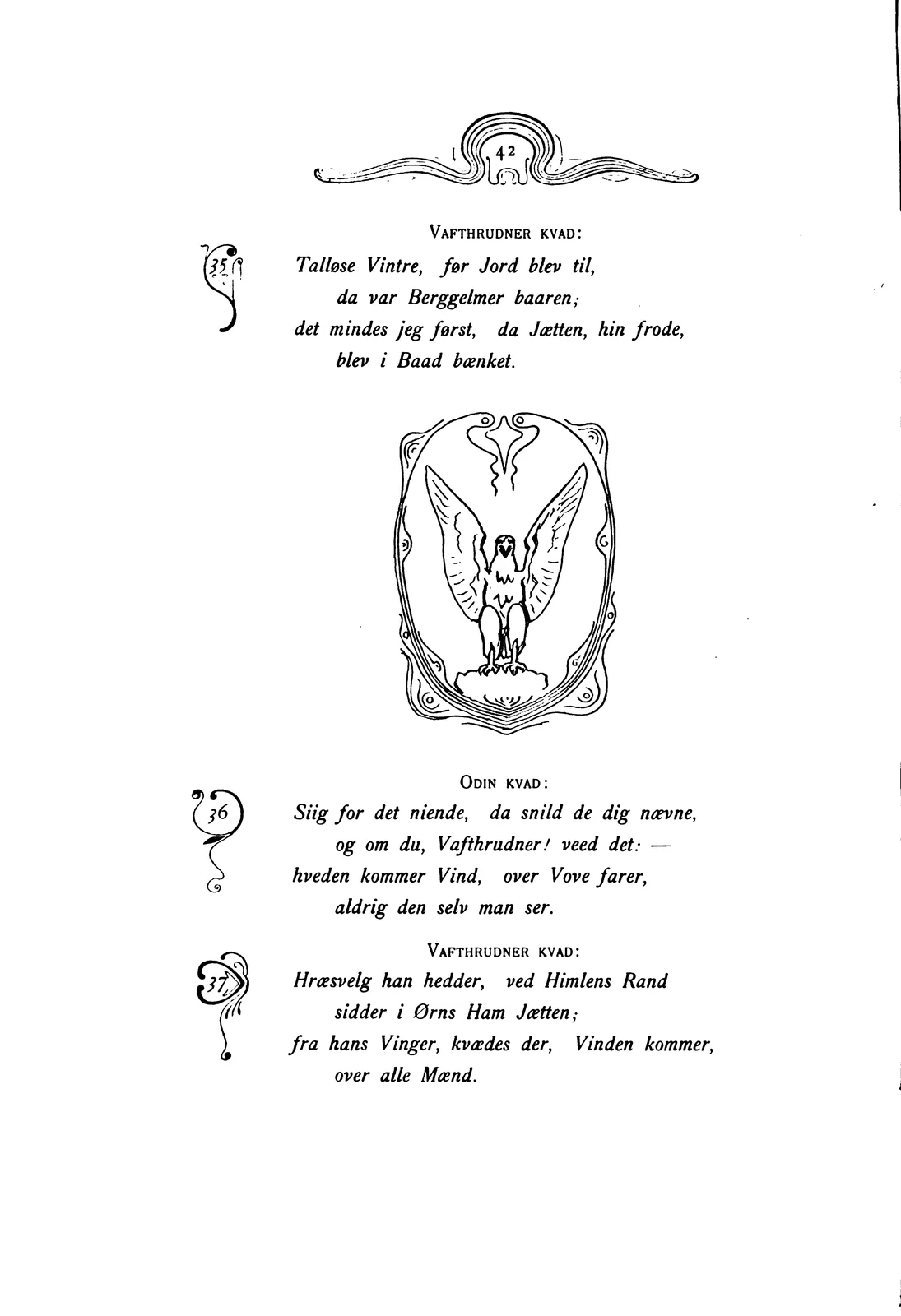
Frølich’s eagle-formed Hræsvelgr beside Vafþrúðnismál verse 37, 1895
Frølich places an eagle with raised wings beside the verses describing Hræsvelgr at heaven’s edge and the wind produced by his wings. The ornamental frame and frontal pose belong to this 1895 representation; this named wind-giant is distinct from the unnamed eagle in Yggdrasill.
Overview
The Gylfaginning answers a question about the origin of wind by locating an extraordinary being at heaven’s northern edge. Hræsvelgr is called a giant with eagle plumage; when he moves his wings, air passes outward over people. The passage turns an invisible force into the consequence of a visible bodily movement at a cosmic location.
Snorri also cites verse to support the explanation, showing how prose teaching incorporates older poetic material. The account does not identify Hræsvelgr as the unnamed eagle sitting in Yggdrasill, so those figures should remain distinct unless another source explicitly connects them. An eagle-shaped giant at the edge of heaven is a narrative explanation of wind, not an ancient measurement or a zoological classification of an enormous bird.
The poetic exchange is specifically located in Vafthrudnismal, stanzas 36–37. Gagnrad asks where the wind comes from as it crosses the ocean invisibly; Vafthrudnir answers by naming Hraesvelg, a giant in eagle plumage seated at heaven’s end. Thorpe’s wording does not specify a northern direction. Brodeur’s prose translation supplies that direction and makes the action more explicit: stretching the wings for flight produces wind beneath them.
The prose question also singles out wind’s ability to stir great seas and swell fire despite remaining unseen. Its answer therefore links an invisible, powerful environmental force to an eagle-formed giant’s movement. This is a comparison of the located poetic answer and Snorri’s teaching dialogue, rather than evidence that the giant sits on Yggdrasill or participates in a narrated battle.
Origins & earliest records
This entry follows Gylfaginning, sections XVIII, in Snorri Sturluson’s Prose Edda, composed around 1220 and translated here by Arthur Gilchrist Brodeur in 1916. The medieval work incorporates older poetic traditions, but its compilation date does not establish the beginning of a being’s oral history or every earlier attestation.
Records & interpretation
Vafthrudnismal 36–37 preserves the question and named poetic answer; Gylfaginning XVIII expands the explanation in prose and quotes verse. Their wording documents a literary account of wind and a later prose presentation, not a zoological observation.
In the literature
“when he spreads his wings for flight, the winds arise from under them.”
The Fooling of Gylfe, chapter VII, section 18 · Rasmus Björn Anderson
Hræsvelgr is a giant clothed in eagle feathers, whose wings produce winds.
Selected bibliography
Documented works and useful reading. This is not a list of every appearance.
- 01
Prose Edda: Gylfaginning, sections XVIII
Selected public-domain prose witness. Numbering follows the linked Brodeur translation; neither a universal canon nor an exhaustive bibliography.
- 02
Vafthrudnismal, The Lay of Vafthrudnir, stanzas 36–37
Question about invisible wind over the ocean and answer naming the eagle-plumed giant. Northern direction is supplied in the separate Brodeur prose XVIII, not Thorpe’s poetic wording.
- 03
The Younger Edda
Chicago: Scott, Foresman and Company, 1901; translation copyright 1879, with translator’s preface dated September 1879.
Family, evolution & connections
Eagles
Gylfaginning describes Hræsvelgr as a giant in eagle form whose wings produce wind. Real eagles provide an avian comparison, but the cosmological explanation is not a weather mechanism or a zoological record. The connection does not assign the giant to a living eagle species or infer a shared origin for all wind myths.
Located primary passages
Specific passages supporting details in this entry, grouped by their published witness.
Primary source witness
Chicago: Scott, Foresman and Company, 1901; translation copyright 1879, with translator’s preface dated September 1879.
- Hræsvelgr is a giant clothed in eagle feathers, whose wings produce winds.
This documents Snorri’s literary account in Anderson’s translation, not zoological existence or a universal account of all Norse traditions.
Primary source witness
Rasmus Björn Anderson translation, Chicago: Scott, Foresman and Company, 1901; translation copyright 1879.
- Hræsvelgr is situated at the northern end of heaven.
- The narrative calls Hræsvelgr a giant clothed in eagle feathers.
Version-specific detail in the translated literary narrative; not an earliest-attestation or real-fauna claim.
Encyclopedia background
An additional attributed reference, separate from the editorial profile above.
Read the open encyclopedia overview
Hræsvelgr (Old Norse) is a jötunn in the form of an eagle in Norse mythology. He sits at the northern edge of the heavens, and all the winds are created by him flapping his wings.
Text from Wikipedia contributors, “Hræsvelgr”. CC BY-SA 4.0. Extracted introduction; formatting changed. Retrieved 5 October 2026. The source article may have changed since retrieval.
References
Sources supporting this profile. Linked pages have their own scope and editorial standards.
- Primary textThe Prose Edda: Gylfaginning XVIII (Brodeur translation)Research access: 2026-10-05
- Primary poem in historical translationThe Elder Eddas: Thorpe’s Vafthrudnir translation, 1906 collected editionResearch access: 2026-10-05
Image credits
Historical illustrationFrølich’s eagle-formed Hræsvelgr beside Vafþrúðnismál verse 37, 1895
Frølich places an eagle with raised wings beside the verses describing Hræsvelgr at heaven’s edge and the wind produced by his wings. The ornamental frame and frontal pose belong to this 1895 representation; this named wind-giant is distinct from the unnamed eagle in Yggdrasill.