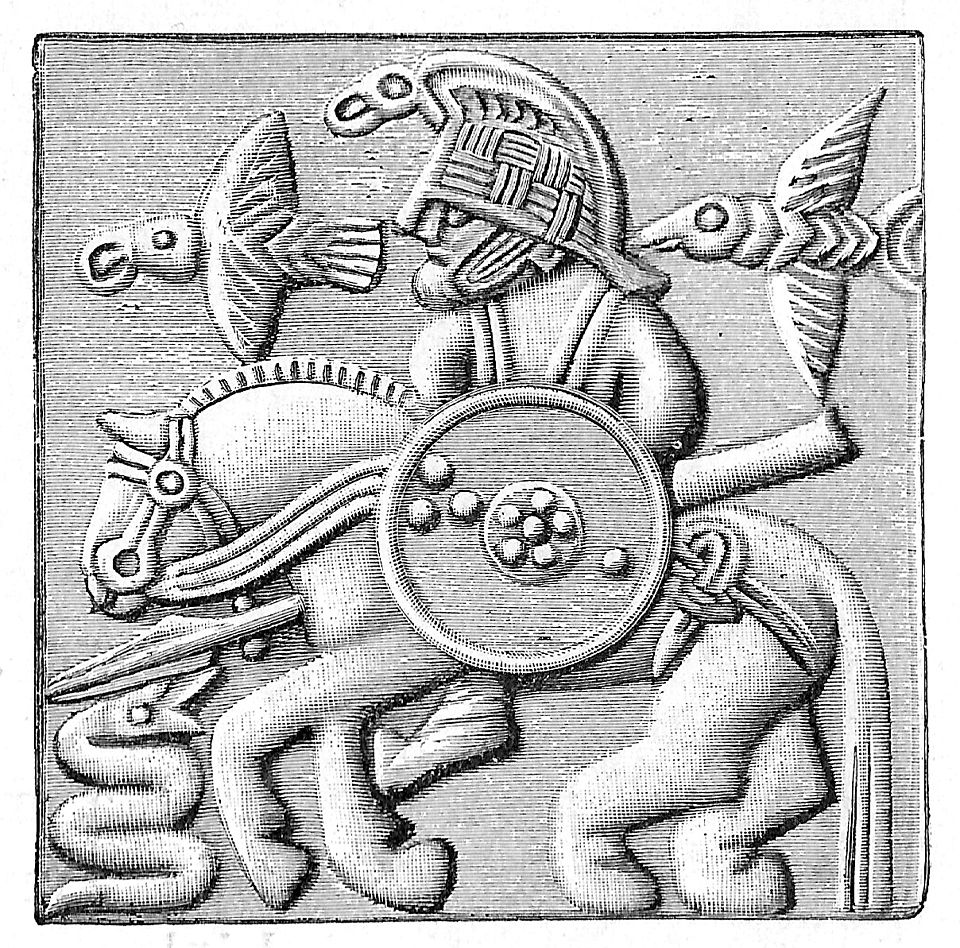
Huginn and Muninn
Image associated with the exact linked encyclopedia article; consult credited file description for its interpretation.
Overview
Huginn and Muninn are Odin’s pair of travelling ravens. In Anderson’s translation of Gylfaginning, they sit on his shoulders and bring to his ears what they have heard and seen. Odin sends them across the world at dawn and they return at breakfast time in this translation. Their journeys explain how information reaches him from beyond the place where he is seated; the passage also associates them with his title of raven-god.
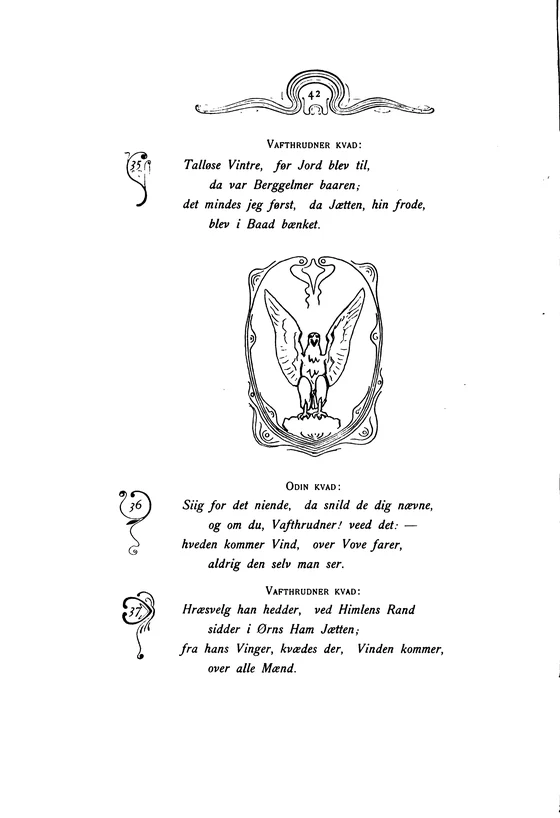
The prose immediately quotes a verse expressing Odin’s anxiety: Huginn may not come back, and his concern for Muninn is greater still. The corresponding stanza 20 of Grímnismál, read in Thorpe’s translation, likewise describes their daily flight and the unequal worry for their return. Neither inspected passage tells a story in which one raven actually fails to return. The expressed fear should not be converted into an invented episode of disappearance or death.
The complete poem gives this statement a particular dramatic setting. Odin, travelling under the name Grímnir, has been placed between fires by King Geirröd. The king’s young son Agnar offers him a drink, and the long speech ranges through the dwellings, creatures and names of the gods before the speaker reveals himself. The ravens’ stanza belongs within that speech. The poem’s king is not automatically identical with the giant Geirröd who appears in another Norse narrative.
The glossary in the inspected 1906 collection connects Huginn with hugr, giving a range including spirit, thought and mind, and explains Muninn through mind, memory and recollection. The familiar Thought and Memory renderings are therefore interpretations of the names, not two independently narrated powers or proof that the birds are literal pieces of Odin’s body. The selected accounts assign their travels and reporting to the pair jointly, while distinguishing the degree of concern expressed about each.
These witnesses give the birds named roles, a daily routine and a relationship with Odin, but no parents, offspring or separate life histories. Connections to other raven traditions or modern fictional pairs require their own evidence; visual resemblance alone cannot establish a shared origin or a documented influence.
Origins & earliest records
The inspected prose is Anderson’s The Fooling of Gylfe XII, paragraph 39, p. 105, in the 1901 edition. The separately inspected poem is Grímnismál 20 in Thorpe’s translation as printed by the Norrœna Society in 1906. The glossary belongs to that collected edition and is identified as such, rather than attributed to the medieval verse.
Records & interpretation
Complete Anderson Life in Valhal chapter and complete Thorpe Lay of Grimnir, including prose framing, ending and notes, read. Glossary entries Hugi/Huginn and Muninn checked. These are literary and lexical witnesses; no particular archaeological raven image has been identified through them.
In the literature
“Two ravens sit on Odin’s shoulders, and bring to his ears all that they hear and see.”
The Fooling of Gylfe, chapter XII, section 39, paragraph beginning “Two ravens…” · Rasmus Björn Anderson
Huginn and Muninn bring Odin information after their flights.
Selected bibliography
Documented works and useful reading. This is not a list of every appearance.
- 01
The Younger Edda: The Fooling of Gylfe
Chapter XII, Life in Valhal, paragraph 39, p. 105; complete chapter read.
- 02
The Lay of Grimnir (Grímnismál), in The Elder Eddas
Stanza 20, p. 21, with complete prose frame and poem. The same collected volume’s glossary entries Hugi/Huginn and Muninn were checked separately.
- 03
The Younger Edda
Chicago: Scott, Foresman and Company, 1901; translation copyright 1879, with translator’s preface dated September 1879.
Family, evolution & connections
Odin
Gylfaginning describes Huginn and Muninn leaving at daybreak, travelling through the world and reporting what they see or hear into Odin’s ears. Their relation is one of information gathering and companionship. This is directly attested narrative behavior, rather than an assertion that ordinary ravens can deliver universal knowledge or human speech.
Located primary passages
Specific passages supporting details in this entry, grouped by their published witness.
Primary source witness
Chicago: Scott, Foresman and Company, 1901; translation copyright 1879, with translator’s preface dated September 1879.
- Huginn and Muninn bring Odin information after their flights.
The Fooling of Gylfe, chapter XII, section 39, paragraph beginning “Two ravens…”
This documents Snorri’s literary account in Anderson’s translation, not zoological existence or a universal account of all Norse traditions.
Primary source witness
Rasmus Björn Anderson translation, Chicago: Scott, Foresman and Company, 1901; translation copyright 1879.
- Odin dispatches the two ravens at dawn.
- The ravens return at breakfast after their morning flight.
Version-specific detail in the translated literary narrative; not an earliest-attestation or real-fauna claim.
Encyclopedia background
An additional attributed reference, separate from the editorial profile above.
Read the open encyclopedia overview
In Norse mythology, Huginn and Muninn (sometimes anglicized as Hugin and Munin; or ; roughly "mind and will" – see § Etymology) are a pair of ravens that serve under the god Odin, flying around the world (Midgard) and bringing him information and gossip. Huginn and Muninn are attested in the Poetic Edda, compiled in the 13th century from earlier traditional sources: the Prose Edda and Heimskringla; in the Third Grammatical Treatise, compiled in the 13th century by Óláfr Þórðarson; and in the poetry of skalds.
In the Poetic Edda, a disguised Odin expresses that he fears the ravens may not return from their daily flights. The Prose Edda explains that Odin is referred to as Hrafnaguð (Old Norse: [ˈhrɑvnɑˌɡuð]; "raven-god") due to his association with Huginn and Muninn. In the Prose Edda and the Third Grammatical Treatise, the two ravens are described as perching on Odin's shoulders. Heimskringla details that Odin gave Huginn and Muninn the ability to speak.
Examples of artifacts that may depict Odin with one of the ravens include Migration Period golden bracteates, Vendel era helmet plates, a pair of identical Germanic Iron Age bird-shaped brooches, Viking Age objects depicting a moustached man wearing a helmet, and a portion of the 10th or 11th century Thorwald's Cross. Huginn and Muninn's role as Odin's messengers has been linked to shamanic practices, the Norse raven banner, general raven symbolism among the Germanic peoples, and the Norse concepts of the fylgja and the hamingja.
Text from Wikipedia contributors, “Huginn and Muninn”. CC BY-SA 4.0. Extracted introduction; formatting changed. Retrieved 5 October 2026. The source article may have changed since retrieval.
References
Sources supporting this profile. Linked pages have their own scope and editorial standards.
- Primary textAnderson, The Younger Edda, p. 105Research access: 2026-10-05
- Primary textThorpe, Grímnismál 20 and 1906 volume glossaryResearch access: 2026-10-05
Image credits
Reference illustrationHuginn and Muninn
Image associated with the exact linked encyclopedia article; consult credited file description for its interpretation.