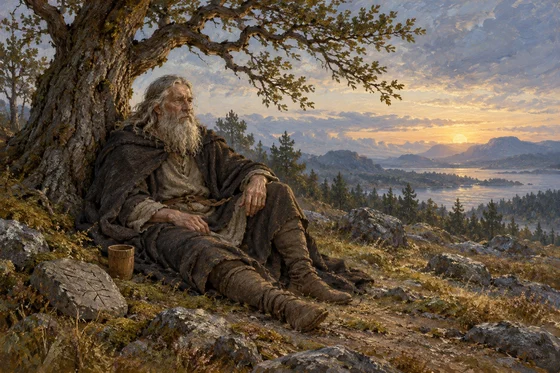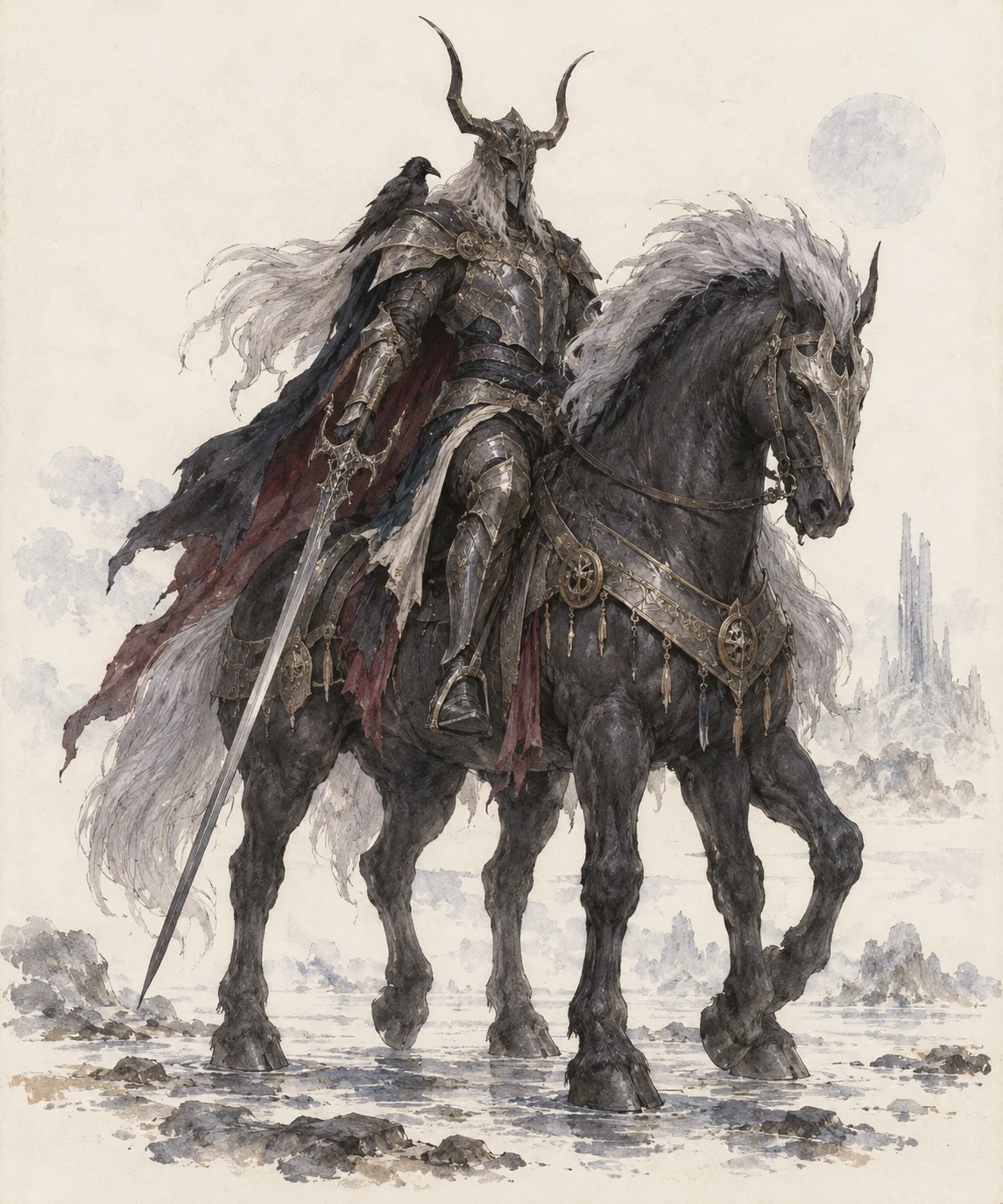
Odin (Final Fantasy) - original unofficial interpretation.
AI-generated unofficial interpretation; unspecified appearance and scenery are imagined. No publisher approval or endorsement.
Overview
Odin appears with Sleipnir and Zantetsuken, but the mounted warrior is not one traveler moving through every numbered world. In III, defeating him in Saronia’s catacombs earns his assistance as a summon. VII depicts a solitary swordsman riding a six-legged Sleipnir: enemies vulnerable to instant defeat face Zantetsuken, while death-resistant opponents receive Gunge Lance. The alternative attack is an important limit on the familiar image of a sword that ends every encounter.
VIII makes Odin an unpredictable ally rather than a Guardian Force selected from the normal battle menu. Acquisition involves the timed Centra Ruins challenge; once recruited, he may arrive at a battle’s opening without an order from the player. If obtained before the relevant Lunatic Pandora confrontation, he attacks Seifer, who counters and kills him. Gilgamesh subsequently replaces that battle presence. This is a particular narrative and system transition, not a universal account of Odin’s mortality or an upgrade that happens in every installment.
XVI gives the name to Barnabas Tharmr’s Eikon. Barnabas rules Waloed in eastern Ash, and his manifestation preserves the armored rider and dark steed while adding enormous magical barriers to the presentation. Human Dominant, summoned ally and optional opponent are different roles; none establishes that the Norse god and these fictional figures share a canon biography.
Tanaka’s retrospective identifies Odin as III’s first developed summon, based visually on an existing Amano horseman illustration. Rad Racer scanline-scrolling experience helped make enemies appear sliced. This is development testimony, not the rider’s fictional history; Tanaka could not recall why Zantetsuken was chosen.
First appearances & development
Odin debuted as a Final Fantasy summon in the original Japanese Final Fantasy III in 1990. Later numbered games retain the name and mounted silhouette while independently rebuilding the encounter, narrative and rules. The franchise’s supernatural rider is distinct from the Norse deity.
Canon & continuity
Square Enix’s horse-themed retrospective supplies the III, VII and XVI comparisons. Tanaka’s interview documents development rather than fictional ancestry. The VIII-specific reference distinguishes recruitment, random intervention and Seifer’s counterattack; those scene and combat accounts are reference-mediated rather than a newly viewed playthrough.
Selected bibliography
Documented works and useful reading. This is not a list of every appearance.
- 01
Final Fantasy III
Original Japanese release; Saronia opponent and recruitable summon.
- 02
Final Fantasy VII
Odin materia; Zantetsuken and the death-resistant-target lance alternative.
- 03
Final Fantasy VIII
Centra Ruins recruitment, uncontrolled intervention and Seifer/Gilgamesh transition.
- 04
Final Fantasy XVI
Barnabas, Waloed and the Odin Eikon.
Family, evolution & connections
Odin in Snorri’s Gylfaginning
Square Enix names Odin as Barnabas’s Eikon and describes a spectral steed and black blade. Snorri’s Odin belongs to a broader Norse cosmology with different relationships and attributes. The shared divine name is clear, but the comparison should not collapse game continuity into medieval tradition or claim an unlocated creator explanation.
Yoshitaka Amano’s pre-existing horse-rider illustration
Hiromichi Tanaka identifies an existing Amano image of a mounted man as the visual starting point. He does not remember why the team chose Zantetsuken rather than a spear.
Rad Racer’s scanline scrolling technique
Tanaka links Odin’s screen-splitting attack to scanline scrolling previously used for Rad Racer’s turning road. This is technical animation reuse in FFIII, not fictional ancestry or a later summon’s origin.
Odin in the Rune-Song (Thorpe rendering)
Thorpe’s Rune-Song presents Odin through an ordeal, rune learning, further songs and the growth of knowledge. Final Fantasy’s separately documented Odin is a mounted supernatural figure whose role varies between games. The shared name supports a historical comparison; the poem does not supply Zantetsuken, game mechanics or a common biography, and there is no evidence here that the designers consulted this translation.
Odin’s contest with Vafthrudnir (Thorpe)
In Thorpe’s complete Lay of Vafthrudnir, Odin enters a giant’s hall as Gagnrad and wins a head-staked contest through a question about private words to his son. This particular religious poem provides historical context beside Final Fantasy’s separate use of the name Odin. It does not give the game figure the poem’s biography, cosmology or fate, or establish that its designers consulted Thorpe.
References
Sources supporting this profile. Linked pages have their own scope and editorial standards.
- ReferenceOdin (Final Fantasy) — reference guideResearch access: 2026-10-05
- OfficialFF Weekly: Horse Day, OdinResearch access: 2026-10-05
- OfficialFinal Fantasy III anniversary interview, Vol. 1Research access: 2026-10-05
- ReferenceOdin in Final Fantasy VIIIResearch access: 2026-10-05
Image credits
Original modern interpretation of the cited accountOdin (Final Fantasy) - original unofficial interpretation.
AI-generated unofficial interpretation; unspecified appearance and scenery are imagined. No publisher approval or endorsement.