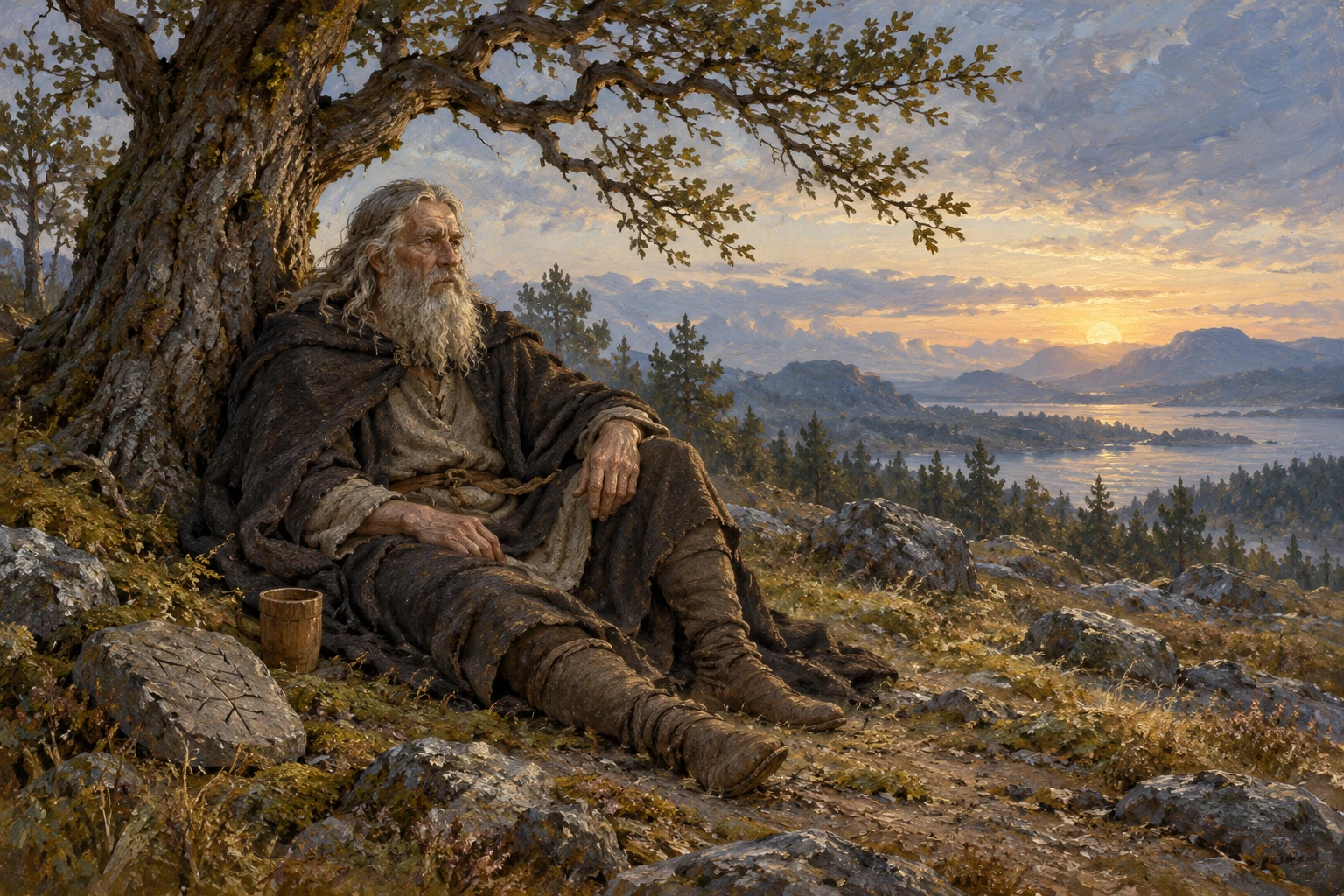
AI-generated symbolic interpretation of the knowledge gained in Thorpe’s Rune-Song. The resting pose, face, clothes, cup, marks and landscape are imagined, not a literal scene described by the poem. The selected text leaves the tree unnamed. No game design or universal ritual practice is represented.
The image evokes the passage’s movement from hardship to knowledge and renewed growth; it does not reconstruct the ordeal or depict an actual historical practice.
Overview
The section headed Odin’s Rune-Song in Benjamin Thorpe’s English Elder Edda presents a first-person account of suffering followed by the acquisition of knowledge. In the retained 1906 collected edition, its speaker says that he hung for nine nights on a wind-rocked tree, wounded and offered to Odin, himself to himself. The tree is not named in these stanzas: its root is described as unknown. Identifying it here as Yggdrasil would add information not supplied by this selected witness.
No one gives the speaker bread or drink. He looks downward, learns the runes with a cry and falls from the tree. The passage then turns to further acquisition: he learns nine potent songs from the famous son of Bolthorn, Bestla’s father, and receives a draught from Odhrærir. That teacher is not personally named in the stanza. The speaker begins to flourish and gain knowledge, pursuing words through words and facts through facts. This movement from deprivation to learning and renewed growth forms the outcome of the opening ordeal.
The following stanzas extend the account into a repertoire of rune knowledge and songs. They distinguish divine and other makers of characters, ask about their understanding and use, and warn against excessive offering. Eighteen numbered songs are then claimed. Their attributed effects include help in distress, restraint of enemies, escape from bonds, protection from weapons or fire, calming hostility and sea, and communication with a dead person. Other songs concern divine distinctions and desire; the last is deliberately withheld from most listeners. The poem lists claimed capabilities without supplying complete practical procedures or making each one a property of every Norse god.
The closing stanza addresses those who sing, know and hear the songs, marking the end of this selected composition. Thorpe’s accompanying note 24 admits difficulty interpreting the opening eight stanzas and proposes a possible connection with sacrificial groves and a lost legend. Those are the translator’s nineteenth-century suggestions, not demonstrated explanations of the poem’s origin. Notes 25–27 offer further glosses and comparisons. This account remains distinct from Odin’s well-eye pledge, the theft of the mead and a modern game’s mounted fighter. No creator consultation, shared game powers or complete account of historical religious practice is established.
Origins & earliest records
The selected English witness is printed in the 1906 Norroena Society collected edition. Its title and stanza numbering identify the passage as Odin’s Rune-Song 140–166. This dates the inspected edition rather than the beginning of oral transmission. No Old Norse manuscript collation or original composition date is established here.
Records & interpretation
Complete titled Rune-Song 140–166 and all four attached notes 24–27 read from retained source. The first-person narrative, repertoire and closing address were not truncated at the hanging scene. Translator speculation remains explicitly attributed.
Selected bibliography
Documented works and useful reading. This is not a list of every appearance.
- 01
The Elder Eddas of Saemund Sigfusson; and the Younger Eddas of Snorre Sturleson
Norroena Society 1906 title metadata retained; Odin’s Rune-Song 140–166, printed pp.44–48, notes 24–27. Blackwell’s Younger Edda translation is a separate component.
Family, evolution & connections
Odin (Final Fantasy)
Thorpe’s Rune-Song presents Odin through an ordeal, rune learning, further songs and the growth of knowledge. Final Fantasy’s separately documented Odin is a mounted supernatural figure whose role varies between games. The shared name supports a historical comparison; the poem does not supply Zantetsuken, game mechanics or a common biography, and there is no evidence here that the designers consulted this translation.
Odin (Snorri’s selected account)
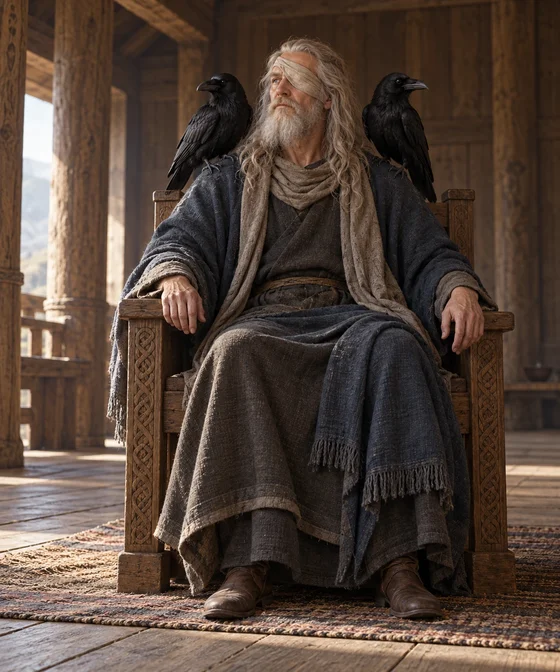
These are distinct selected literary accounts of Odin. Thorpe’s Rune-Song moves from an ordeal on an unnamed tree to learning and a repertoire of songs. Anderson’s selected Gylfaginning passages describe the eye pledge at Mimer’s well, Sleipner, wolves and reporting ravens. Neither account is a complete inventory of Odin traditions; differences should not be silently combined into one episode.
References
Sources supporting this profile. Linked pages have their own scope and editorial standards.
- Historical English poetic translation with translator notesThorpe, Odin’s Rune-Song 140–166 and notes 24–27, PG 14726Research access: 2026-10-26
Image credits
Modern interpretation of a historical literary accountAI-generated symbolic interpretation of the knowledge gained in Thorpe’s Rune-Song. The resting pose, face, clothes, cup, marks and landscape are imagined, not a literal scene described by the poem. The selected text leaves the tree unnamed. No game design or universal ritual practice is represented.
The image evokes the passage’s movement from hardship to knowledge and renewed growth; it does not reconstruct the ordeal or depict an actual historical practice.