
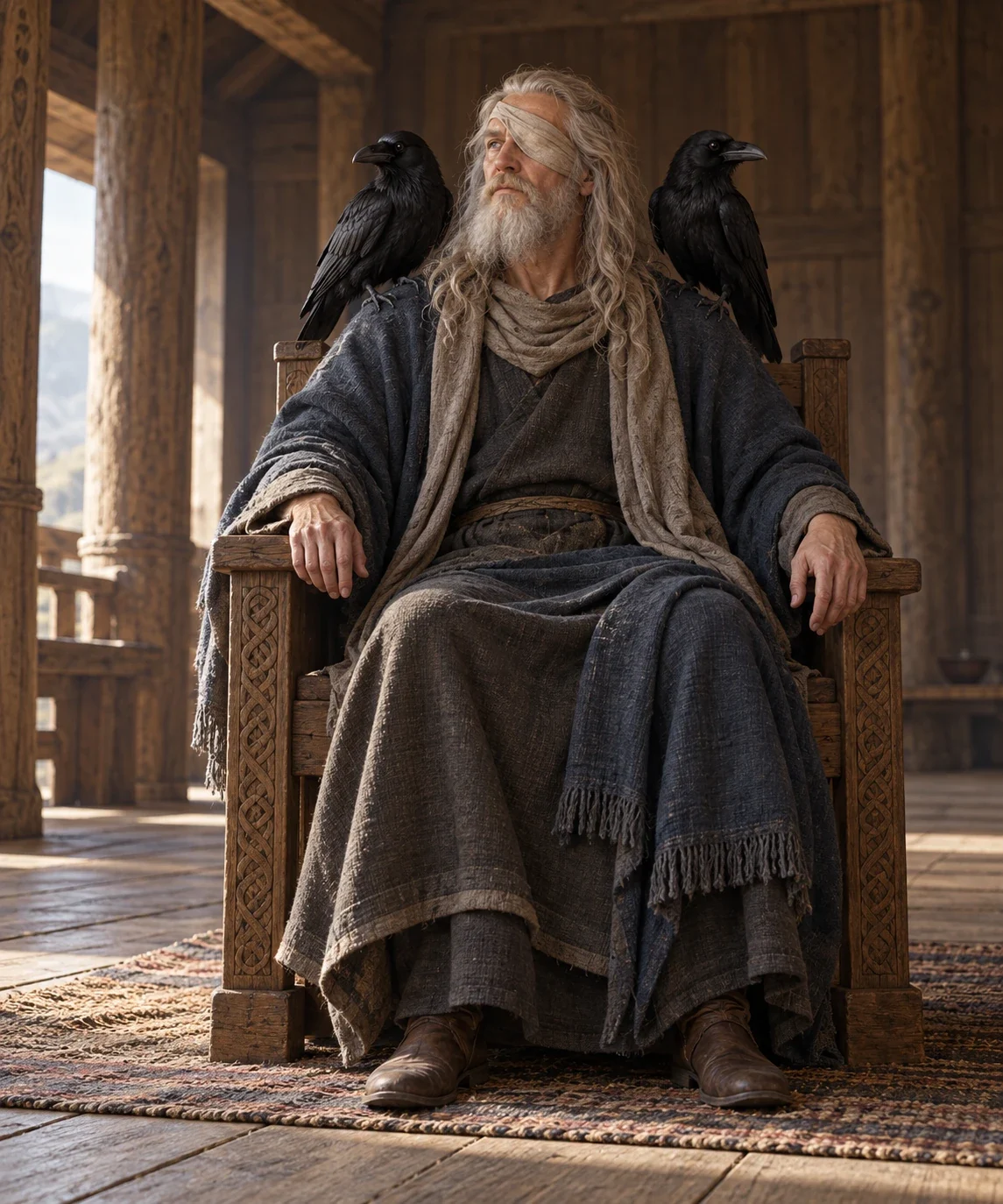
AI-generated artistic interpretation of Odin with his reporting ravens in Snorri’s account; appearance, eye covering and setting are imagined.
Face, age, robe, chair, eye covering, hall and furnishings are artistic inventions. This is a respectful imagined literary portrait, not an authenticated historical costume or reconstruction of contemporary religious practice. No historical source image or game artwork used.
Overview
Odin is presented in Snorri’s Gylfaginning through a conversation about divine knowledge and the ordering of the world. In Rasmus B. Anderson’s selected English version, the disguised King Gylfe calls himself Ganglere and questions three enthroned speakers. Their account describes Odin as the highest and oldest of the asas, with Frigg as his wife. The names Alfather and Valfather express different aspects of his position: the latter connects him with those who fall in battle and receive a place in Valhal and Vingolf. These claims belong to the text’s narrated cosmology, rather than a historical ruler’s verified biography.
Wisdom has a cost in the account of the world-tree. Beneath one root of Ygdrasil lies Mimer’s well, where knowledge and wisdom are concealed. Alfather asks to drink from it, but must leave an eye as a pledge before receiving permission. The same section names Odin’s horse Sleipner, credits it with eight feet and calls it the best of the gods’ horses. This juxtaposition establishes a god who seeks knowledge and travels within a larger divine community; it does not reduce him to a mounted warrior or supply the sword and battle mechanics of a modern game.
The description of life in Valhal gives his animal companions distinct functions. Food placed before Odin goes to the wolves Gere and Freke, while wine alone sustains him. Two ravens, Hugin and Munin, sit on his shoulders and report what they have heard and seen. Sent out at dawn, they return at breakfast, bringing information from their journeys through the world. A quoted verse also voices anxiety that the birds may not return. Their feeding and reporting relationships are narrated companionship, not biological descent or evidence that ordinary wolves and ravens possess these divine roles.
This profile follows complete selected sections in Anderson’s 1901 printing, whose copyright notice dates his translation to 1879. The medieval work and the later English wording are separate witnesses; no earliest oral origin, complete inventory of Odin traditions or account of contemporary religious practice is established here. Final Fantasy’s separately documented Odin shares the name, but the existing comparison does not prove that its creators consulted this translation or that the game figure and the Norse deity inhabit one continuity.
Origins & earliest records
Selected Gylfaginning sections 2, 15, 20, 39 in Anderson’s 1901 printing of his 1879 English translation; no first oral origin established.
Records & interpretation
Complete selected numbered sections read, including their dialogue and inset verses. Full cached master reused; whole volume not claimed fully read.
Selected bibliography
Documented works and useful reading. This is not a list of every appearance.
- 01
The Younger Edda — The Fooling of Gylfe, sections 2, 15, 20, 39
Complete selected sections, including embedded verse; title-page and translator distinction retained.
Family, evolution & connections
Odin (Final Fantasy)
Square Enix names Odin as Barnabas’s Eikon and describes a spectral steed and black blade. Snorri’s Odin belongs to a broader Norse cosmology with different relationships and attributes. The shared divine name is clear, but the comparison should not collapse game continuity into medieval tradition or claim an unlocated creator explanation.
References
Sources supporting this profile. Linked pages have their own scope and editorial standards.
- Primary medieval literary account in historical English translationAnderson, The Younger Edda, selected Gylfaginning sections 2, 15, 20, 39Research access: 2026-10-24
Image credits
AI-generated narrative interpretationAI-generated artistic interpretation of Odin with his reporting ravens in Snorri’s account; appearance, eye covering and setting are imagined.
Face, age, robe, chair, eye covering, hall and furnishings are artistic inventions. This is a respectful imagined literary portrait, not an authenticated historical costume or reconstruction of contemporary religious practice. No historical source image or game artwork used.