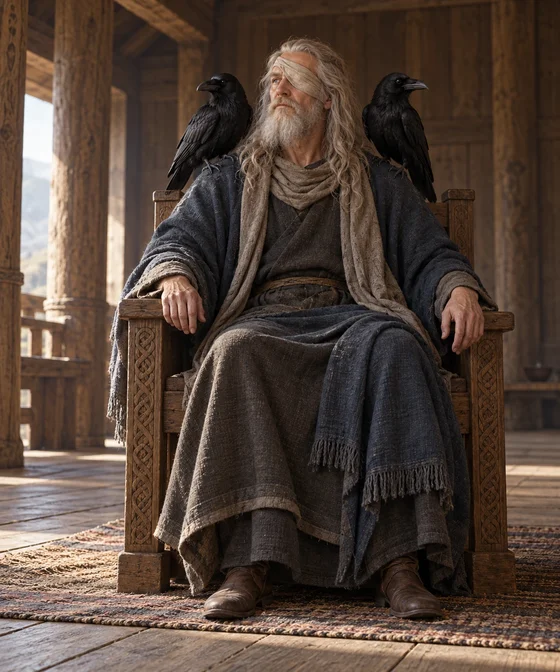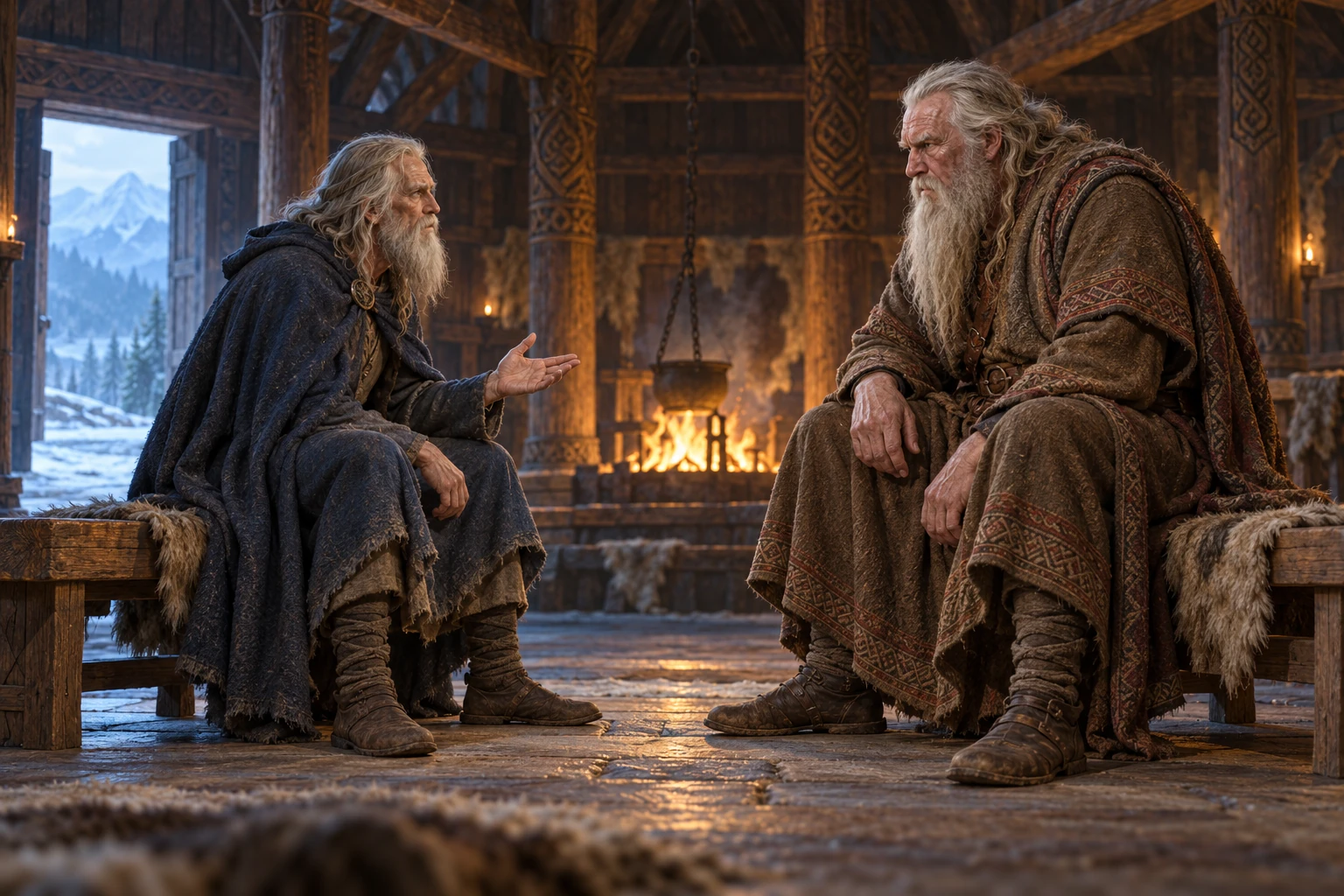
AI-generated interpretation of the wisdom contest in Thorpe’s Lay of Vafthrudnir. Guest, giant, hall and seated exchange follow the account; faces, clothing, furnishings and relative scale are artistic choices. This is not a historical artifact or a depiction of Final Fantasy.
The scene imagines their dialogue; the poem’s fatal wager is not illustrated as an execution.
Overview
Odin seeks a contest in ancient knowledge with the giant Vafthrudnir. Frigg advises him to remain among the gods because she knows no giant of comparable power, but, when Odin persists, she wishes him a safe journey and return. He enters the hall under the name Gagnrad and presents himself as a thirsty traveller needing hospitality. The encounter begins with a dangerous condition: the host says that his visitor will not leave unless he proves the wiser. Odin initially speaks from the floor rather than immediately taking the offered seat.
Vafthrudnir tests his guest about the horses drawing day and night, the river between gods and giants, and the plain of a future battle. After Odin answers, the giant invites him to the bench and explicitly proposes staking their heads on their knowledge. Odin then becomes the questioner. The exchange covers the making of earth and heaven from Ymir, heavenly timekeeping, the origins of seasons and giants, the source of wind, and relations among divine beings. These are attributed answers within the poem, rather than a single explanation of every historical Norse tradition.
The dialogue extends into the future. Vafthrudnir describes human survivors sustained by morning dew, a daughter who follows the sun’s course, divine successors and the fate awaiting Odin himself. The wolf will devour Odin, and Vidar will avenge him. The host’s extensive travels and knowledge therefore do not protect him from the contest’s final question. Odin asks what he said into his son’s ear before the son was placed on the funeral pyre. The selected wording does not name that son or disclose the whispered words.
Vafthrudnir recognizes that only Odin could have posed this private question and acknowledges the god as the wisest. His closing reference to a dying mouth and the prose framing establish the fatal stakes and his loss; the poem does not narrate a separate execution scene. This complete guest-and-host contest is distinct from Odin’s ordeal and learning in the Rune-Song and from the separate accounts of an eye exchanged for wisdom or the theft of poetic mead. Thorpe’s historical English rendering is the selected witness, not evidence that a modern game designer consulted this poem.
Origins & earliest records
The Lay of Vafthrudnir in Benjamin Thorpe’s Elder Edda component of the Norroena Society 1906 collected edition, edited by Rasmus B. Anderson and J. W. Buel. Blackwell’s Younger Edda is a separate component. No original Old Norse manuscript or physical 1906 printing independently collated.
Records & interpretation
Complete prose framing and all 55 verse blocks read through the final recognition, ending before The Lay of Grimnir. No attached note anchors or inline note markers occur in this unit. Hosted numbering repeats 33 and omits 32; the exact extract preserves that defect.
Selected bibliography
Documented works and useful reading. This is not a list of every appearance.
- 01
The Elder Eddas of Saemund Sigfusson; and the Younger Eddas of Snorre Sturleson
Complete titled Lay of Vafthrudnir: prose framing and 55 verse blocks, no attached notes observed. Cached stanza labels repeat 33 instead of supplying 32; unchanged in retained extract. This is not Blackwell’s separate Younger Edda translation.
Family, evolution & connections
Odin (Final Fantasy)
Final Fantasy’s Odin supplies a separate fictional namesake beside this historical account of disguise, dangerous hospitality and a wisdom contest. The poem’s final private question and Vafthrudnir’s recognition belong to Thorpe’s selected rendering; they are not attributed to the game incarnation. The comparison documents historical context rather than a demonstrated design source or shared continuity.
References
Sources supporting this profile. Linked pages have their own scope and editorial standards.
- Historical English rendering of a Norse religious poemThorpe, complete Lay of Vafthrudnir and framing, Norroena 1906 collected witnessResearch access: 2026-10-26
Image credits
Modern interpretation of a historical literary accountAI-generated interpretation of the wisdom contest in Thorpe’s Lay of Vafthrudnir. Guest, giant, hall and seated exchange follow the account; faces, clothing, furnishings and relative scale are artistic choices. This is not a historical artifact or a depiction of Final Fantasy.
The scene imagines their dialogue; the poem’s fatal wager is not illustrated as an execution.