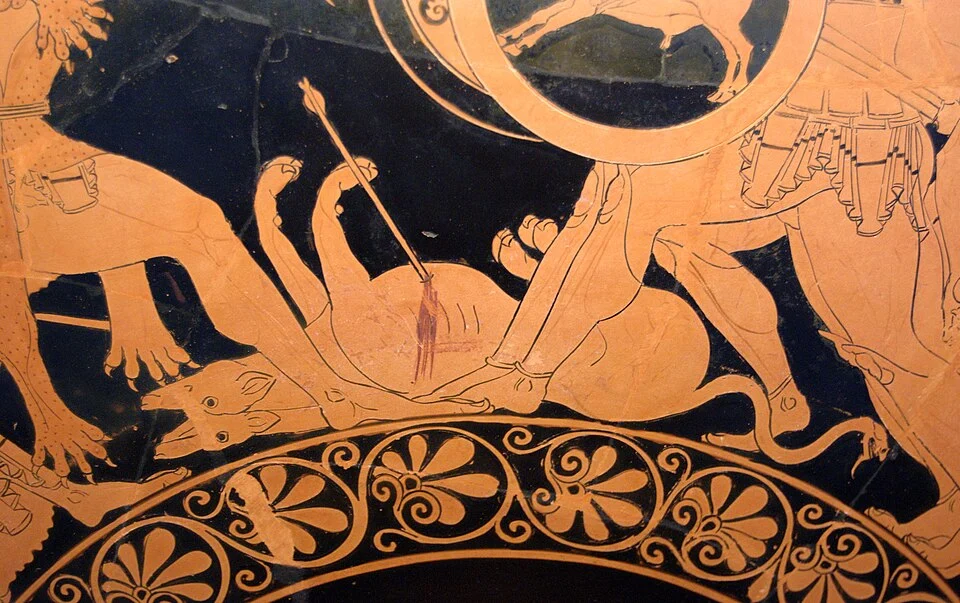
Orthrus
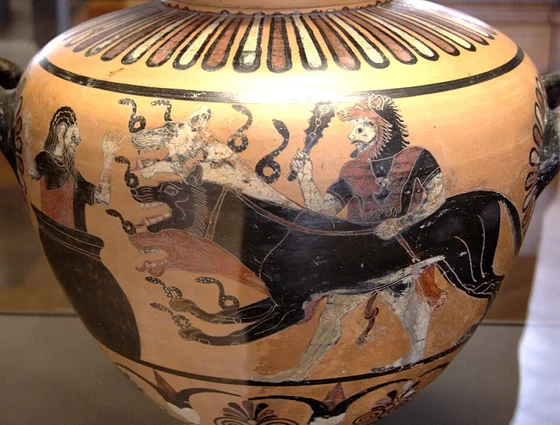
Image associated with the exact linked encyclopedia article; consult credited file description for its interpretation.
Overview
The Library identifies the hound as an offspring of Typhon and Echidna and assigns him two heads. His responsibility is the protection of Geryon’s red cattle, alongside the herdsman Eurytion. When Heracles reaches the island of Erythia, the dog detects him and rushes to meet the intruder, beginning the violence that makes the cattle accessible.
Heracles kills the hound with his club, then defeats Eurytion and Geryon. Orthrus therefore has a specific role in a guarded household and herd, distinct from Cerberus’s relationship with the dead. Translators may use Orthus rather than Orthrus; that spelling variation does not create another creature. A comparison of the two hounds is useful only if their different duties and narrative settings remain visible.
In the Library’s tenth labour, Erythia is an ocean island identified by the narrator with Gadira. Heracles reaches it using the Sun’s golden cup and lodges on Mount Abas. Orthus detects him and charges before Eurytion intervenes. The herdsman Menoetes, pasturing Hades’ cattle there, survives to inform Geryon. The owner confronts the departing cattle-raider beside the river Anthemus and is shot dead. The hound’s death is thus the opening of a longer herd-taking sequence; it is not a narrated escape from an underworld gate.
Hesiod’s Theogony 306–332 places Orthus first among Echidna and Typhaon’s offspring and calls him Geryones’ hound, but does not give his head count in that passage. Later in the same sequence Echidna’s union with Orthus produces the Sphinx and Nemean lion. That reproductive role supplements his guardianship in the Library without establishing a single harmonised genealogy across all ancient sources. The two-headed description belongs explicitly to Library2.5.10.
Origins & earliest records
This entry follows The Library, Book II, at 2.5.10, in the linked English translation. The work preserves a particular ancient narrative rather than establishing the first appearance of every motif. Its composition period dates a surviving literary witness; older oral transmission and earlier artistic evidence require separate investigation.
Records & interpretation
Ancient poem and mythographer provide a named herd-guardian, explicit two-headed form in the Library, and a separate poetic genealogical role.
In the literature
“first she bare Orthus the hound of Geryones,”
Theogony, lines 306–332 · Hugh G. Evelyn-White
Echidna’s offspring with Typhaon include Orthrus; this passage does not specify his head count.
Selected bibliography
Documented works and useful reading. This is not a list of every appearance.
- 01
The Library, Book II, 2.5.10
Selected primary passage; wording is summarized independently, and incompatible later versions are not silently combined.
- 02
Theogony, lines 306–332
Geryones’ hound and Echidna union; passage does not specify Orthus’s head count.
- 03
Theogony, in Hesiod, the Homeric Hymns, and Homerica
Historical English translation; translator’s preface dated 9 September 1914. Gutenberg includes the English portions and relocated footnotes.
- 04
The Library (Bibliotheca)
Pseudo-Apollodorus, The Library, James George Frazer translation, Loeb Classical Library 121–122; Harvard University Press / William Heinemann, 1921.
Family, evolution & connections
Textual genealogy: Typhaon and Echidna in Theogony
The three sequentially enumerated offspring at Theogony lines 306–318.
Scroll sideways to see all branches. With a keyboard, focus the tree and use the arrow keys.
- Parents: Typhaon (Typhon) and Echidna
Follow the explicitly named pairing of Typhaon and Echidna and the first, second and third offspring in Evelyn-White's translation. Selected parentage in Hesiod. Typhaon is the name used here for Typhon. Later Chimera and Sphinx passages involve interpretive pronoun questions; those are not silently appended. Hera's nourishment of Hydra is not maternity. No claim of zoological ancestry.
Textual genealogy: selected children of Typhon and Echidna in Library
Explicit named parentage in Library 2.3.1, 2.5.10, 2.5.11 and 3.5.8.
Scroll sideways to see all branches. With a keyboard, focus the tree and use the arrow keys.
- Parents: Typhon and Echidna
Combine four explicit parentage statements within one named work, keeping each creature under the stated Typhon–Echidna pair. This is a selected version attributed to Pseudo-Apollodorus. The Hesperides' dragon is identified with the Ladon profile, although this passage calls it the dragon rather than using that name. Hesiod gives that dragon different parents; the alternative remains separate. Sphinx means the Greek figure. Fosterers, killers and owners are not parents.
Typhon
Hesiod names Orthrus first among the offspring produced by Echidna and Typhaon, a spelling associated with Typhon. The connection records the poem’s family relationship rather than inferring parentage from shared monstrous anatomy. Later appearances and different translations should not silently replace this source’s terminology.
Echidna
Library 2.5.10 introduces Geryon’s cattle, Eurytion the herdsman and Orthus the two-headed watchdog, explicitly identifying the dog as Typhon’s offspring by Echidna. This maternal connection rests on the named statement, not resemblance to Cerberus. The herd-guarding role belongs to the same narrative, while the parentage remains a mythic genealogy rather than a natural canine lineage.
Located primary passages
Specific passages supporting details in this entry, grouped by their published witness.
Primary source witness
Historical English translation; translator’s preface dated 9 September 1914. Gutenberg includes the English portions and relocated footnotes.
- Echidna’s offspring with Typhaon include Orthrus; this passage does not specify his head count.
This passage documents one ancient literary version. Translation publication dates are not ancient composition dates or earliest-attestation claims.
The Library, Book II, 2.5.10
Pseudo-Apollodorus, The Library, James George Frazer translation, Loeb Classical Library 121–122; Harvard University Press / William Heinemann, 1921.
- The two-headed watchdog Orthus guards Geryon’s cattle and is a child of Typhon and Echidna.
- Hercules kills the watchdog with his club when it rushes at him.
A version-specific primary witness, not an earliest-attestation claim or proof of zoological existence.
Encyclopedia background
An additional attributed reference, separate from the editorial profile above.
Read the open encyclopedia overview
In Greek mythology, Orthrus (Ancient Greek: Ὄρθρος, Orthros) or Orthus (Ancient Greek: Ὄρθος, Orthos) was, according to the mythographer Apollodorus, a two-headed dog who guarded Geryon's cattle and was killed by Heracles. He was the offspring of the monsters Echidna and Typhon, and the brother of Cerberus, who was also a multi-headed guard dog.
Text from Wikipedia contributors, “Orthrus”. CC BY-SA 4.0. Extracted introduction; formatting changed. Retrieved 5 October 2026. The source article may have changed since retrieval.
References
Sources supporting this profile. Linked pages have their own scope and editorial standards.
- Primary textThe Library, Book II: 2.5.10 (Theoi Classical Texts Library or Project Gutenberg transcription)Research access: 2026-10-05
- Primary ancient text in historical translationTheogony, lines 306–332Research access: 2026-10-05
Image credits
Reference illustrationOrthrus
Image associated with the exact linked encyclopedia article; consult credited file description for its interpretation.