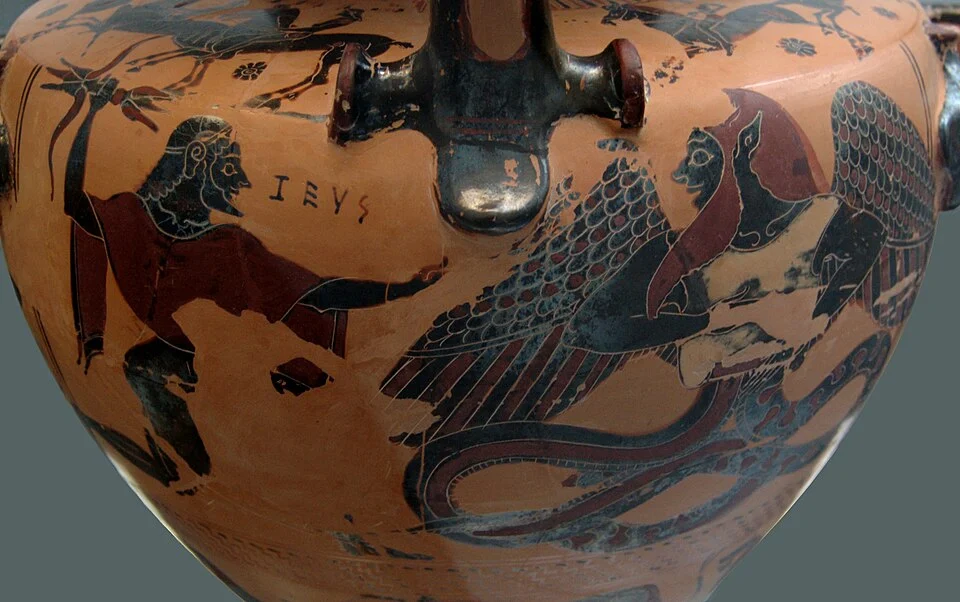
Typhon
Image associated with the exact linked encyclopedia article; consult credited file description for its interpretation.
Overview
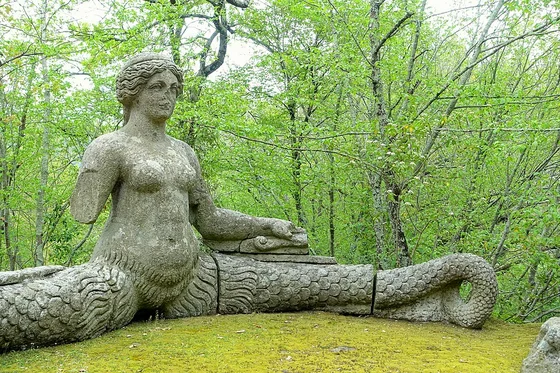
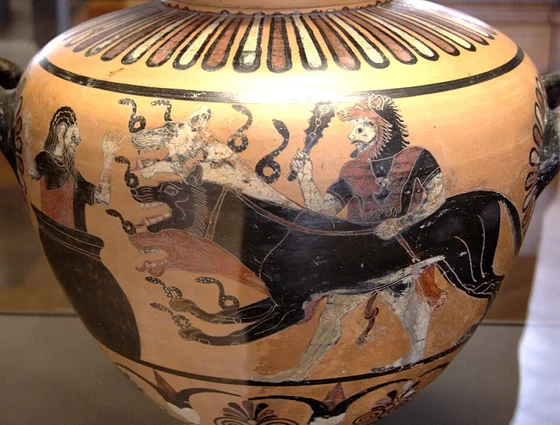
The Library presents Typhon as an offspring of Earth and Tartarus, with a human-shaped upper body and immense coils below. Numerous dragon heads and fiery features intensify the threat. He attacks the gods and briefly overcomes Zeus, taking away the sinews of the god’s hands and feet and hiding them under guard.
Hermes and Aegipan restore the sinews, allowing Zeus to renew the pursuit and eventually bury Typhon beneath Etna. The sequence makes his defeat a recovery of cosmic government after a real crisis within the narrative. His composite form is not a diagram of an unknown animal; it gives material shape to overwhelming opposition. Genealogical links with other monsters must be attributed to the particular ancient account supplying them.
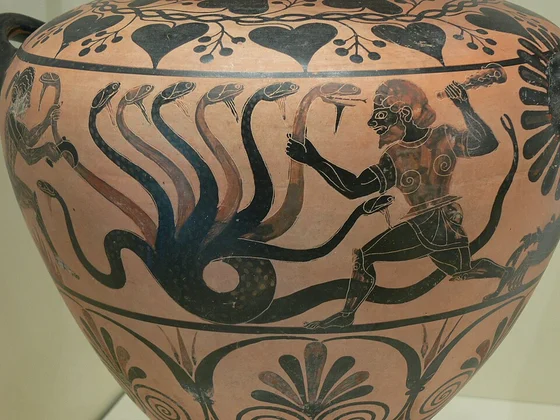
The Library’s detailed form reaches beyond a simple snake-legged giant. His human-shaped upper body overtops mountains, his head approaches the stars, and his outstretched hands reach east and west with a hundred dragon heads projecting from them. Viper coils form the lower part, the body is winged, hair streams from head and cheeks, and his eyes flash fire. As he throws burning rocks toward heaven, the other gods flee to Egypt and assume animal forms. Zeus’s early sickle attack therefore does not immediately settle the conflict.
The sinew episode occurs after Zeus grapples with the wounded monster at Mount Casius. Typhon carries the disabled god across the sea to Cilicia’s Corycian cave and places the severed sinews in a bearskin under Delphyne’s guard. Following the theft and restoration by Hermes and Aegipan, Zeus pursues in a chariot. The Fates trick Typhon into eating short-lived fruits that he expects to strengthen him. At Haemus he throws mountains, only to have them driven back by thunderbolts; the account explains the mountain’s name through the resulting blood. Etna ends this particular pursuit.
Hesiod’s Theogony 820–880 supplies an earlier and differently organized confrontation. Earth bears Typhoeus through Tartarus after the Titans’ defeat. A hundred snake heads grow from his shoulders, their voices shifting among intelligible divine speech, bull and lion sounds, puppy cries and hissing. Zeus answers with thunder and lightning; the combat shakes Olympus, sea, earth and the underworld and scorches the landscape. Hesiod compares the melting earth to metal worked by craftspeople, then places the defeated monster in Tartarus. This passage has neither the stolen-sinew rescue nor Etna confinement of the Library. Its aftermath derives destructive, irregular winds from Typhoeus while expressly excepting the beneficial Notus, Boreas and Zephyr.
Origins & earliest records
Hesiod’s Archaic Greek Theogony supplies the selected Typhoeus confrontation; the later Library, attributed conventionally to Pseudo-Apollodorus, supplies a distinct expanded pursuit. The selected English witnesses are H. G. Evelyn-White’s 1914 and James George Frazer’s 1921 translations. Their publication and composition dates do not establish the first occurrence of the oral motifs.
Records & interpretation
Theogony 820–880 describes shoulder-borne snake heads, changing voices, cosmic combat, Tartarus confinement and destructive winds. Library 1.6.3 places the heads at outstretched hands and adds wings, stolen sinews, Delphyne’s guard, pursuit and Etna. These source-specific differences prevent a single composite reconstruction from being mistaken for either witness.
In the literature
“From his shoulders grew an hundred heads of a snake, a fearful dragon,”
Theogony, lines 820–868 · Hugh G. Evelyn-White
Typhoeus has a hundred snake heads; preserved as this poem’s description.
“And from Typhoeus come boisterous winds which blow damply, except Notus and Boreas and clear Zephyr.”
Theogony, lines 869–880 · Hugh G. Evelyn-White
Destructive winds are attributed to Typhoeus, with named exceptions.
Selected bibliography
Documented works and useful reading. This is not a list of every appearance.
- 01
The Library, Book I, 1.6.3
Complete section 1.6.3: anatomy, gods’ flight, sinew crisis, restorative theft and pursuit through Etna.
- 02
Theogony, 820–880: Typhoeus and the destructive winds
Complete confrontation and wind aftermath; shoulder heads and Tartarus outcome distinguished from the Library’s hands and Etna.
- 03
Theogony, in Hesiod, the Homeric Hymns, and Homerica
Historical English translation; translator’s preface dated 9 September 1914. Gutenberg includes the English portions and relocated footnotes.
- 04
The Library (Bibliotheca)
Pseudo-Apollodorus, The Library, James George Frazer translation, Loeb Classical Library121–122; Harvard University Press / William Heinemann,1921.
Family, evolution & connections
Textual genealogy: Typhaon and Echidna in Theogony
The three sequentially enumerated offspring at Theogony lines 306–318.
Scroll sideways to see all branches. With a keyboard, focus the tree and use the arrow keys.
- Parents: Typhaon (Typhon) and Echidna
Follow the explicitly named pairing of Typhaon and Echidna and the first, second and third offspring in Evelyn-White's translation. Selected parentage in Hesiod. Typhaon is the name used here for Typhon. Later Chimera and Sphinx passages involve interpretive pronoun questions; those are not silently appended. Hera's nourishment of Hydra is not maternity. No claim of zoological ancestry.
Textual genealogy: selected children of Typhon and Echidna in Library
Explicit named parentage in Library 2.3.1, 2.5.10, 2.5.11 and 3.5.8.
Scroll sideways to see all branches. With a keyboard, focus the tree and use the arrow keys.
- Parents: Typhon and Echidna
Combine four explicit parentage statements within one named work, keeping each creature under the stated Typhon–Echidna pair. This is a selected version attributed to Pseudo-Apollodorus. The Hesperides' dragon is identified with the Ladon profile, although this passage calls it the dragon rather than using that name. Hesiod gives that dragon different parents; the alternative remains separate. Sphinx means the Greek figure. Fosterers, killers and owners are not parents.
Gaia (Earth) and Tartarus
At Theogony line 820, Earth bears Typhoeus through her union with Tartarus. This supplies explicit parentage for the figure covered by the Typhon profile in this text. Aphrodite’s role in facilitating the union is not parentage, and Typhoeus’s later imprisonment in Tartarus does not erase the distinction between the personified parent and the narrative place.
Located primary passages
Specific passages supporting details in this entry, grouped by their published witness.
Primary source witness
Historical English translation; translator’s preface dated 9 September 1914. Gutenberg includes the English portions and relocated footnotes.
- Typhoeus has a hundred snake heads; preserved as this poem’s description.
- Destructive winds are attributed to Typhoeus, with named exceptions.
This passage documents one ancient literary version. Translation publication dates are not ancient composition dates or earliest-attestation claims.
The Library, Book I, 1.6.3
Pseudo-Apollodorus, The Library, James George Frazer translation, Loeb Classical Library121–122; Harvard University Press / William Heinemann,1921.
- Earth and Tartarus produce Typhon in Cilicia: an enormous human-beast hybrid with dragon heads, viper coils, wings and fire.
- Typhon severs Zeus’s sinews and hides them with Delphyne; Hermes and Aegipan restore them, and Zeus eventually crushes Typhon under Etna.
Version-specific ancient compilation, not an earliest-attestation assertion. Compound episode claim was checked in full; the brief evidence excerpt is not the entire supporting passage.
Encyclopedia background
An additional attributed reference, separate from the editorial profile above.
Read the open encyclopedia overview
Typhon ( ; Ancient Greek: Τυφῶν, romanized: Typhôn, [tyːpʰɔ̂ːn]), also known as Typhoeus (; Τυφωεύς, Typhōeús), Typhaon (Τυφάων, Typháōn) or Typhos (Τυφώς, Typhṓs), was a monstrous serpentine giant and one of the deadliest creatures in Greek mythology. According to Hesiod, Typhon was the son of Gaia and Tartarus. However, one source has Typhon as the son of Hera alone, while another makes Typhon the offspring of Cronus. Typhon and his mate Echidna were the progenitors of many famous monsters.
Typhon attempted to overthrow Zeus for the supremacy of the cosmos. The two fought a cataclysmic battle, which Zeus finally won with the aid of his thunderbolts. Defeated, Typhon was cast into Tartarus, or buried underneath Mount Etna, or in later accounts, the island of Ischia.
Typhon mythology is part of the Greek succession myth, which explained how Zeus came to rule the gods. Typhon's story is also connected with that of Python (the serpent killed by Apollo), and both stories probably derived from several Near Eastern antecedents. Typhon was (from c. 500 BC) also identified with the Egyptian god of destruction Set. In later accounts, Typhon was often confused with the Giants.
Text from Wikipedia contributors, “Typhon”. CC BY-SA 4.0. Extracted introduction; formatting changed. Retrieved 5 October 2026. The source article may have changed since retrieval.
References
Sources supporting this profile. Linked pages have their own scope and editorial standards.
- Primary textPseudo-Apollodorus, Library 1.6.3, Frazer translationResearch access: 2026-10-05
- Primary text in translationHesiod, Theogony 820–880, Evelyn-White translationResearch access: 2026-10-05
Image credits
Reference illustrationTyphon
Image associated with the exact linked encyclopedia article; consult credited file description for its interpretation.