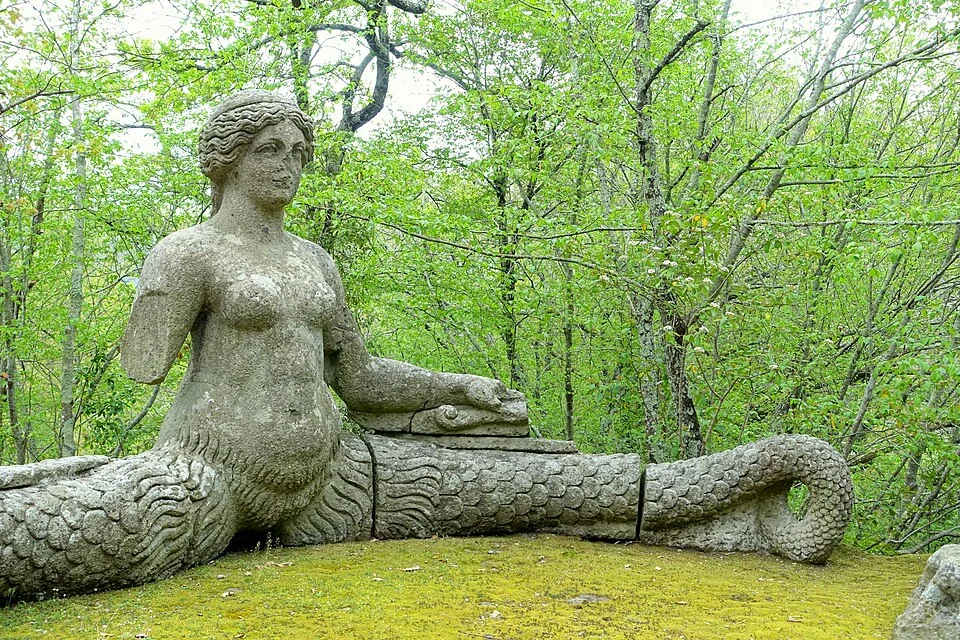
Echidna
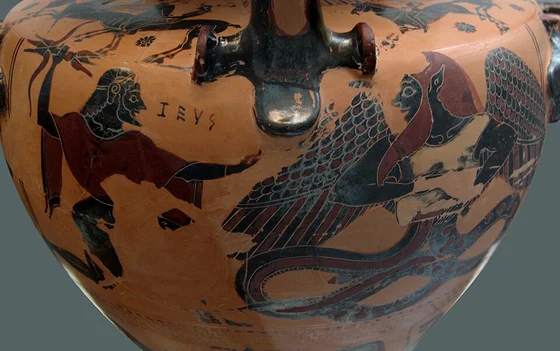
Image associated with the exact linked encyclopedia article; consult credited file description for its interpretation.
Overview
In the Theogony, Echidna inhabits a deep cave and combines an attractive nymph-like upper appearance with an immense serpentine form. She neither ages nor dies in the account. Her association with Typhaon leads into the birth of dangerous offspring, placing her within the poem’s wider organization of divine and monstrous relationships.
Genealogy is the main structure through which the poem connects her with hounds, the Hydra and other beings. Those relationships are not identical in every later source, and grammatical ambiguities can complicate the interpretation of a parentage. Echidna should therefore be read through a specified text rather than a universal family tree assembled from incompatible witnesses. Her name’s modern use for an Australian mammal is a separate act of naming.
Hesiod’s description at lines 295–305 emphasises the contrast between fair cheeks and glancing eyes above and a great speckled snake below. The creature eats raw flesh within the hidden earth, occupying a cave under hollow rock in Arima, apart from both human beings and the other deathless gods. The gods appoint that dwelling, and the poem expressly says that she does not die or grow old. These spatial and bodily details make her more than an unspecified parent in the ensuing monster catalogue.
The Library 2.1.2 offers an incompatible end. In its account of Argus the All-seeing, Echidna is called a daughter of Tartarus and Earth who carries off passers-by; Argus catches her sleeping and kills her. This death belongs to that mythographer’s sequence of Argus’s feats, alongside killing a ravaging bull and a cattle-robbing satyr. It should not be appended as the inevitable ending of Hesiod’s expressly ageless, deathless cave-dweller. The two witnesses preserve different representations of her parentage, activity and mortality.
Origins & earliest records
This entry follows Theogony, at Theogony 295–332, in the linked English translation. The work preserves a particular ancient narrative rather than establishing the first appearance of every motif. Its composition period dates a surviving literary witness; older oral transmission and earlier artistic evidence require separate investigation.
Records & interpretation
Located ancient witnesses describe the cave-dwelling hybrid and preserve explicit disagreement about mortality and parentage.
In the literature
“half a nymph with glancing eyes and fair cheeks, and half again a huge snake,”
Theogony, lines 295–305 · Hugh G. Evelyn-White
Echidna’s body combines a nymph’s upper appearance with a snake.
“a nymph who dies not nor grows old all her days.”
Theogony, lines 295–305 · Hugh G. Evelyn-White
The poet describes Echidna as ageless in her underground dwelling.
Selected bibliography
Documented works and useful reading. This is not a list of every appearance.
- 01
Theogony, Theogony 295–332
Selected primary passage; wording is summarized independently, and incompatible later versions are not silently combined.
- 02
The Library, 2.1.2
Echidna daughter of Tartarus/Earth, abduction and sleeping death by Argus; conflicts with Hesiod’s deathlessness.
- 03
Theogony, in Hesiod, the Homeric Hymns, and Homerica
Historical English translation; translator’s preface dated 9 September 1914. Gutenberg includes the English portions and relocated footnotes.
- 04
The Library (Bibliotheca)
Pseudo-Apollodorus, The Library, James George Frazer translation, Loeb Classical Library121–122; Harvard University Press / William Heinemann,1921.
Family, evolution & connections
Textual genealogy: Typhaon and Echidna in Theogony
The three sequentially enumerated offspring at Theogony lines 306–318.
Scroll sideways to see all branches. With a keyboard, focus the tree and use the arrow keys.
- Parents: Typhaon (Typhon) and Echidna
Follow the explicitly named pairing of Typhaon and Echidna and the first, second and third offspring in Evelyn-White's translation. Selected parentage in Hesiod. Typhaon is the name used here for Typhon. Later Chimera and Sphinx passages involve interpretive pronoun questions; those are not silently appended. Hera's nourishment of Hydra is not maternity. No claim of zoological ancestry.
Textual genealogy: selected children of Typhon and Echidna in Library
Explicit named parentage in Library 2.3.1, 2.5.10, 2.5.11 and 3.5.8.
Scroll sideways to see all branches. With a keyboard, focus the tree and use the arrow keys.
- Parents: Typhon and Echidna
Combine four explicit parentage statements within one named work, keeping each creature under the stated Typhon–Echidna pair. This is a selected version attributed to Pseudo-Apollodorus. The Hesperides' dragon is identified with the Ladon profile, although this passage calls it the dragon rather than using that name. Hesiod gives that dragon different parents; the alternative remains separate. Sphinx means the Greek figure. Fosterers, killers and owners are not parents.
Gaia (Earth) and Tartarus
Library 2.1.2 calls Echidna the daughter of Tartarus and Earth before recounting her death at the hands of Argus. This selected account differs from Hesiod’s description of an ageless Echidna. The connection therefore remains attached to the Library’s version; it does not combine every ancient genealogy or assume that contradictory death and immortality statements describe one consistent life history.
Located primary passages
Specific passages supporting details in this entry, grouped by their published witness.
Primary source witness
Historical English translation; translator’s preface dated 9 September 1914. Gutenberg includes the English portions and relocated footnotes.
- Echidna’s body combines a nymph’s upper appearance with a snake.
- The poet describes Echidna as ageless in her underground dwelling.
This passage documents one ancient literary version. Translation publication dates are not ancient composition dates or earliest-attestation claims.
The Library, 2.1.2
Pseudo-Apollodorus, The Library, James George Frazer translation, Loeb Classical Library121–122; Harvard University Press / William Heinemann,1921.
- This compiler calls Echidna a daughter of Tartarus and Earth who abducts passers-by and is killed asleep by Argus; this differs from Hesiod’s deathless witness.
Version-specific ancient compilation, not an earliest-attestation assertion. Compound episode claim was checked in full; the brief evidence excerpt is not the entire supporting passage.
Encyclopedia background
An additional attributed reference, separate from the editorial profile above.
Read the open encyclopedia overview
In Greek mythology, Echidna (; Ancient Greek: Ἔχιδνα, romanized: Ékhidna, lit. 'she-viper', pronounced [ékʰidna]) was a monster, half-woman and half-snake, who lived alone in a cave. She was the mate of the fearsome monster Typhon and was the mother of many of the most famous monsters of Greek myth.
Text from Wikipedia contributors, “Echidna (mythology)”. CC BY-SA 4.0. Extracted introduction; formatting changed. Retrieved 5 October 2026. The source article may have changed since retrieval.
References
Sources supporting this profile. Linked pages have their own scope and editorial standards.
- Primary textTheogony: Theogony 295–332 (Theoi Classical Texts Library or Project Gutenberg transcription)Research access: 2026-10-05
- Primary ancient text in historical translationThe Library, 2.1.2Research access: 2026-10-05
Image credits
Reference illustrationEchidna
Image associated with the exact linked encyclopedia article; consult credited file description for its interpretation.