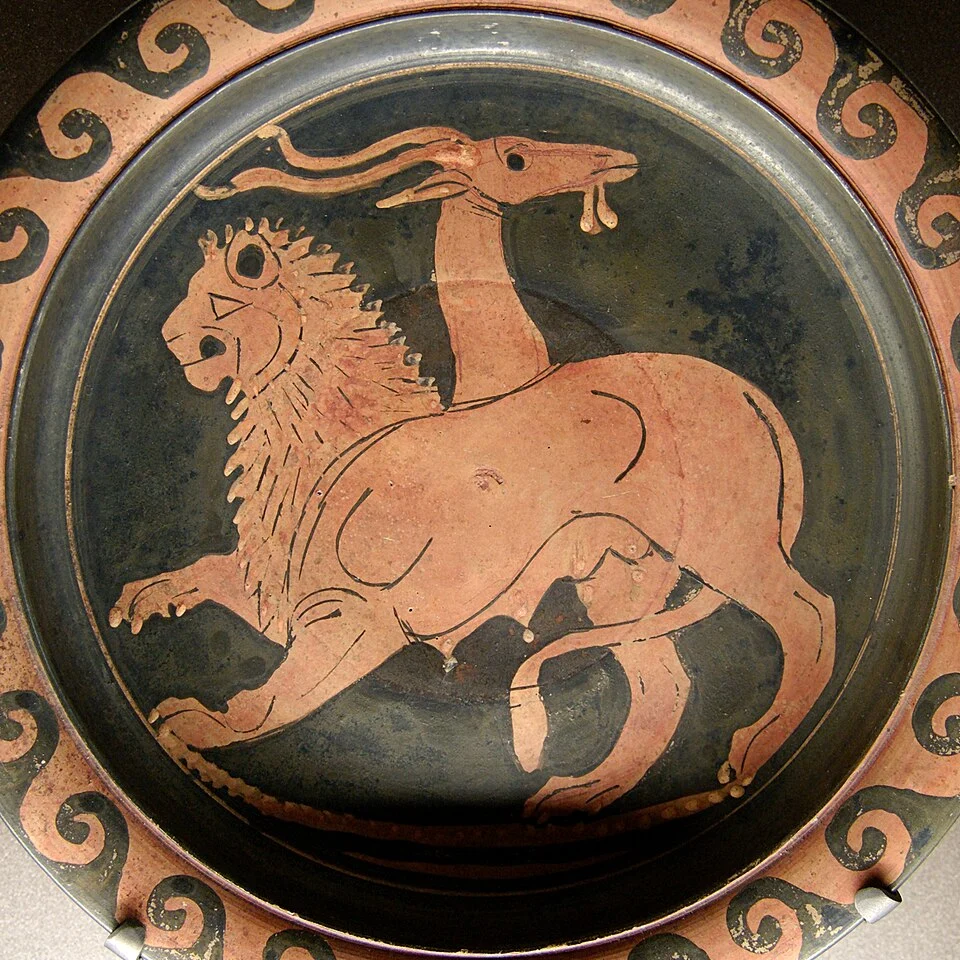
Chimera
Image associated with the exact linked encyclopedia article; consult credited file description for its interpretation.
Overview
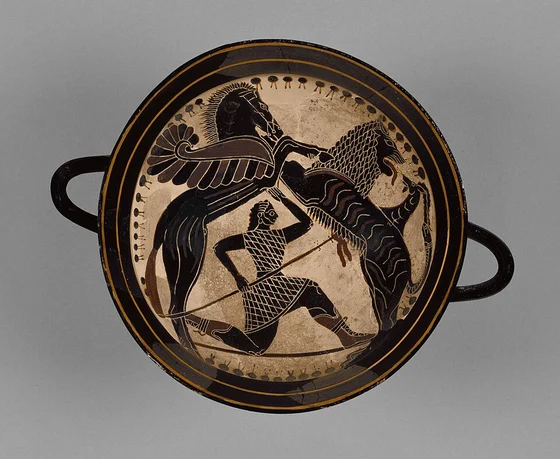
The Chimera is the fire-breathing composite monster assigned to Bellerophon as an apparently fatal opponent. Greek poems and later mythography combine lion, goat and serpent features, but describe the encounter at different levels of detail. The Lycian setting, the rider’s divine assistance and the monster’s place among Echidna’s offspring connect it to several other narratives. Surviving Italian artworks also give the figure a material and religious history that extends beyond the description of one battle.
In Iliad VI, Glaucus recounts his ancestry to Diomedes on the battlefield. Bellerophon rejects Anteia, wife of Proetus, who then falsely accuses him. Proetus sends him to his wife’s father in Lycia carrying a message intended to secure his death. The king entertains him before reading it, then orders him against the Chimera. Glaucus describes a divine creature with leonine forequarters, a serpent behind and a goat in the middle, breathing fire. Bellerophon kills her with divine guidance; the selected passage does not describe Pegasus or a particular weapon. Further assignments and an ambush follow. This monster story is therefore part of an ancestral account that ultimately allows Glaucus and Diomedes to recognise inherited guest-friendship and avoid fighting each other.
Theogony 319–325 places the Chimera within the sequence of monstrous offspring associated with Echidna and Typhaon. The inspected Evelyn-White translation emphasizes three heads, strength, speed and fire, then names both Pegasus and Bellerophon as her killers. The genealogical passage situates her alongside Orthus, Cerberus and the Lernaean Hydra. It is a poetic kinship account, not a biological evolutionary tree, and supplies no detailed account of how the horse was obtained or the monster was attacked.
Pindar’s Olympian XIII includes the victory among the achievements of Corinth’s heroes while celebrating the athlete Xenophon. Bellerophon struggles to bridle Pegasus at Peirene until Athena appears in a dream with a golden bit. He wakes with it beside him, consults the seer, and receives instructions for a sacrifice to Poseidon and an altar to Athena. Once bridled, the horse carries him into the air and accompanies his victories over the Amazons, Solymi and fire-breathing Chimera. The ode chooses to leave Bellerophon’s subsequent fate unspoken while giving Pegasus a home in Zeus’s stalls. This is an account of divinely enabled horsemanship within a victory ode, rather than an extended description of the monster’s death.
Library II.3.1–2 names the accusing queen Stheneboea and the Lycian ruler Iobates. Here the monster ravages the country and its cattle; fire issues through the goat head. The narrator identifies Typhon and Echidna as parents and says Amisodarus reared it. Bellerophon mounts Pegasus, rises above the creature and shoots it down. The account continues through the Solymi, Amazons and failed ambush before Iobates reveals the letter, offers his daughter Philonoe and ultimately leaves Bellerophon the kingdom. These explicit tactics and names belong to this version. They should not be silently inserted into Homer’s shorter recollection, nor confused with the separate ancestry of Pegasus through Medusa and Poseidon.
The Etruscan bronze known as the Chimera of Arezzo, dated by the Getty exhibition to about 400 BCE, provides evidence for ancient representation and dedication. Its right foreleg bears a dedication to Tinia; its defensive pose suggests, without proving, a lost group with Bellerophon and Pegasus. Found in 1553 with smaller bronzes, it was initially mistaken for a lion because it was incomplete. The serpent tail was replaced in 1785, with its head positioned against the goat’s horn. That restoration matters when reading photographs as evidence for ancient design. The object demonstrates skilled casting and religious use, not the existence of a composite animal.
Origins & earliest records
The Iliad and Theogony are the earliest literary witnesses examined here. Pindar’s ode supplies a dated fifth-century BCE reception, while the later Library expands the encounter. These surviving works do not date the beginning of oral tradition or prove a single original version.
Records & interpretation
Located poetic and mythographic witnesses preserve anatomy, kinship and differing narrative detail. Museum research separately documents an Etruscan bronze’s dedication, discovery and restoration. These are evidence of literary transmission, artistic production and religious practice; no specimen establishes the monster as a real organism.
In the literature
“The Chimaera was a fearful monster, breathing fire.”
Chapter X, “Pegasus and the Chimaera”
Bulfinch’s opening characterization of the Lycian monster.
“who had three heads, one of a grim-eyed lion; in her hinderpart, a dragon; and in her middle, a goat,”
Theogony, lines 306–332 · Hugh G. Evelyn-White
The Chimera combines lion, dragon and goat forms in this text.
“Her did Pegasus and noble Bellerophon slay;”
Theogony, lines 306–332 · Hugh G. Evelyn-White
Pegasus and Bellerophon kill the Chimera.
“slew the Solymoi, and Chimaira breathing fire.”
Olympian XIII, Bellerophon’s airborne victories · Ernest Myers
Bellerophon’s victories accompany Pegasus in this complete Corinthian victory ode.
Selected bibliography
Documented works and useful reading. This is not a list of every appearance.
- 01
Iliad VI.119–236, especially 179–183
Complete Glaucus–Diomedes exchange read; Bellerophon narrative and guest-friendship context. Pegasus is not described in this passage.
- 02
Theogony 319–325, with surrounding monster genealogy
Three-headed fire-breather and defeat by Pegasus and Bellerophon in the inspected translation.
- 03
Olympian XIII, for Xenophon of Corinth
Complete ode and attached notes read. Athena’s bit, acquisition of Pegasus and brief monster victory.
- 04
The Library II.3.1–2
Complete Bellerophon episode: letter, composite anatomy, parentage, aerial attack and later assignments.
- 05
Theogony, in Hesiod, the Homeric Hymns, and Homerica
Historical English translation; translator’s preface dated 9 September 1914. Gutenberg includes the English portions and relocated footnotes.
- 06
Bulfinch’s Mythology: The Age of Fable (revised by E. E. Hale)
Exact contiguous excerpt checked against the linked primary e-text on 2026-10-05; only whitespace normalized. Work first published 1855; date of the Hale revision used by this e-text is not specified.
- 07
The Library (Bibliotheca)
Pseudo-Apollodorus, The Library, James George Frazer translation, Loeb Classical Library121–122; Harvard University Press / William Heinemann,1921.
- 08
Iliad — Glaucus and Diomedes, Bellerophon’s lineage
Homer Iliad VI, A.T.Murray translation; Theoi Classical Texts Library identifies its older Loeb translation as1924 on BookI, distinct from its Lattimore biography excerpts. Actual hosted print impression not independently collated. Translator AugustusTaberMurray1866–1940 confirmed by Rutgers Database of Classical Scholars; Rutgers lists the two-volume edition1925, so the1924 field follows this host’s selected-volume label rather than an asserted first-publication resolution.
- 09
The Extant Odes of Pindar — Olympian XIII
Pindar, The Extant Odes, translated ErnestMyers, London:Macmillan1904, actual hosted title page. First edition1874 and intervening reprints appear in edition history;1904 is the inspected textual witness. OlympianXIII headed ToXenophonOfCorinth,WinnerInTheStadionRaceAndInThePentathlon; complete ode and its footnotes read, not the later Isthmian ode of the same Roman number.
Family, evolution & connections
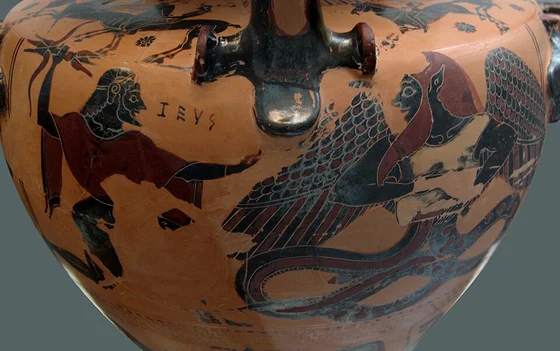
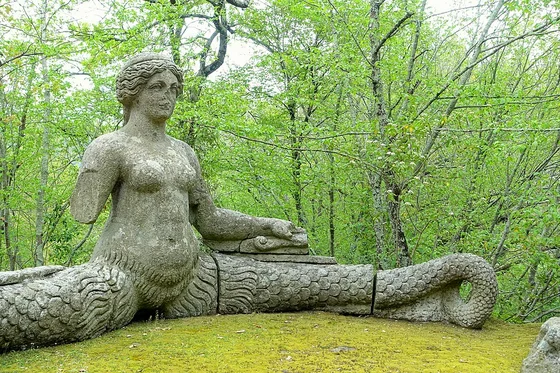
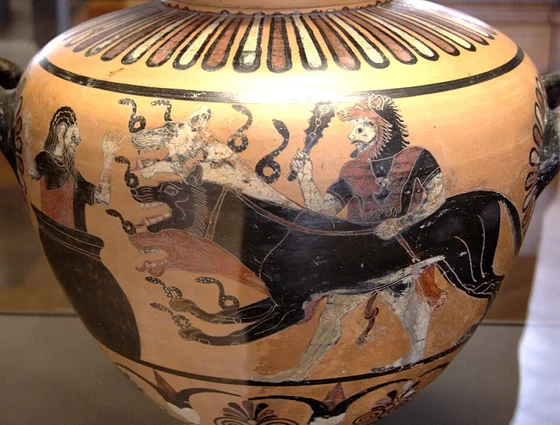
Textual genealogy: selected children of Typhon and Echidna in Library
Explicit named parentage in Library 2.3.1, 2.5.10, 2.5.11 and 3.5.8.
Scroll sideways to see all branches. With a keyboard, focus the tree and use the arrow keys.
- Parents: Typhon and Echidna
Combine four explicit parentage statements within one named work, keeping each creature under the stated Typhon–Echidna pair. This is a selected version attributed to Pseudo-Apollodorus. The Hesperides' dragon is identified with the Ladon profile, although this passage calls it the dragon rather than using that name. Hesiod gives that dragon different parents; the alternative remains separate. Sphinx means the Greek figure. Fosterers, killers and owners are not parents.
Typhon
The Library identifies the Chimera as offspring of Typhon and Echidna in its account of Bellerophon’s task. This records named parentage in a specific ancient compilation. Its mixed lion, goat and serpent anatomy is not a scientific hybrid formula, and the genealogy should not be presented as universal across every retelling.
Lion (Panthera leo), representative of the lion motif
Pseudo-Apollodorus, Library 2.3.1, gives the Chimera a lion's forepart, a dragon's tail and a goat head in the middle. The lion supplies one explicitly named animal component of that composite description. Panthera leo is a modern reference for the motif, not a proven specimen behind the story or an ancestor of a zoologically real hybrid.
Goat (Capra hircus), representative of the goat motif
Library 2.3.1 identifies the Chimera's middle head as a goat's and associates that head with its fire-breathing. A domestic-goat reference helps distinguish the recognizable animal component from the supernatural action. The passage does not identify a breed, document hybrid reproduction, or make a real goat responsible for the monster's origin.
Echidna
Library 2.3.1 states that Typhon begot the Chimera on Echidna. It separately reports that Amisodarus raised the creature, so birth and rearing should not be conflated. This edge uses the Library’s explicit parentage, leaving the Chimera’s lion, goat and dragon features as composite imagery rather than supposed biological contributions from three ordinary animal parents.
Located primary passages
Specific passages supporting details in this entry, grouped by their published witness.
Primary source witness
Historical English translation; translator’s preface dated 9 September 1914. Gutenberg includes the English portions and relocated footnotes.
- The Chimera combines lion, dragon and goat forms in this text.
- Pegasus and Bellerophon kill the Chimera.
This passage documents one ancient literary version. Translation publication dates are not ancient composition dates or earliest-attestation claims.
Bulfinch’s Mythology: The Age of Fable (revised by E. E. Hale)
Exact contiguous excerpt checked against the linked primary e-text on 2026-10-05; only whitespace normalized. Work first published 1855; date of the Hale revision used by this e-text is not specified.
- Bulfinch’s opening characterization of the Lycian monster.
Literary witness only. Bulfinch is a nineteenth-century reteller rather than the ancient origin text. Matching is limited to the specified profile and does not cross franchise, culture or animal-species boundaries.
The Library II.3.1–2
Pseudo-Apollodorus, The Library, James George Frazer translation, Loeb Classical Library121–122; Harvard University Press / William Heinemann,1921.
- The Chimera combines lion, dragon-tail and goat-head forms, breathes fire and ravages country and cattle; the compiler links Amisodarus and Typhon/Echidna versions to Homer and Hesiod.
- Bellerophon rides Pegasus above the Chimera and shoots it from the height.
Version-specific ancient compilation, not an earliest-attestation assertion. Compound episode claim was checked in full; the brief evidence excerpt is not the entire supporting passage.
Iliad VI.119–236, especially 179–183
Homer Iliad VI, A.T.Murray translation; Theoi Classical Texts Library identifies its older Loeb translation as1924 on BookI, distinct from its Lattimore biography excerpts. Actual hosted print impression not independently collated. Translator AugustusTaberMurray1866–1940 confirmed by Rutgers Database of Classical Scholars; Rutgers lists the two-volume edition1925, so the1924 field follows this host’s selected-volume label rather than an asserted first-publication resolution.
- On the battlefield Glaucus recites Bellerophon’s lineage to Diomedes. A false accusation sends Bellerophon to Lycia carrying a deadly tablet; after nine days of hospitality, the king orders the Chimera quest. The creature is of divine stock with lion front, serpent rear and goat middle, breathing fire. Bellerophon kills it trusting divine signs, then defeats Solymoi, Amazons and an ambush. Royal marriage and children precede isolation and family losses. Recognising inherited guest-friendship, the two battlefield speakers refuse mutual combat and exchange armour.
This complete selected encounter is not a full-Iliad claim. Glaucus’s recital does not name Pegasus, describe a lead weapon or explain a specific killing technique; those cannot be imported from later accounts.
The Extant Odes of Pindar — Olympian XIII
Pindar, The Extant Odes, translated ErnestMyers, London:Macmillan1904, actual hosted title page. First edition1874 and intervening reprints appear in edition history;1904 is the inspected textual witness. OlympianXIII headed ToXenophonOfCorinth,WinnerInTheStadionRaceAndInThePentathlon; complete ode and its footnotes read, not the later Isthmian ode of the same Roman number.
- The Corinthian victory ode recounts Bellerophon’s struggle to bridle Pegasus and Athena’s dream gift of a golden bit. After the prophet interprets the vision, Bellerophon gains the winged horse. From the air the pair attack Amazons, Solymoi and fire-breathing Chimaira. The poet declines to narrate Bellerophon’s fate, while Pegasus finds a home in Zeus’s Olympian stalls.
The complete ode supplies airborne companionship, not triple anatomy or a specific death weapon. Its victory context and editorial notes are distinguished from the monster episode;1904 is the inspected edition, not the ancient composition date.
Encyclopedia background
An additional attributed reference, separate from the editorial profile above.
Read the open encyclopedia overview
The Chimera, Chimaera, Chimæra, or Khimaira ( ky-MEER-ə, kih-, -MAIR-; Ancient Greek: Χίμαιρα, romanized: Chímaira, lit. 'she-goat') was a monstrous fire-breathing hybrid creature in Greek mythology, said to be from Lycia, Asia Minor, and composed of different animal parts. Typically, it is depicted as a lion with a goat's head protruding from its back and a tail ending with a snake's head. Some representations also include dragon's wings. It was an offspring of Typhon and Echidna and a sibling of monsters like Cerberus and the Lernaean Hydra.
The term "chimera" has come to describe any mythical or fictional creature with parts taken from various animals.
Text from Wikipedia contributors, “Chimera (mythology)”. CC BY-SA 4.0. Extracted introduction; formatting changed. Retrieved 5 October 2026. The source article may have changed since retrieval.
References
Sources supporting this profile. Linked pages have their own scope and editorial standards.
- Primary literary translationHomer, Iliad VI, Murray translationResearch access: 2026-10-05
- Primary literary translationHesiod, Theogony, Evelyn-White translationResearch access: 2026-10-05
- Primary literary translationPindar, Olympian XIII, Myers 1904 editionResearch access: 2026-10-05
- Primary literary translationPseudo-Apollodorus, Library II, Frazer translationResearch access: 2026-10-05
- Museum exhibition researchGetty, The Chimaera of Arezzo exhibition: Religion and DiscoveryResearch access: 2026-10-05
Image credits
Reference illustrationChimera
Image associated with the exact linked encyclopedia article; consult credited file description for its interpretation.