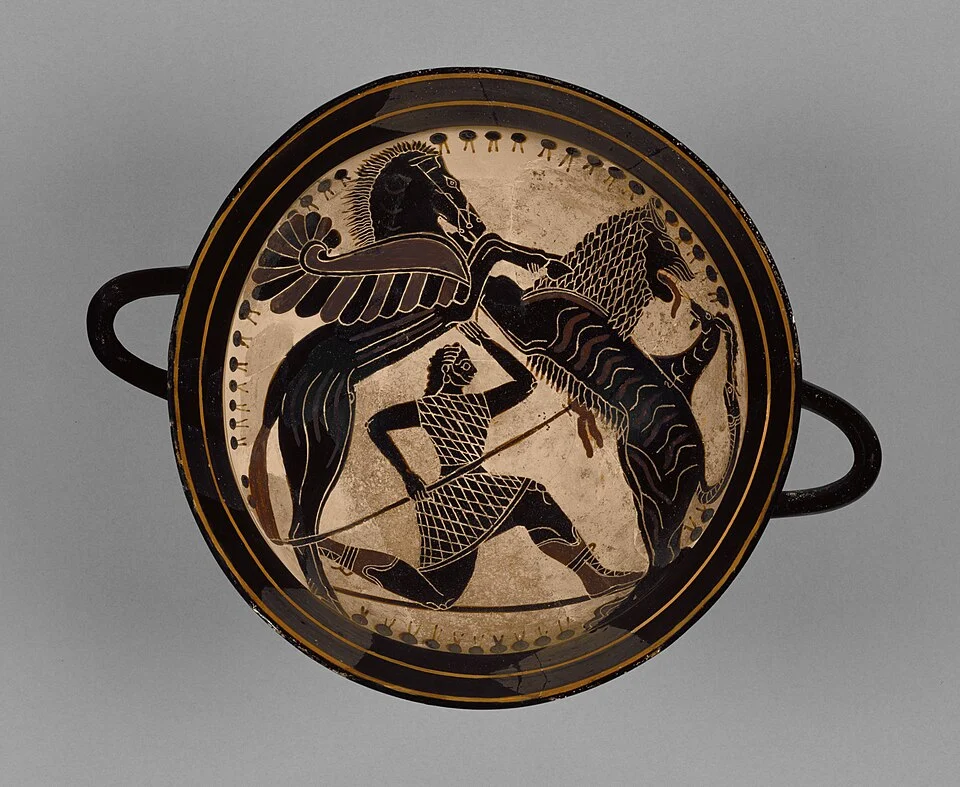
Pegasus
Image associated with the exact linked encyclopedia article; consult credited file description for its interpretation.
Overview
Pegasus is an individually named horse whose flight connects several ancient Greek narratives. In Hesiod’s Theogony, Medusa bears Pegasus and Chrysaor when Perseus cuts off her head. The preceding passage places her with Poseidon in a flowering meadow. Hesiod explains the horse’s name through the springs of Ocean, then sends him from earth to the immortals: he lives with Zeus and carries thunder and lightning. This is the poem’s own account of the name and divine service. It should be distinguished from a modern linguistic proof or a complete sequence of every later adventure attributed to Pegasus.
Pindar’s Olympian XIII gives Bellerophon’s capture of the horse a ritual and dream setting. After unsuccessful efforts at Peirene’s spring, the hero sleeps at Athena’s altar under a seer’s direction. The goddess appears with a golden bridle, which remains beside him when he wakes. The seer directs him to offer a bull to Poseidon and establish an altar to Athena associated with horses. He then bridles Pegasus and takes to the air. The ode makes the horse his companion against the Amazons, Solymi and fire-breathing Chimera, before leaving the hero’s eventual fate unspoken and placing Pegasus in Zeus’s Olympian stalls. The sequence belongs to a victory ode celebrating Corinthian achievement, rather than a detached catalogue of equine characteristics.
The Library supplies a more compact combat account. It explicitly identifies Pegasus as the winged offspring of Medusa and Poseidon and has Bellerophon shoot down the Chimera from above. Its later Perseus narrative describes both Pegasus and Chrysaor emerging from the beheaded Gorgon. That account gives Perseus winged sandals for his own journey. It does not say that Pegasus carries him during the inspected escape and Andromeda episodes; the equipment and companions assigned to different heroes should remain distinct.
The horse also appears in warnings about human ambition. In Pindar’s ode for Strepsiades, Pegasus throws Bellerophon when the rider seeks the gods’ heavenly dwelling and the company of Zeus. The brief comparison follows reflections on mortal limits. It does not specify a gadfly causing the fall. This ode is numbered VI in the inspected Myers edition, while the separate Pindar and Anacreon witness numbers the Strepsiades ode VII. Identifying the victor and passage avoids treating the differing numbers as two different stories.
Pausanias records local associations rather than one uninterrupted biography. At Corinth, the account attached to Athena the Bridler says the goddess herself tamed Pegasus and delivered him to Bellerophon, differing in emphasis from Pindar’s dream and bridle. At Troezen, a Horse’s Fountain is connected with a hoof-strike and with water used to cleanse Orestes. On Helicon, another such fountain lies above the grove of the Muses; Pausanias reports that Bellerophon’s horse struck the ground to produce it. These are separately located traditions. The existence of a spring supports the geographical setting, while the miraculous explanation remains an attributed story.
A surviving Corinthian silver stater gives material evidence for the horse’s public imagery. Cleveland Museum of Art dates object 1916.984 to about 350–338 BCE and identifies a flying Pegasus on one face and helmeted Athena on the other. The catalogue also explains the archaic koppa as a reference to Corinth. The coin attests the use of these images in an ancient manufactured object. It neither establishes the first appearance of the story nor supplies zoological evidence for a winged horse.
Origins & earliest records
The selected Theogony and fifth-century Pindar witnesses precede the later Library and Pausanias accounts. A Corinthian coin dated about350–338 BCE is a separately documented object. These sources establish particular ancient representations; this entry has not demonstrated the first oral telling, earliest image or origin of all winged-horse motifs.
Records & interpretation
Poems, mythographic prose, a travel account and an extant coin supply different forms of evidence for Pegasus’s representation. Parentage belongs to narrative genealogy, fountain creation to attributed local tradition, and the coin to material iconography. None is a specimen or biological evolutionary record of a flying horse. Contemporary custodial metadata was read; no new coin image is approved by this text review.
In the literature
“When Perseus cut off Medusa's head, the blood sinking into the earth produced the winged horse Pegasus.”
Chapter X, “Pegasus and the Chimaera”, opening paragraph
A later retelling of Pegasus’s birth; not a claim that all ancient accounts describe earth-produced birth.
“there sprang forth great Chrysaor and the horse Pegasus”
Theogony, lines 270–294 · Hugh G. Evelyn-White
Pegasus and Chrysaor emerge when Perseus cuts off Medusa’s head.
“he dwells in the house of Zeus and brings to wise Zeus the thunder and lightning.”
Theogony, lines 270–294 · Hugh G. Evelyn-White
Pegasus serves Zeus after leaving the earth.
“Thus did winged Pegasos throw his lord Bellerophon”
Isthmian VI in Myers, Strepsiades ode, final exemplum before concluding invocation · Ernest Myers
Pegasos throws Bellerophon during his attempted entry into the divine dwelling; no gadfly is named.
Selected bibliography
Documented works and useful reading. This is not a list of every appearance.
- 01
Theogony, lines 270–294 and 319–325
Medusa, Pegasus and Chrysaor context; name explanation, service to Zeus and brief Chimera victory. Selected passages, not the complete poem.
- 02
Olympian XIII, for Xenophon of Corinth
Complete ode and associated Myers introduction/notes read; Peirene, dream bridle, rituals, aerial battles and Olympian stalls.
- 03
The Library, II.3.1–2 and II.4.2–3
Complete Bellerophon episode and selected Perseus birth/escape/Andromeda context; separate modes of flight retained.
- 04
Isthmian ode for Strepsiades: VI in Myers, VII in the comparison witness
Complete short ode and notes read. Brief Bellerophon fall has no specified gadfly. Myers treats a proposed date as conjectural.
- 05
Description of Greece, II.4.1, II.31.8–9 and IX.31.3
Separate Corinthian taming and Troezen/Helicon fountain notices with their immediate context; exact URLs for all three locations retained among sources.
- 06
Theogony, in Hesiod, the Homeric Hymns, and Homerica
Historical English translation; translator’s preface dated 9 September 1914. Gutenberg includes the English portions and relocated footnotes.
- 07
Bulfinch’s Mythology: The Age of Fable (revised by E. E. Hale)
Exact contiguous excerpt checked against the linked primary e-text on 2026-10-05; only whitespace normalized. Work first published 1855; date of the Hale revision used by this e-text is not specified.
- 08
The Library (Bibliotheca)
Pseudo-Apollodorus, The Library, James George Frazer translation, Loeb Classical Library121–122; Harvard University Press / William Heinemann,1921.
- 09
The Extant Odes of Pindar — Olympian XIII
Pindar, The Extant Odes, translated ErnestMyers, London:Macmillan1904, actual hosted title page. First edition1874 and intervening reprints appear in edition history;1904 is the inspected textual witness. OlympianXIII headed ToXenophonOfCorinth,WinnerInTheStadionRaceAndInThePentathlon; complete ode and its footnotes read, not the later Isthmian ode of the same Roman number.
- 10
The Extant Odes of Pindar — Isthmian VI for Strepsiades
Ernest Myers translation, Macmillan1904 selected title-page witness; complete Isthmian VI, For Strepsiades of Thebes, Winner in the Pankration, with four footnotes and prefatory date qualification read. This edition numbers the Strepsiades ode VI; the separate Pindar and Anacreon witness numbers it VII. No assertion whole Pindar volume read.
- 11
Description of Greece — BookII Pegasus notices
Hosted historical W.H.S.Jones translation of Pausanias BookII; selected numbered notice and immediate context read from root-retained full page, not whole book. Series spans1918–1935; 1918 is historical volume context, not a newly identified hosted impression. Exact modern site framing is not copied.
- 12
Description of Greece — BookIX Pegasus notices
Hosted historical W.H.S.Jones translation of Pausanias BookIX; selected numbered notice and immediate context read from root-retained full page, not whole book. Series spans1918–1935; 1935 is historical volume context, not a newly identified hosted impression. Exact modern site framing is not copied.
Family, evolution & connections
Textual genealogy: children of Medusa and Poseidon in Library
Pegasus and Chrysaor at Library 2.4.2; Pegasus's parentage is repeated at 2.3.2.
Scroll sideways to see all branches. With a keyboard, focus the tree and use the arrow keys.
- Parents: Medusa and Poseidon
- Chrysaor
Use the explicit statement that Medusa had Pegasus and Chrysaor by Poseidon, rather than inferring parentage from the beheading scene alone. A supernatural birth narrative in this particular text. Perseus causes the emergence by beheading Medusa but is not identified as a parent. Chrysaor has no local profile yet and is retained as a named node. No direct biological ancestry is implied.
Medusa
The Library identifies Pegasus as offspring of Medusa and Poseidon while describing Bellerophon’s aerial attack on the Chimera. This connects the winged horse to the Gorgon story through explicit literary parentage. It does not make horses and snake-haired beings biological relatives or establish that later adaptations preserve the same origin.
Chrysaor
In Hesiod’s Theogony, lines 270–286, Pegasus and Chrysaor emerge when Perseus beheads Medusa. The poem subsequently gives Chrysaor a separate marriage and offspring, while Pegasus enters Zeus’s household. This is an explicitly textual sibling connection. It does not make Chrysaor a winged horse or turn the extraordinary birth scene into a biological mechanism.
Poseidon
Apollodorus’s Library 2.4.2 states that Medusa had Pegasus and Chrysaor by Poseidon, immediately after describing their emergence at her beheading. This supplies explicit parentage for the selected account. Hesiod uses a divine epithet in the corresponding passage; the present edge relies on Apollodorus’s named identification rather than guessing a parent from the horse’s appearance or powers.
Located primary passages
Specific passages supporting details in this entry, grouped by their published witness.
Primary source witness
Historical English translation; translator’s preface dated 9 September 1914. Gutenberg includes the English portions and relocated footnotes.
- Pegasus and Chrysaor emerge when Perseus cuts off Medusa’s head.
- Pegasus serves Zeus after leaving the earth.
This passage documents one ancient literary version. Translation publication dates are not ancient composition dates or earliest-attestation claims.
Bulfinch’s Mythology: The Age of Fable (revised by E. E. Hale)
Exact contiguous excerpt checked against the linked primary e-text on 2026-10-05; only whitespace normalized. Work first published 1855; date of the Hale revision used by this e-text is not specified.
- A later retelling of Pegasus’s birth; not a claim that all ancient accounts describe earth-produced birth.
Literary witness only. Bulfinch is a nineteenth-century reteller rather than the ancient origin text. Matching is limited to the specified profile and does not cross franchise, culture or animal-species boundaries.
The Library, II.3.1–2 and II.4.2–3
Pseudo-Apollodorus, The Library, James George Frazer translation, Loeb Classical Library121–122; Harvard University Press / William Heinemann,1921.
- The winged horse Pegasus emerges with Chrysaor after Medusa is beheaded; Poseidon is given as their father.
- Pegasus carries Bellerophon in the aerial attack that kills the Chimera.
Version-specific ancient compilation, not an earliest-attestation assertion. Compound episode claim was checked in full; the brief evidence excerpt is not the entire supporting passage.
The Extant Odes of Pindar — Olympian XIII
Pindar, The Extant Odes, translated ErnestMyers, London:Macmillan1904, actual hosted title page. First edition1874 and intervening reprints appear in edition history;1904 is the inspected textual witness. OlympianXIII headed ToXenophonOfCorinth,WinnerInTheStadionRaceAndInThePentathlon; complete ode and its footnotes read, not the later Isthmian ode of the same Roman number.
- Pegasus is the snaky Gorgon’s son at Peirene’s spring. Bellerophon’s failed attempts end when Athena provides a golden bit in a dream that becomes physical reality. The prophet confirms the divine aid; Bellerophon binds and rides the winged steed, attacks Amazons, Solymoi and Chimaira from the air, and Pegasus ultimately occupies Zeus’s ancient stalls.
The line says Gorgon rather than naming Medusa here. No specific Chimaira weapon or later Bellerophon fall is supplied; the poet explicitly keeps the latter silent. Sacred instructions are paraphrased without excerpting formulae.
The Extant Odes of Pindar — Isthmian VI for Strepsiades
Ernest Myers translation, Macmillan1904 selected title-page witness; complete Isthmian VI, For Strepsiades of Thebes, Winner in the Pankration, with four footnotes and prefatory date qualification read. This edition numbers the Strepsiades ode VI; the separate Pindar and Anacreon witness numbers it VII. No assertion whole Pindar volume read.
- The ode celebrates Strepsiades’s pankration victory and the renown of his deceased warrior uncle of the same name. Its warning against unattainable divine heights invokes winged Pegasos throwing Bellerophon when he wishes to enter Zeus’s company. It supplies no gadfly or detailed fatal outcome. Myers’s proposed link between the uncle’s battle and Oinophyta is explicitly conjectural.
Myers VI is not silently relabelled with the comparison witness VII. The concluding invocation and other sacred language are not excerpted; no specific date established from the translator’s tentative suggestion.
Description of Greece, II.4.1, II.31.8–9 and IX.31.3
Hosted historical W.H.S.Jones translation of Pausanias BookII; selected numbered notice and immediate context read from root-retained full page, not whole book. Series spans1918–1935; 1918 is historical volume context, not a newly identified hosted impression. Exact modern site framing is not copied.
- At Corinth Pausanias describes Athena Chalinitis’s temple and reports the local belief that Athena helped Bellerophontes by herself breaking in and bridling Pegasus before delivering him to the hero. The next paragraph distinguishes the writer’s judgement on the hero’s political subjection from the preceding local tradition.
Local reported attribution to Athena is distinct from Pindar’s dream-gift and the hero’s own taming; not evidence that every ancient author narrated the same sequence.
Primary source witness
Hosted historical W.H.S.Jones translation of Pausanias BookII; selected numbered notice and immediate context read from root-retained full page, not whole book. Series spans1918–1935; 1918 is historical volume context, not a newly identified hosted impression. Exact modern site framing is not copied.
- Pausanias describes the Troezen Booth of Orestes and the purification tradition, then names Horse’s Fountain water among the reported cleansing means. Troezenians say the earth produced its water when Pegasus struck the ground with a hoof, comparing it with the Boeotian account. The same notice separately reports Bellerophontes’s proposed marriage to Aethra and banishment before it took place.
Troezen fountain is a separate local site from Helicon; proposed marriage is not a completed wedding or Pegasus parentage. Ritual details are paraphrased, without copying formulas.
Description of Greece — BookIX Pegasus notices
Hosted historical W.H.S.Jones translation of Pausanias BookIX; selected numbered notice and immediate context read from root-retained full page, not whole book. Series spans1918–1935; 1935 is historical volume context, not a newly identified hosted impression. Exact modern site framing is not copied.
- Within his account of Helicon dedications and local celebrations, Pausanias places Horse’s Fountain roughly twenty stades above the grove. The local account says Bellerophon’s horse made it by striking the ground with a hoof. Pegasus is not named in this particular sentence, unlike the Troezen passage.
IX.31.3, complete Horse’s Fountain notice with31.2/31.4 context
The identification through Bellerophon’s horse is explicitly qualified; the text does not say the horse invented poetry or assign this fountain to Troezen.
Encyclopedia background
An additional attributed reference, separate from the editorial profile above.
Read the open encyclopedia overview
Pegasus (Ancient Greek: Πήγασος, romanized: Pḗgasos; Latin: Pegasus, Pegasos) is a winged horse in Greek mythology, usually depicted as a white stallion. He was sired by Poseidon, in his role as horse-god, and foaled by Medusa, one of three Gorgon sisters. Pegasus was the brother of Chrysaor, both born from Medusa's blood when their mother was decapitated by Perseus. Greco-Roman poets wrote about his ascent to heaven after his birth and his obeisance to Zeus, who instructed him to bring lightning and thunder from Olympus.
Pegasus is the creator of Hippocrene, the fountain on Mount Helicon. He was captured by the Greek hero Bellerophon, near the fountain Peirene, with the help of Athena and Poseidon. Pegasus allowed Bellerophon to ride him in order to defeat the monster Chimera, which led to many more exploits. Bellerophon later fell from Pegasus's back while trying to reach Mount Olympus. Both Pegasus and Bellerophon were said to have died at the hands of Zeus for trying to reach Olympus. Other tales have Zeus bring Pegasus to Olympus to carry his thunderbolts.
Also known as a constellation, Pegasus is a subject of much iconography, especially through ancient Greek pottery as well as paintings and sculptures of the Renaissance.
Text from Wikipedia contributors, “Pegasus”. CC BY-SA 4.0. Extracted introduction; formatting changed. Retrieved 5 October 2026. The source article may have changed since retrieval.
References
Sources supporting this profile. Linked pages have their own scope and editorial standards.
- Primary literary translationHesiod, Theogony, Evelyn-White translationResearch access: 2026-10-05
- Primary literary translationPindar, complete Olympian XIII and Isthmian Strepsiades ode, Myers1904Research access: 2026-10-05
- Primary literary translationPseudo-Apollodorus, Library II, Frazer translationResearch access: 2026-10-05
- Primary literary translationPausanias II.4: Athena the Bridler at CorinthResearch access: 2026-10-05
- Primary literary translationPausanias II.31: Horse’s Fountain at TroezenResearch access: 2026-10-05
- Primary literary translationPausanias IX.31: Horse’s Fountain on HeliconResearch access: 2026-10-05
- Custodial object descriptionCleveland Museum of Art: Corinthian stater1916.984Research access: 2026-10-05
- Historical translation and numbering comparisonPindar and Anacreon: Strepsiades ode numbered VIIResearch access: 2026-10-05
Image credits
Reference illustrationPegasus
Image associated with the exact linked encyclopedia article; consult credited file description for its interpretation.