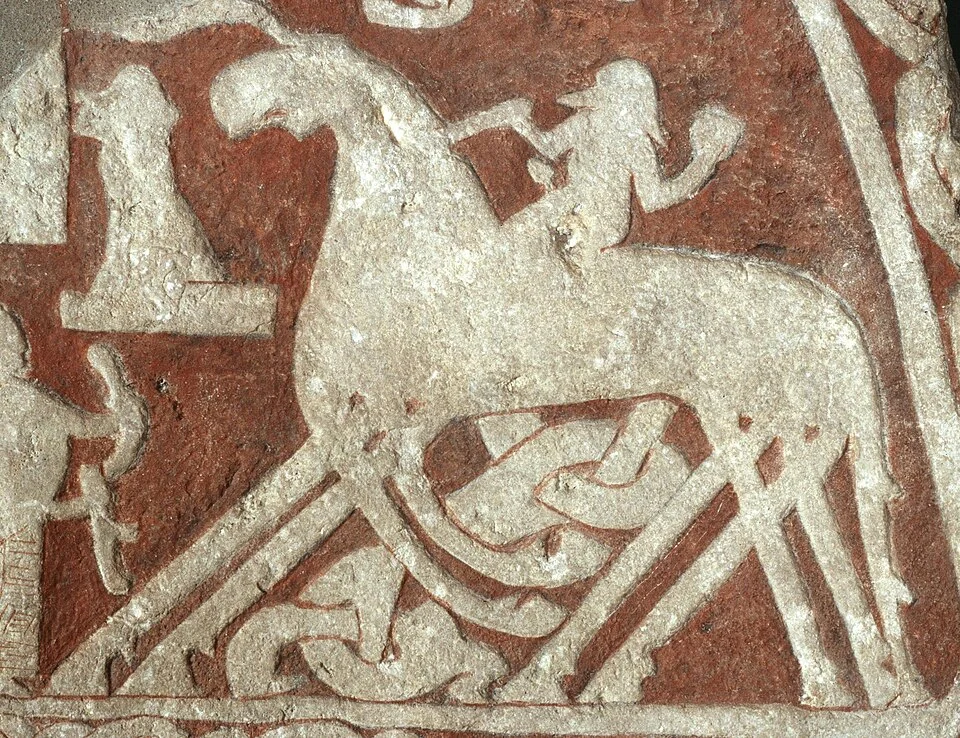
Sleipnir
Image associated with the exact linked encyclopedia article; consult credited file description for its interpretation.
Overview
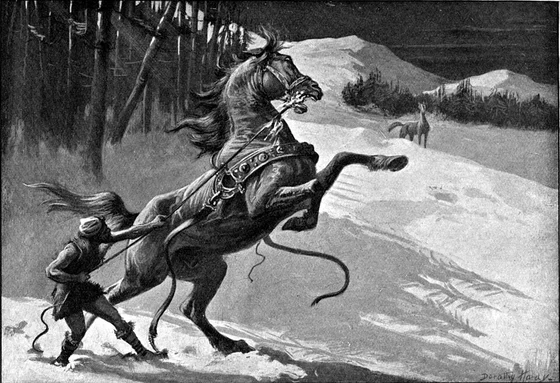
A builder offers to complete a stronghold for the gods under terms that could cost them Freyja, the sun and the moon. His stallion Svaðilfari contributes such exceptional labor that completion seems possible. Loki takes a mare’s form and draws the stallion away, interrupting the work and preventing the builder from meeting the deadline.
Loki subsequently gives birth to a gray foal with eight legs, identified as the finest horse among gods and men. Sleipnir also carries Hermóðr on the journey to Hel in the account of Baldr’s death. These episodes link the mount with difficult bargains and travel across an extraordinary boundary. Modern theories about the eight legs are interpretations and should be distinguished from what the text actually narrates.
Gylfaginning XLII locates the birth in the gods’ first construction of their stronghold. The bargain is narrowed to completion in one winter, without another person’s assistance, but the builder is allowed Svaðilfari at Loki’s urging. The stallion hauls astonishing stones and performs more rough work than the builder. Three days before summer, only the gate remains unfinished. Threatened by the gods for his advice, Loki arranges the mare’s distraction. The horses run all night, construction falls behind, and the builder reveals his giant nature. Thor kills him despite the earlier sworn bargain. Sleipnir’s birth follows this sequence; the prose does not explain eight limbs by a burial custom or shamanic theory.
Section XV names Sleipnir as Odin’s eight-footed horse and the best among the divine mounts used for journeys to the gods’ judgement place at Yggdrasill. Section XLIX then lends that mount to Hermóðr for the embassy concerning Baldr. Rider and horse travel nine nights through deep, dark valleys to the river Gjöll. Its bridge-keeper remarks on the tremendous sound of the living traveller’s crossing and directs him down and north towards Hel.
At Hel’s gate, Hermóðr dismounts, tightens the girths and mounts again. Sleipnir leaps so high that he clears the gate without touching it. The embassy reaches Baldr, but Hel makes release conditional on universal mourning, and a refusal subsequently prevents his return. Sleipnir thus enables the journey across the barrier; he does not himself restore Baldr or overcome Hel’s condition.
Origins & earliest records
This entry follows Gylfaginning, sections XV; XLII; XLIX, in Snorri Sturluson’s Prose Edda, composed around 1220 and translated here by Arthur Gilchrist Brodeur in 1916. The medieval work incorporates older poetic traditions, but its compilation date does not establish the beginning of a being’s oral history or every earlier attestation.
Records & interpretation
Located Gylfaginning episodes in Arthur Gilchrist Brodeur’s 1916 translation preserve the named being’s actions and the prose narrator’s qualifications. Chapter numbering and printed page references belong to this edition, rather than to every manuscript or modern translation.
In the literature
“Sleipner is the best one; he belongs to Odin, and he has eight feet.”
The Fooling of Gylfe, chapter VII, section 15 · Rasmus Björn Anderson
The catalogue of divine horses identifies Odin’s eight-footed steed.
“But Loke had run such a race with Svadilfare that he some time after bore a foal.”
The Fooling of Gylfe, chapter XIII, section 43 · Rasmus Björn Anderson
The building episode explicitly identifies Loki as the foal’s bearer; the next sentence gives the eight-footed anatomy.
Selected bibliography
Documented works and useful reading. This is not a list of every appearance.
- 01
Prose Edda: Gylfaginning XV, p. 28; XLII, pp. 53–56; XLIX, pp. 72–75
Brodeur’s located 1916 prose translation; episode outcomes and explicitly competing fishing accounts retained where applicable.
- 02
The Younger Edda
Chicago: Scott, Foresman and Company, 1901; translation copyright 1879, with translator’s preface dated September 1879.
Family, evolution & connections
Textual genealogy: Sleipnir in Gylfaginning
Sleipnir's origin in the fortress-builder episode, chapter XLII.
Scroll sideways to see all branches. With a keyboard, focus the tree and use the arrow keys.
- Parents: Loki (in mare form) and Svadilfari
Identify the foal introduced in the Sleipnir discussion: Loki, in mare form, encounters the stallion Svadilfari and later gives birth. The root names the two narrative parents. Loki's mare form is a transformation of that character, not a separate ancestor. Odin's later possession of the horse is not parentage. This is textual genealogy, not biological evolution.
Svaðilfari
Gylfaginning connects the birth of the eight-legged horse with Loki’s encounter with Svaðilfari during the builder episode. The parentage belongs to the story’s shapeshifting circumstances. It should be displayed as mythic kinship, not as a scientifically possible horse pedigree or evidence that extra legs mark evolutionary advancement.
Grani (Volsunga saga)
When Sigurd selects Grani, the old man later identified as Odin says the horse comes from Sleipnir’s kin. The wording establishes an ancestral or family association but does not specify that Grani is Sleipnir’s immediate son. This record preserves that narrower statement. No intervening horses, reproductive mechanism or evolutionary branch is invented to convert an unspecified saga relationship into a complete pedigree.
Located primary passages
Specific passages supporting details in this entry, grouped by their published witness.
Primary source witness
Chicago: Scott, Foresman and Company, 1901; translation copyright 1879, with translator’s preface dated September 1879.
- The catalogue of divine horses identifies Odin’s eight-footed steed.
This documents Snorri’s literary account in Anderson’s translation, not zoological existence or a universal account of all Norse traditions.
Primary source witness
Chicago: Scott, Foresman and Company, 1901; translation copyright 1879, with translator’s preface dated September 1879.
- The building episode explicitly identifies Loki as the foal’s bearer; the next sentence gives the eight-footed anatomy.
This documents Snorri’s literary account in Anderson’s translation, not zoological existence or a universal account of all Norse traditions.
Primary source witness
Rasmus Björn Anderson translation, Chicago: Scott, Foresman and Company, 1901; translation copyright 1879.
- The foal born after Loki’s encounter with Svaðilfari is gray and eight-footed.
Version-specific detail in the translated literary narrative; not an earliest-attestation or real-fauna claim.
Encyclopedia background
An additional attributed reference, separate from the editorial profile above.
Read the open encyclopedia overview
In Norse mythology, Sleipnir (Old Norse: "slippy" or "the slipper") is an eight-legged horse ridden by Odin. Sleipnir is attested in the Poetic Edda, compiled in the 13th century from earlier traditional sources, and the Prose Edda, written in the 13th century by Snorri Sturluson. In both sources, Sleipnir is Odin's steed, while also being the child of Loki and Svaðilfari. It is described as the best of all horses, and is sometimes ridden to the location of Hel. The Prose Edda contains extended information regarding the circumstances of Sleipnir's birth, and details that he is grey in color.
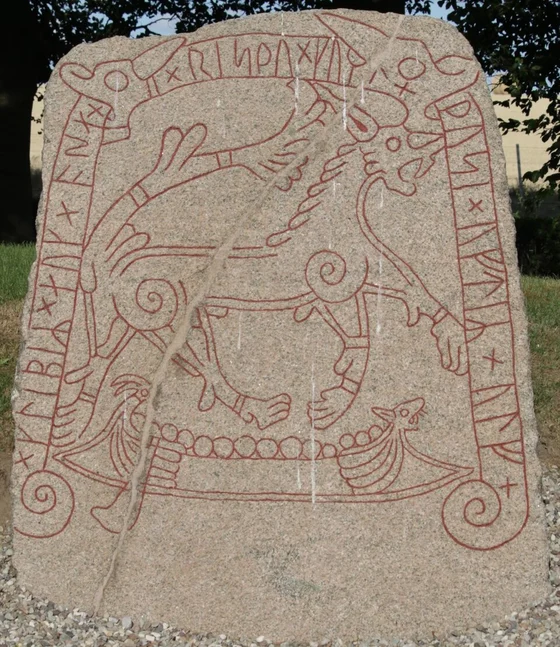
Sleipnir is also mentioned in a riddle found in the 13th-century legendary saga Hervarar saga ok Heiðreks, in the 13th-century legendary saga Völsunga saga as the ancestor of the horse Grani, and book I of Gesta Danorum, written in the 12th century by Saxo Grammaticus, contains an episode considered by many scholars to involve Sleipnir. Sleipnir is generally accepted as depicted on two 8th-century Gotlandic image stones: the Tjängvide image stone and the Ardre VIII image stone.
Scholarly theories have been proposed regarding Sleipnir's potential connection to shamanic practices among the Norse pagans. In modern times, Sleipnir appears in Icelandic folklore as the creator of Ásbyrgi, in works of art, literature, software, and in the names of ships.
Text from Wikipedia contributors, “Sleipnir”. CC BY-SA 4.0. Extracted introduction; formatting changed. Retrieved 5 October 2026. The source article may have changed since retrieval.
References
Sources supporting this profile. Linked pages have their own scope and editorial standards.
- Primary textThe Prose Edda: Gylfaginning XV; XLII; XLIX (Brodeur translation)Research access: 2026-10-05
Image credits
Reference illustrationSleipnir
Image associated with the exact linked encyclopedia article; consult credited file description for its interpretation.