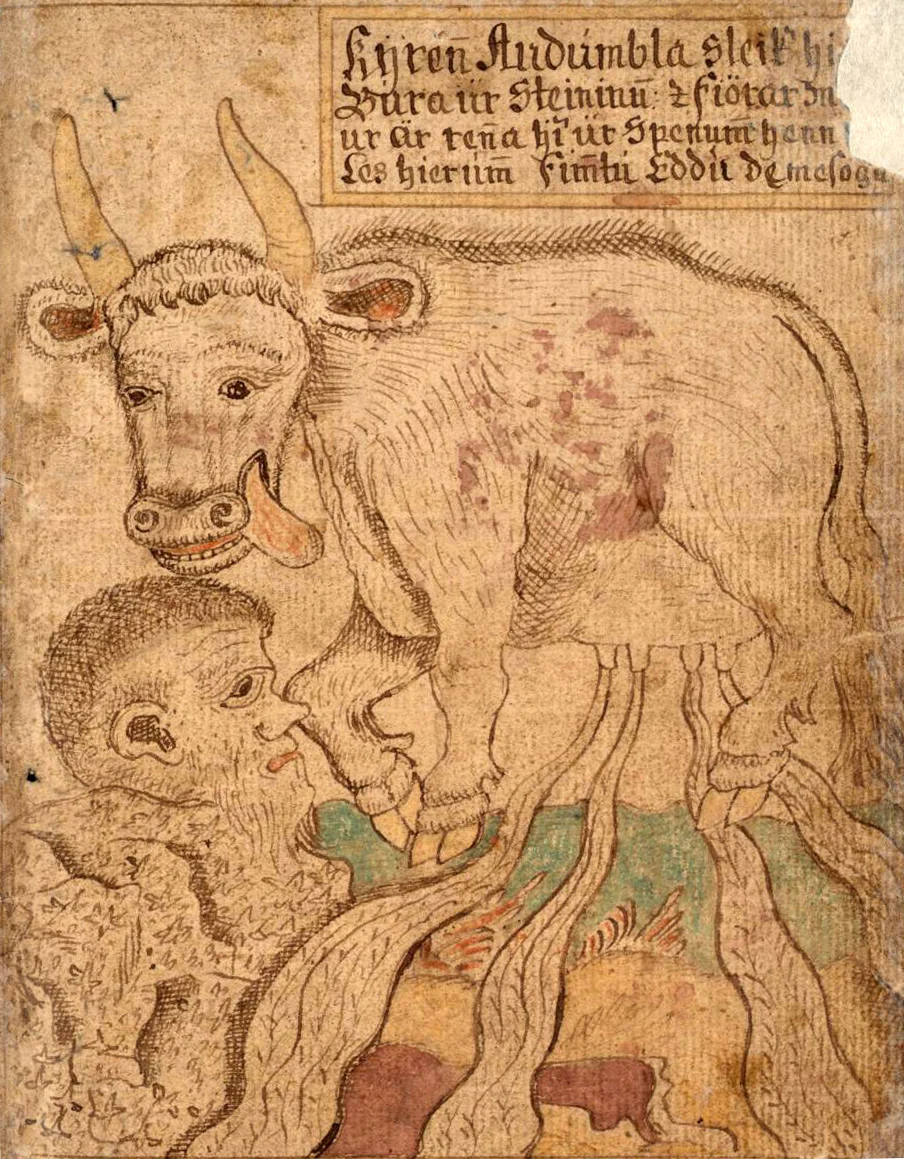
Auðumbla
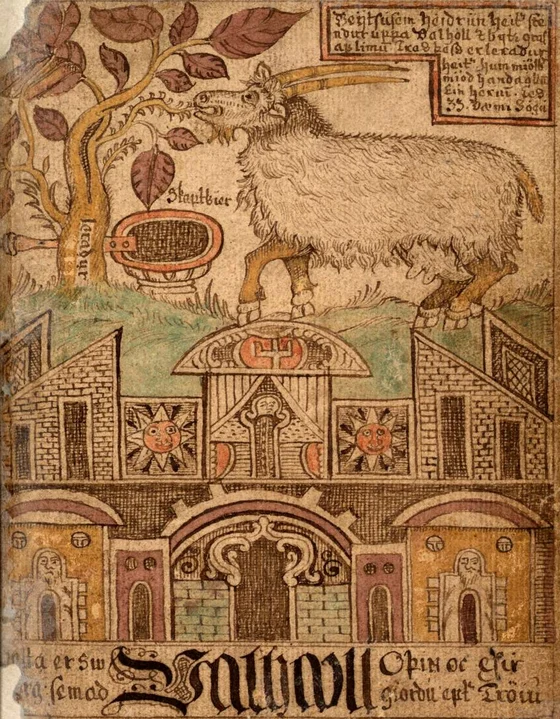
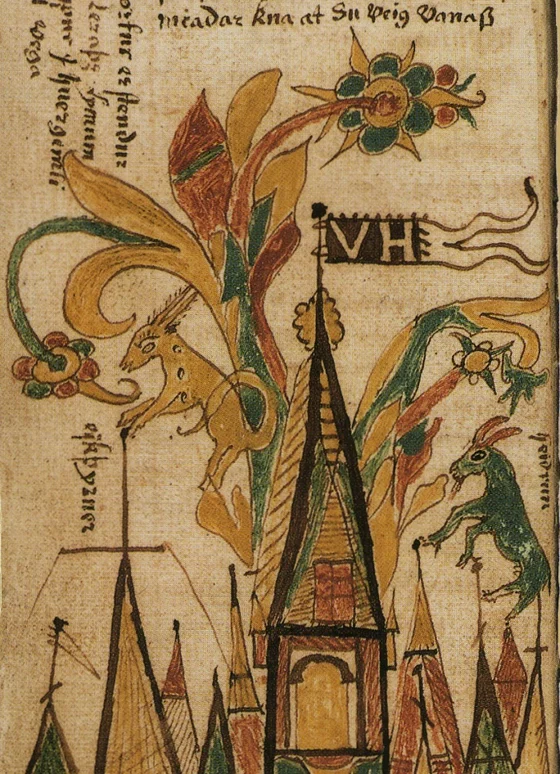
Image associated with the exact linked encyclopedia article; consult credited file description for its interpretation.
Overview
Auðumbla appears in the account of beginnings told to Gangleri in Gylfaginning. In Rasmus B. Anderson’s translation, where her name is printed Audhumbla, the cow is formed when the primordial rime melts into drops. She follows Ymir’s emergence in the narrative, before the world has been fashioned from his body. The account gives her a practical role in this otherwise unfamiliar setting: four streams of milk flow from her teats and feed the giant.
Gangleri then asks what feeds the cow herself. She licks the salty stones covered with rime. By the first evening a man’s hair has emerged; on the second day his head appears; on the third the whole man is revealed. This is Búri, described as handsome, great and powerful. The text does not narrate an ordinary birth from the cow. Her licking uncovers him from the frozen material, so a relationship diagram should distinguish this action from parentage.
The following sentences connect Búri to the gods. He fathers Borr, who marries Bestla, daughter of the giant Bölþorn. Their sons are Odin, Vili and Vé. Thus Auðumbla’s feeding of Ymir and her uncovering of Búri place her beside two lines within this particular creation account. Ymir’s descendants and Búri’s descendants are not simply a single lineage descending biologically from the cow.
The surrounding dialogue describes the meeting of heat and frost and later the killing of Ymir, but the selected passage gives Auðumbla no separate journey, named mate or account of her eventual fate. Her few recorded actions are nevertheless precise: she emerges, nourishes and uncovers. They are presented as a medieval literary account of the cosmos, with Anderson’s Audhumbla, Ymer and Bure corresponding to the normalized names Auðumbla, Ymir and Búri used here.
Origins & earliest records
The directly read account is Gylfaginning, Anderson’s The Fooling of Gylfe, Chapter IV, paragraph 6, pp. 59–60, with the surrounding creation dialogue. The inspected title page is dated 1901 and carries a copyright notice of 1879. This edition date is distinct from the medieval work and does not date the beginning of oral tradition.
Records & interpretation
Complete paragraphs 4–7 and their immediate narrative frame read. They locate the cow, the three-day uncovering and the ensuing genealogy; they provide textual evidence for the account rather than biological evidence for a primordial cow.
In the literature
“Four milk-streams ran from her teats, and she fed Ymer.”
The Fooling of Gylfe, chapter IV, section 6 · Rasmus Björn Anderson
Auðumbla feeds Ymir during the creation narrative.
Selected bibliography
Documented works and useful reading. This is not a list of every appearance.
- 01
The Younger Edda: The Fooling of Gylfe
Chapter IV, The Creation of the World, paragraph 6, pp. 59–60; surrounding paragraphs 4–7 also read. Names are normalized in the profile, not quoted as Anderson’s spellings.
- 02
The Younger Edda
Chicago: Scott, Foresman and Company, 1901; translation copyright 1879, with translator’s preface dated September 1879.
Family, evolution & connections
Ymir
Younger Edda section 6 says the cow Audhumbla formed from melting rime and fed Ymer through four streams of milk. The giant’s nourishment is explicit, but the text does not call the cow his mother. This records a feeding relationship within the creation narrative, without translating magical formation, enormous milk streams or cosmic scale into real cattle biology.
Located primary passages
Specific passages supporting details in this entry, grouped by their published witness.
Primary source witness
Chicago: Scott, Foresman and Company, 1901; translation copyright 1879, with translator’s preface dated September 1879.
- Auðumbla feeds Ymir during the creation narrative.
This documents Snorri’s literary account in Anderson’s translation, not zoological existence or a universal account of all Norse traditions.
Primary source witness
Rasmus Björn Anderson translation, Chicago: Scott, Foresman and Company, 1901; translation copyright 1879.
- Auðumbla comes into being as frozen rime melts.
- The cow feeds by licking salt-covered frozen stones.
- Three days of licking reveal Buri, whose name is given in the following sentence.
Version-specific detail in the translated literary narrative; not an earliest-attestation or real-fauna claim.
Encyclopedia background
An additional attributed reference, separate from the editorial profile above.
Read the open encyclopedia overview
In Norse mythology, Auðumbla (Old Norse pronunciation: [ˈɔuðˌumblɑ]; also Auðhumla [ˈɔuðˌhumlɑ] and Auðumla [ˈɔuðˌumlɑ]) is a primeval cow. The primordial frost jötunn Ymir fed upon her milk, and over the course of three days she licked away the salty rime rocks and revealed Búri, grandfather of the gods and brothers Odin, Vili and Vé. The creature is attested solely in the Prose Edda, composed in the 13th century by Icelander Snorri Sturluson. Scholars identify her as stemming from a very early stratum of Germanic mythology, and ultimately belonging to larger complex of primordial bovines or cow-associated goddesses.
Text from Wikipedia contributors, “Auðumbla”. CC BY-SA 4.0. Extracted introduction; formatting changed. Retrieved 5 October 2026. The source article may have changed since retrieval.
References
Sources supporting this profile. Linked pages have their own scope and editorial standards.
- Primary textAnderson, The Younger Edda, Chapter IV, paragraphs 4–7Research access: 2026-10-05
Image credits
Reference illustrationAuðumbla
Image associated with the exact linked encyclopedia article; consult credited file description for its interpretation.