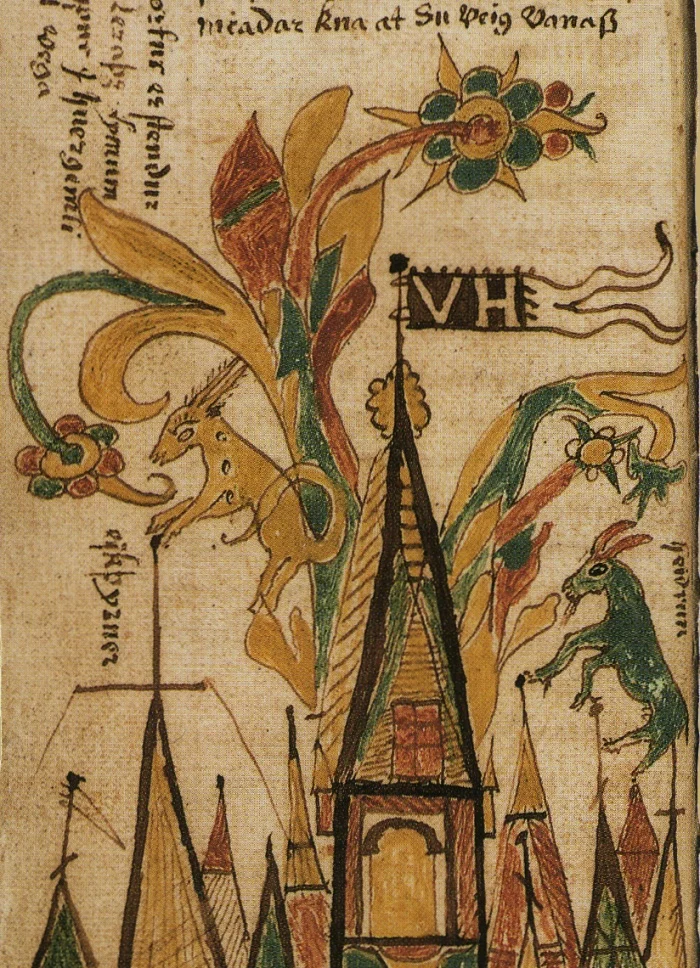
Eikþyrnir
Image associated with the exact linked encyclopedia article; consult credited file description for its interpretation.
Overview
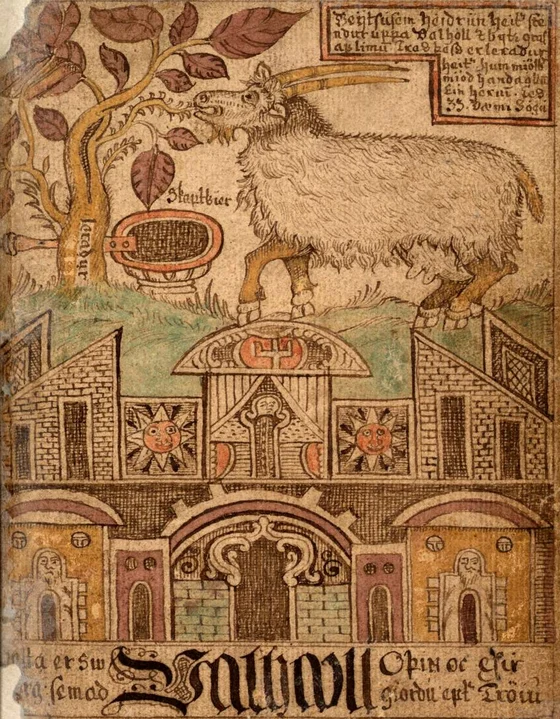
After describing Heiðrún, Snorri introduces a stag feeding from the limbs of the same tree in Valhöll. Eikþyrnir’s antlers give off enough moisture to descend into Hvergelmir, from which an extensive list of rivers flows. The stag thus belongs to an account of cosmic water circulation rather than to a heroic hunt.
The passage connects animal feeding, a tree, an underground source and named waterways. It supplies a distinctive function but does not describe a long sequence of adventures or a detailed physical appearance. Those limits should remain visible in an illustrated profile. Eikþyrnir also differs from the four stags that browse Yggdrasill: sharing a familiar animal form does not make separate Eddic roles and locations interchangeable.
In the Lay of Grimnir, the hart stands above Odin’s hall and browses Læraðr. Drops fall from its horns into Hvergelmir, introduced as the source of all waters. Two following verses name rivers and distinguish waters running around the gods’ dwelling from those falling toward Hel. Brodeur’s prose similarly sends the antler exudation into Hvergelmir and lists waterways, but places the animal in Valhall. This poetic location above the hall and the prose’s phrasing are kept visible; neither selected passage gives the stag a colour, a special number of legs or a battle.
Origins & earliest records
The selected witnesses are Grímnismál in Benjamin Thorpe’s translation, as printed in the 1906 Norroena edition, and Snorri Sturluson’s Gylfaginning, composed around 1220 and translated by Arthur Gilchrist Brodeur in 1916. Poem and prose are cited separately; these edition dates do not identify the beginning of oral transmission.
Records & interpretation
Poetic verses 26–28 establish the horn-water source and following river sequence, compared with prose section XXXIX. The translated literary witnesses document the named animal’s role in their respective accounts.
In the literature
“the hart Eikthyrner, which stands over Valhal and bites the branches of the same tree.”
The Fooling of Gylfe, chapter XII, section 40 · Rasmus Björn Anderson
The hart feeds on Lerad; the next sentence describes water flowing from his horns.
Selected bibliography
Documented works and useful reading. This is not a list of every appearance.
- 01
Prose Edda: Gylfaginning, sections XXXIX
Selected public-domain prose witness. Numbering follows the linked Brodeur translation; neither a universal canon nor an exhaustive bibliography.
- 02
Grímnismál, verses 25–30, especially 26–28
Poetic verses 26–28 establish the horn-water source and following river sequence, compared with prose section XXXIX.
- 03
The Younger Edda
Chicago: Scott, Foresman and Company, 1901; translation copyright 1879, with translator’s preface dated September 1879.
Family, evolution & connections
Hvergelmir
Snorri’s account makes liquid from Eikthyrnir’s horns descend into Hvergelmir, from which named rivers flow. The stag also browses Lærádr near Valhall. This records the animal’s role in a particular cosmological explanation of water, not a literal zoological mechanism or proof that every Norse source arranges the cosmos identically.
Located primary passages
Specific passages supporting details in this entry, grouped by their published witness.
Primary source witness
Chicago: Scott, Foresman and Company, 1901; translation copyright 1879, with translator’s preface dated September 1879.
- The hart feeds on Lerad; the next sentence describes water flowing from his horns.
This documents Snorri’s literary account in Anderson’s translation, not zoological existence or a universal account of all Norse traditions.
Primary source witness
Rasmus Björn Anderson translation, Chicago: Scott, Foresman and Company, 1901; translation copyright 1879.
- Water from Eikþyrnir’s horns flows down to Hvergelmir.
Version-specific detail in the translated literary narrative; not an earliest-attestation or real-fauna claim.
References
Sources supporting this profile. Linked pages have their own scope and editorial standards.
- Primary textThe Prose Edda: Gylfaginning XXXIX (Brodeur translation)Research access: 2026-10-05
- Primary textThe Lay of Grimnir (Thorpe, 1906 edition)Research access: 2026-10-05
Image credits
Reference illustrationEikþyrnir
Image associated with the exact linked encyclopedia article; consult credited file description for its interpretation.