Heiðrún
Image associated with the exact linked encyclopedia article; consult credited file description for its interpretation.
Overview
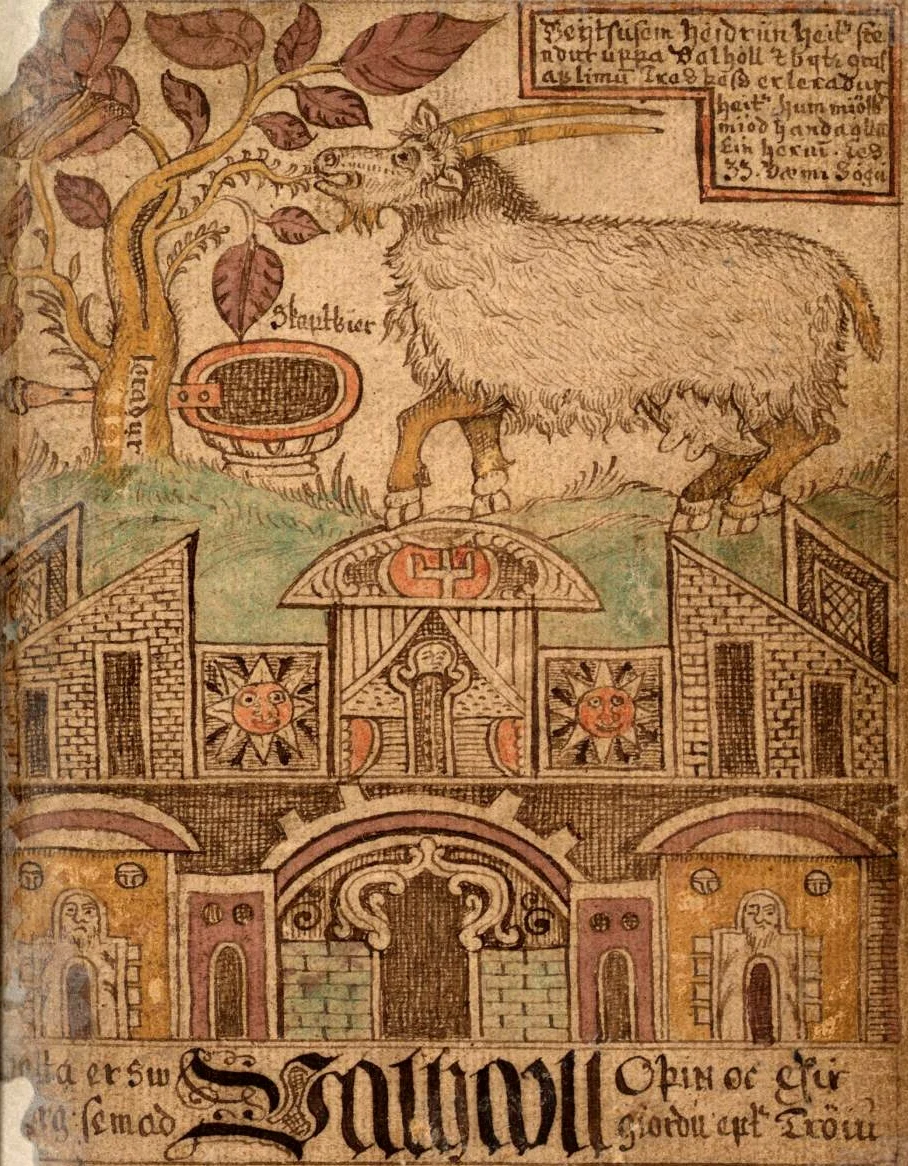
In the Gylfaginning’s explanation of Valhöll, the question of how so many warriors can be given enough drink leads to a remarkable goat. Heiðrún feeds on the famous tree Læraðr, and mead runs from her udders in sufficient quantity to fill a vast vessel every day. The animal makes the hall’s abundant hospitality possible.
The description answers a practical question within an extraordinary setting: an enormous company requires an equally unusual source of provision. Heiðrún’s identity should not be confused with an ordinary goat’s milk production, nor should every symbolic goat in later art be assigned her name. Her nearby companion Eikþyrnir also transforms the tree’s nourishment into flowing liquid, but with a different consequence for the world’s waters.
The Lay of Grimnir places Heiðrún above Odin’s hall, feeding on Læraðr’s branches and filling a bowl with bright mead that never fails. Snorri’s prose expands this compact statement into a conversation about the hospitality owed to dead kings, earls and other warriors who suffered wounds or burning before reaching Valhöll. The quantity becomes a great tun filled daily, sufficient for all the champions to become drunk. The poem’s promise of unfailing drink and the prose’s daily vessel are related formulations, rather than two independently described animals.
Origins & earliest records
The selected witnesses are Grímnismál in Benjamin Thorpe’s translation, as printed in the 1906 Norroena edition, and Snorri Sturluson’s Gylfaginning, composed around 1220 and translated by Arthur Gilchrist Brodeur in 1916. Poem and prose are cited separately; these edition dates do not identify the beginning of oral transmission.
Records & interpretation
Poetic verse 25 is compared with the complete prose dialogue in section XXXIX; the adjacent stag has a different liquid and destination. The translated literary witnesses document the named animal’s role in their respective accounts.
In the literature
“From her teats runs so much mead that she fills every day a vessel in the hall”
The Fooling of Gylfe, chapter XII, section 40 · Rasmus Björn Anderson
Heiðrún’s mead fills the hall’s drinking vessel.
Selected bibliography
Documented works and useful reading. This is not a list of every appearance.
- 01
Prose Edda: Gylfaginning, sections XXXIX
Selected public-domain prose witness. Numbering follows the linked Brodeur translation; neither a universal canon nor an exhaustive bibliography.
- 02
Grímnismál, verses 23–28, especially 25
Poetic verse 25 is compared with the complete prose dialogue in section XXXIX; the adjacent stag has a different liquid and destination.
- 03
The Younger Edda
Chicago: Scott, Foresman and Company, 1901; translation copyright 1879, with translator’s preface dated September 1879.
Family, evolution & connections
Eikthyrnir
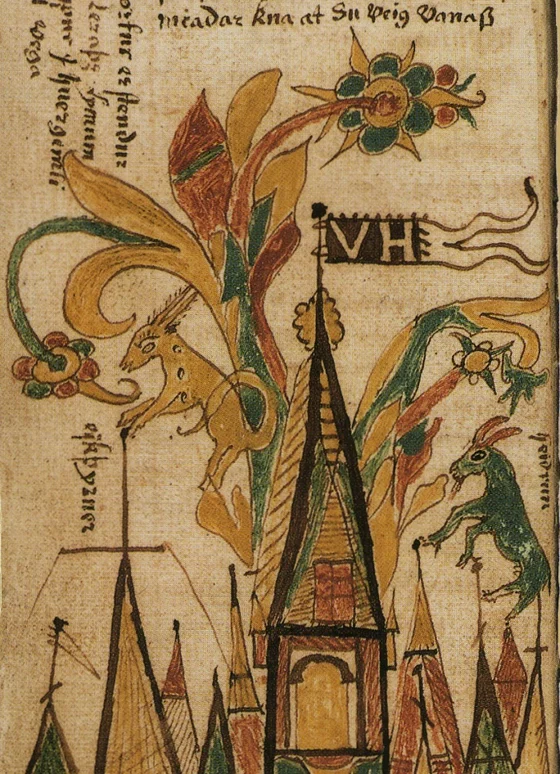
Gylfaginning places the goat Heidrún and the stag Eikthyrnir at Valhall, both feeding from the tree Lærádr. Their outputs differ: the goat supplies mead, while the stag’s horns feed Hvergelmir. This is a documented association within Snorri’s cosmological account, not an ordinary animal food web or a family relationship.
Lærádr
In Gylfaginning chapter XXXIX, Heidrún browses the tree Lærádr and provides abundant mead for Valhall’s champions. The relationship links vegetation, animal feeding and supernatural hospitality in one textual account. It should not be presented as real goat digestion or automatically identify Lærádr with another named world tree without further evidence.
Located primary passages
Specific passages supporting details in this entry, grouped by their published witness.
Primary source witness
Chicago: Scott, Foresman and Company, 1901; translation copyright 1879, with translator’s preface dated September 1879.
- Heiðrún’s mead fills the hall’s drinking vessel.
This documents Snorri’s literary account in Anderson’s translation, not zoological existence or a universal account of all Norse traditions.
Primary source witness
Rasmus Björn Anderson translation, Chicago: Scott, Foresman and Company, 1901; translation copyright 1879.
- Heiðrún feeds on Læraðr’s branches.
- Her mead supply satisfies the einherjar in the hall.
Version-specific detail in the translated literary narrative; not an earliest-attestation or real-fauna claim.
Encyclopedia background
An additional attributed reference, separate from the editorial profile above.
Read the open encyclopedia overview
Heiðrún or Heidrun is a nanny goat in Norse mythology, that consumes the foliage of the tree Læraðr and produces mead from her udders for the einherjar. She is described in the Poetic Edda and Prose Edda.
Text from Wikipedia contributors, “Heiðrún”. CC BY-SA 4.0. Extracted introduction; formatting changed. Retrieved 5 October 2026. The source article may have changed since retrieval.
References
Sources supporting this profile. Linked pages have their own scope and editorial standards.
- Primary textThe Prose Edda: Gylfaginning XXXIX (Brodeur translation)Research access: 2026-10-05
- Primary textThe Lay of Grimnir (Thorpe, 1906 edition)Research access: 2026-10-05
Image credits
Reference illustrationHeiðrún
Image associated with the exact linked encyclopedia article; consult credited file description for its interpretation.