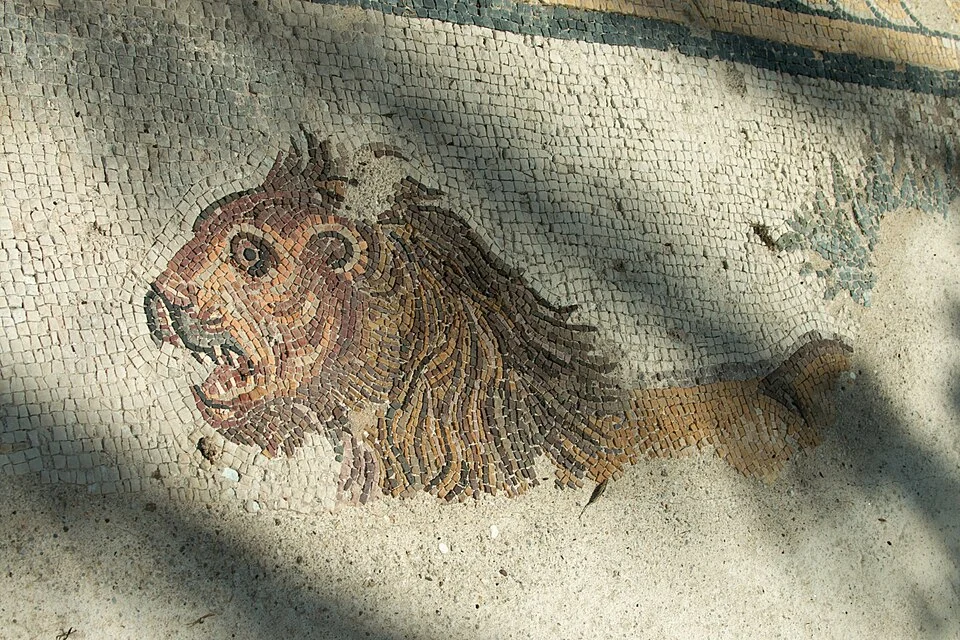
Nemean Lion
Image associated with the exact linked encyclopedia article; consult credited file description for its interpretation.
Overview
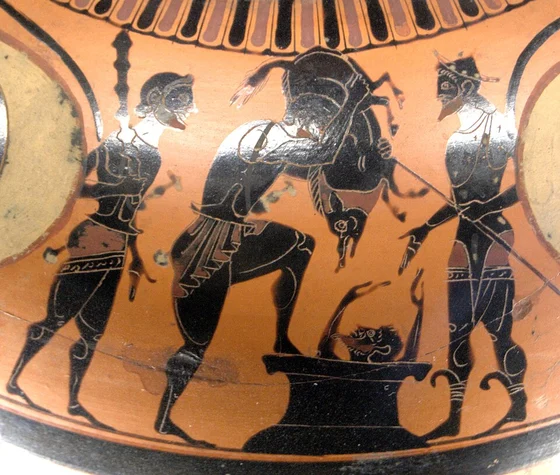
The lion terrorizes the country around Nemea and becomes the first labor in the Library’s account of Heracles. An initial attack with arrows fails because the hide cannot be pierced. The hero then approaches a cave with two openings, blocks one exit and confronts the animal inside, changing the contest from a ranged hunt to a struggle.
Heracles defeats the lion by gripping and choking it, and its skin becomes closely associated with his later appearance. The episode explains both a heroic achievement and a recognizable attribute of the hero. Nemea is a place in the narrative, while the impervious hide marks this particular lion as extraordinary. Its story does not imply that ancient Greek writers considered all lions resistant to weapons.
The Library 2.5.1 calls the invulnerable beast an offspring of Typhon. Its defeat is framed by Heracles’ stay with the labourer Molorchus at Cleonae. The host wishes to sacrifice, but Heracles asks him to wait thirty days: a safe return will require an offering to Saviour Zeus, whereas his death will require honouring him as a hero. Heracles brings the lion back on his shoulders just as Molorchus is preparing the latter offering, and they sacrifice to Zeus instead. At Mycenae the frightened Eurystheus bars the victor from the city and orders future trophies displayed outside the gates; his hiding place and the intermediary herald follow in the same narrative.
Hesiod’s Theogony, in its offspring passage ending at line 332, gives a different genealogical setting. After Echidna’s union with Orthus, it names the Sphinx and Nemean lion; Hera raises the lion as a scourge and settles it in Nemea’s hills. It preys upon the people and ranges over Tretus and Apesas before Heracles overcomes it. This poetic account supplies Hera’s hostile purpose and local places, but does not narrate the blocked cave, the thirty-day sacrifice agreement or the invulnerability test. Its family relationships are kept distinct from the Library’s statement about Typhon.
The twenty-fifth idyll transmitted with Theocritus gives Heracles an extended first-person account of the hunt. Phyleus notices his hide and asks how he killed the extraordinary animal. Heracles says that its origin is unknown to the Argives; divine anger is a conjecture in his speech, not a settled genealogy. He searches a deserted countryside whose frightened inhabitants remain indoors, then sees the blood-covered lion returning to its lair in the evening. Two arrows rebound harmlessly, from flank and breast.
When the lion charges, Heracles strikes its head with his wild-olive club, breaking the weapon but stunning the beast. He seizes it from behind to avoid the claws and strangles it. Unlike the Library’s blocked-cave route, this narrated fight follows the charge. Skinning creates another problem because neither steel nor stone can cut the hide. An unnamed immortal suggests using the lion’s own claws, and Heracles explains that he then wears the skin as protection. The poem leaves that divine adviser unnamed.
Origins & earliest records
This entry follows The Library, Book II, at 2.5.1, in the linked English translation. The work preserves a particular ancient narrative rather than establishing the first appearance of every motif. Its composition period dates a surviving literary witness; older oral transmission and earlier artistic evidence require separate investigation. Idyll XXV in the Theocritus collection preserves a further first-person fight account; its attribution is qualified in the cited edition.
Records & interpretation
Hesiod, Library and the transmitted twenty-fifth idyll give distinct genealogical, heroic and first-person literary settings. The idyll explicitly leaves the lion’s origin unknown and its helpful immortal unnamed; neither is supplied from another version.
In the literature
“the Nemean lion, which Hera, the good wife of Zeus, brought up”
Theogony, lines 306–332 · Hugh G. Evelyn-White
Hera nurtures the lion that later preys on people around Nemea.
Selected bibliography
Documented works and useful reading. This is not a list of every appearance.
- 01
The Library, Book II, 2.5.1
Full Library2.5.1 encounter and Molorchus/Eurystheus aftermath; kept distinct from Hesiod’s genealogy.
- 02
Theogony, offspring passage, lines 326–332
Hera’s rearing of the lion, Tretus and Apesas; genealogy distinct from Library2.5.1.
- 03
Idyll XXV, Heracles the Lion-Slayer (Lang edition pp. 132–143)
Complete preserved fragment read; Phyleus’s question and Heracles’s lion narrative on pp. 139–143. Lang notes incomplete preservation and disputed attribution.
- 04
Theogony, in Hesiod, the Homeric Hymns, and Homerica
Historical English translation; translator’s preface dated 9 September 1914. Gutenberg includes the English portions and relocated footnotes.
- 05
The Library (Bibliotheca)
Pseudo-Apollodorus, The Library, James George Frazer translation, Loeb Classical Library 121–122; Harvard University Press / William Heinemann, 1921.
Family, evolution & connections
Sphinx (Greek)
Hesiod makes the Nemean Lion and the destructive Theban Sphinx offspring of Echidna and Orthrus. The sibling connection belongs to that textual genealogy. Other mythographers change the Sphinx’s father, so a family-tree interface should show the source instead of combining incompatible accounts into one authoritative pedigree.
Located primary passages
Specific passages supporting details in this entry, grouped by their published witness.
Primary source witness
Historical English translation; translator’s preface dated 9 September 1914. Gutenberg includes the English portions and relocated footnotes.
- Hera nurtures the lion that later preys on people around Nemea.
This passage documents one ancient literary version. Translation publication dates are not ancient composition dates or earliest-attestation claims.
The Library, Book II, 2.5.1
Pseudo-Apollodorus, The Library, James George Frazer translation, Loeb Classical Library 121–122; Harvard University Press / William Heinemann, 1921.
- The Nemean lion is invulnerable and is begotten by Typhon in this account.
- Hercules finds arrows ineffective against the lion.
- Hercules blocks one entrance of the two-mouthed cave and chokes the lion.
A version-specific primary witness, not an earliest-attestation claim or proof of zoological existence.
Encyclopedia background
An additional attributed reference, separate from the editorial profile above.
Read the open encyclopedia overview
The Nemean lion (; Ancient Greek: Νεμέος λέων, romanized: Neméos léōn; Latin: Leo Nemeaeus) was a mythical lion in Greek mythology that lived at Nemea. It is most famous for being one of the mythical beasts killed by Heracles (Hercules) in his 12 labours. Because its golden fur was impervious to attack, it could not be killed with mortal weapons. Its claws were sharper than mortal swords and could cut through any strong armour. After Heracles killed the lion, its pelt would come to symbolize Heracles and his strength, being used in art to both recognize the myth itself and to draw connections between Heracles' heroism and others.
Text from Wikipedia contributors, “Nemean lion”. CC BY-SA 4.0. Extracted introduction; formatting changed. Retrieved 5 October 2026. The source article may have changed since retrieval.
References
Sources supporting this profile. Linked pages have their own scope and editorial standards.
- Primary textThe Library, Book II: 2.5.1 (Theoi Classical Texts Library or Project Gutenberg transcription)Research access: 2026-10-05
- Primary ancient text in historical translationTheogony, offspring passage, lines 326–332Research access: 2026-10-05
- Primary textTheocritus collection: Lang1889 edition transcription, Idyll XXVResearch access: 2026-10-05
Image credits
Reference illustrationNemean Lion
Image associated with the exact linked encyclopedia article; consult credited file description for its interpretation.