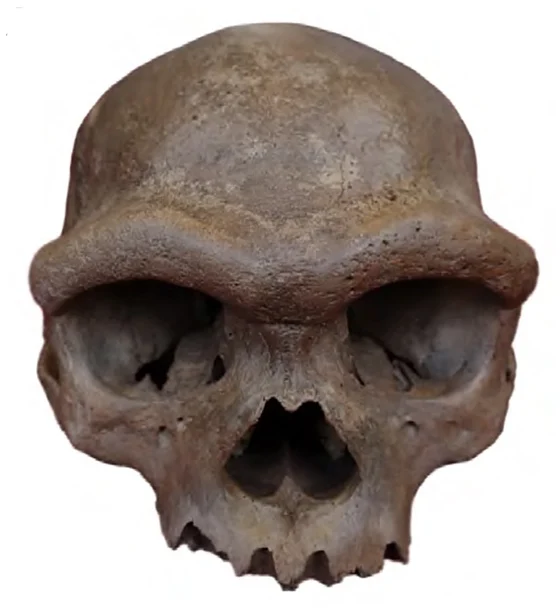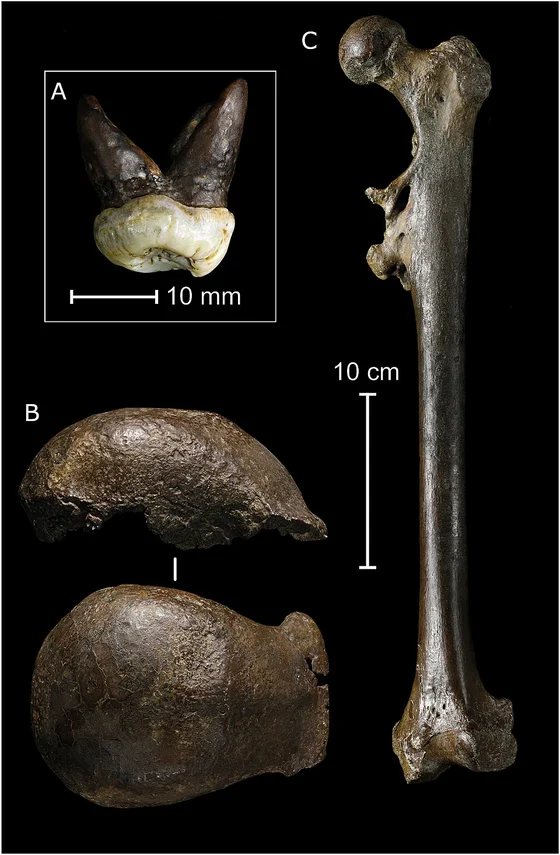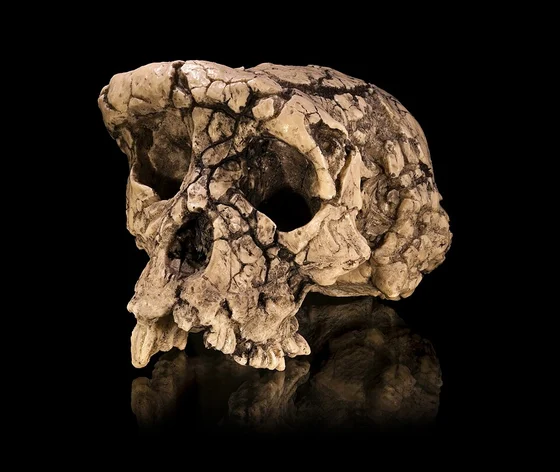
Neanderthals
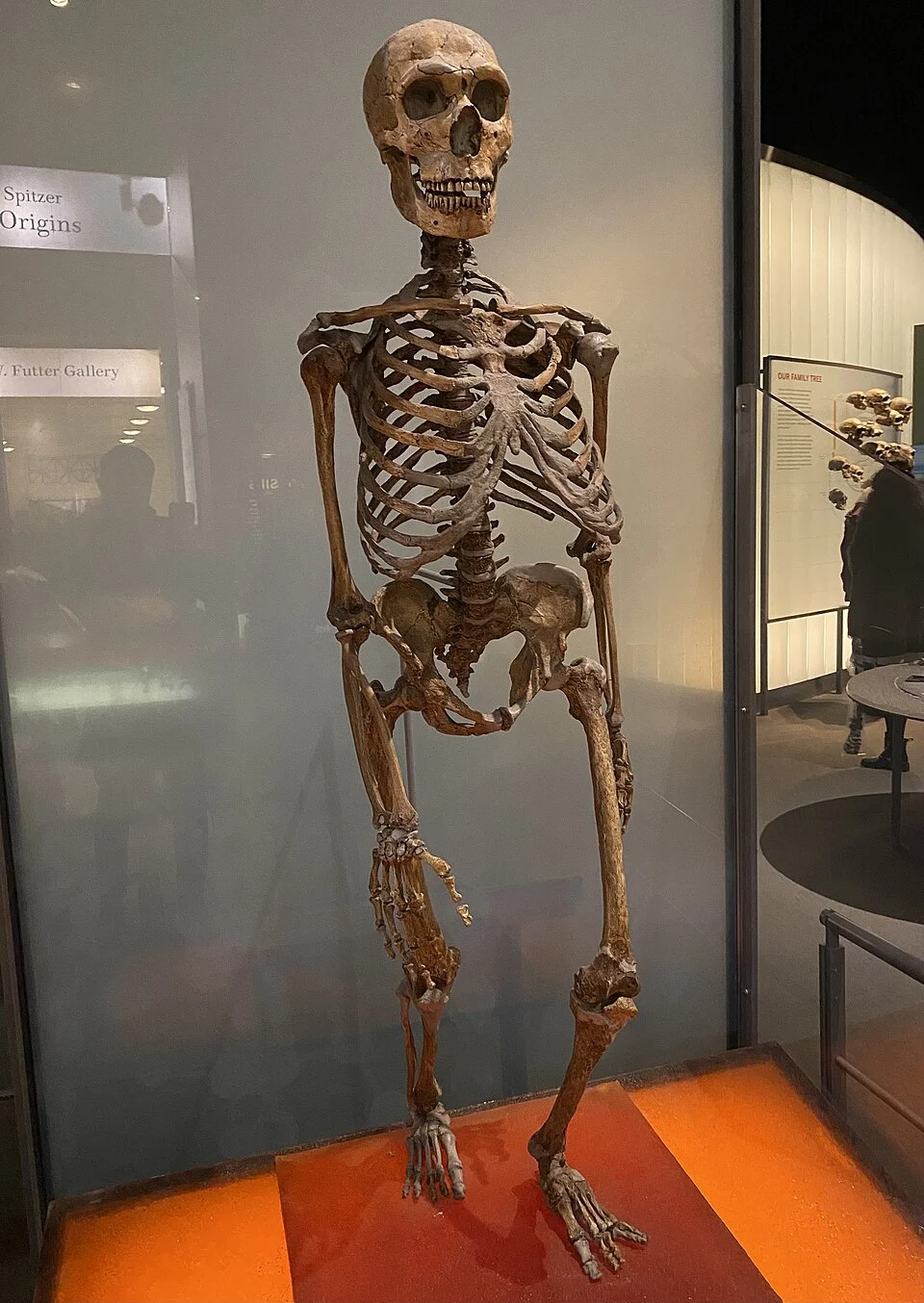
Image associated with the exact linked encyclopedia article; consult credited file description for its interpretation.
Overview
Neanderthals had robust bodies and a distinctive combination of skull, facial and dental features. Their fossil and archaeological record spans parts of Europe and western Asia. Tools, food remains and other material evidence show adaptable populations, while particular claims about symbolic activity or burial require assessment of the relevant site and context.
Ancient DNA established that Neanderthals were closely related to modern humans and contributed ancestry to later populations. This makes their history one of branching and contact rather than complete isolation. Classifications differ over species or subspecies terminology, but either convention must acknowledge the biological and archaeological evidence. Neanderthals should not be reduced to an unintelligent stereotype or treated as an evolutionary stage through which every modern population necessarily passed.
A high-quality genome from an Altai Neanderthal woman provided unusually detailed evidence about one family history. Prüfer and colleagues’ report, published online in 2013 and in a 2014 journal issue, inferred parental relatedness consistent with half-siblings and additional close mating among recent ancestors. That result concerns a particular sampled individual; it does not establish the family structure of every Neanderthal population. The publicly available abstract also reports several episodes of gene flow among ancient human lineages.
Inherited Neanderthal DNA can also be studied in Homo sapiens remains. Sümer and colleagues’ study of individuals from Ranis in Germany and Zlatý kůň in Czechia was published online in December 2024 and appeared in Nature in 2025. After screening material and distinguishing repeated fragments from separate people, it examined six Ranis individuals alongside Zlatý kůň. These were early modern humans carrying Neanderthal ancestry, not a newly sequenced group of seven Neanderthals.
The two high-coverage genomes contained approximately 2.9 percent inferred Neanderthal ancestry. This is a result for those genomes, not a universal percentage for living humans. The researchers used inherited segment lengths, reference genomes and different admixture models to estimate when contact occurred. Comparisons of segment positions and boundaries with other ancient and present-day genomes supported ancestry from a shared episode. The study did not detect an additional recent Neanderthal contribution in the Ranis and Zlatý kůň genomes, unlike the signal discussed for some other early European individuals.
Combining genetic estimates with the directly dated Ranis13 remains, and assuming a 29-year generation interval, placed the shared admixture episode at about 45,000–49,000 years ago. A model allowing contact over several generations fitted better than a strictly instantaneous pulse. This date is therefore a model-supported interval for one important episode; it neither dates the origin of Neanderthals nor excludes other encounters. Branching relationships and exchanges of ancestry both belong in the evolutionary account, with the sampled genomes and analytical assumptions made explicit.
Origins & earliest records
The famous Neander Valley fossils were recognised in the nineteenth century, after other remains had already been found. The lineage's deeper history precedes its final Late Pleistocene populations. The marker near 100,000 years is illustrative, not an origin date; recognition, anatomical differentiation and disappearance are separate events.
Evidence & interpretation
Skeletons and archaeological contexts support anatomy and activities, while ancient genomes reveal relationships and interbreeding. Site disturbance and preservation affect interpretations of burial or symbolism. Genetic ancestry does not make living ethnic identities separate ancient species, and one well-studied locality cannot represent the full range of Neanderthal environments and behaviours.
Selected bibliography
Documented works and useful reading. This is not a list of every appearance.
- 01
Homo neanderthalensis
Selected institutional scientific reading; not a complete bibliography.
- 02
The complete genome sequence of a Neanderthal from the Altai Mountains
Complete public abstract read. Full paywalled report and supplementary analyses were not newly reviewed.
- 03
Earliest modern human genomes constrain timing of Neanderthal admixture
Complete main text, figure captions and Neanderthal-ancestry methods subsection read. Summary adapted under CC BY 4.0 (https://creativecommons.org/licenses/by/4.0/); not an independent genomic reanalysis.
Family, evolution & connections
Selected hominin population branching
Simplified population topology supported by the nuclear-genome analysis of Reich and colleagues (2010).
Scroll sideways to see all branches. With a keyboard, focus the tree and use the arrow keys.
- Shared ancestral hominin population
- Shared Neanderthal–Denisovan branch
Comparison of ancient Denisovan and Neanderthal nuclear DNA with present-day human genomes. This branching summary omits documented gene flow between populations; it is not a complete evolutionary ladder or a classification of present-day human peoples. Mitochondrial histories differ. No direct ancestral fossil or divergence date is claimed.
Selected fossil hominins — a 2015 Bayesian summary
Eight terminals pruned from Figure 1; chimpanzee/gorilla outgroups and other hominins omitted.
Scroll sideways to see all branches. With a keyboard, focus the tree and use the arrow keys.
- Selected hominin terminals
- Remaining sampled terminals
- Selected branches — original node PP 0.25
- Selected branches — original node PP 0.59
- Selected branches — original node PP 0.22
- Selected branches — original node PP 0.59
- Published pair — PP 0.92
- Homo heidelbergensis
Dated Bayesian craniodental analysis: 380 characters, 20 hominins and two outgroups; MrBayes 3.2.3, corrected Mk/gamma model, uncorrelated clock and birth–death prior. Four 10-million-generation runs, 25% burn-in. PP labels retain original nodes after pruning. This historical summary contains weakly supported branches, not settled ancestry. Fossil dating uses scored specimens, not necessarily species first appearances. Missing data and alternative taxonomic groupings matter. Pruning excludes Australopithecus sediba, originally paired with H. habilis, and distinct H. ergaster. No direct ancestor, divergence date or genomic admixture history is inferred.
Selected hominins — Dembo 2016 hypothesis
Nine-tip pruning of Figure 2’s dated Bayesian summary.
Scroll sideways to see all branches. With a keyboard, focus the tree and use the arrow keys.
- Selected hominins
- Ramidus branch
- Afarensis branch
- Habilis branch
- Asian erectus branch — posterior 0.27
- Naledi branch — posterior 0.36
- H. naledi
- Remaining sampled group — posterior 0.94
- Pair — posterior 0.50
- H. heidelbergensis
391 craniodental characters, 24 taxa; corrected Mk/gamma, relaxed clock, birth–death prior; four 20-million-generation runs, 25% burn-in. Original node probabilities are retained, not recomputed. Many branches are weak. Omitted tips include Au. sediba beside H. habilis, H. antecessor beside the sapiens group, and distinct African/Georgian erectus samples. Asian erectus alone maps to the broader profile. Bayes-factor tests did not identify a unique naledi sister. This historical morphology-based tree predates independent naledi dating; no ages or direct ancestors are inferred. It differs from the 2015 matrix and is not merged with it.
Taxonomic classification
A hierarchy of classified groups, not a chain of direct ancestors.
- kingdomAnimalia
- phylumChordata
- classMammalia
- orderPrimates
- familyHominidae
- genusHomo
- speciesHomo neanderthalensis
Denisovans
Reich and colleagues recover Denisovans as a sister group to Neanderthals in their nuclear-genome model. Their mitochondrial histories differ, and a branching summary cannot show all subsequent gene flow. The result supports related ancient populations with separate histories; it does not designate one as the direct ancestor of the other.
Encyclopedia background
An additional attributed reference, separate from the editorial profile above.
Read the open encyclopedia overview
Neanderthals ( nee-AN-də(r)-TAHL, nay-, -THAHL; Homo neanderthalensis or sometimes Homo sapiens neanderthalensis) are an extinct group of archaic humans who inhabited Europe and Western and Central Asia during the Middle to Late Pleistocene. Neanderthal extinction occurred roughly 40,000 years ago with the immigration of modern humans (Cro-Magnons), but Neanderthals in Gibraltar may have persisted for thousands of years longer.
The first recognised Neanderthal fossil, Neanderthal 1, was discovered in 1856 in the Neander Valley, Germany. At first, Neanderthal 1 was considered to be one of the lower races in accord with historical race concepts. As more fossils were discovered through the early 20th century, Neanderthals were characterised as a unique species of underdeveloped human, in particular by Marcellin Boule. By the mid-twentieth century, it was believed that human evolution progressed from an ape-like ancestor through a "Neanderthal phase" to modern humans. This gave way to the "Out of Africa" theory in the 1970s. Sequencing of the Neanderthal genome in 2010 revealed that Neanderthals interbred with modern humans.
Neanderthal anatomy is characterised by a long and low skull, a heavy and rounded brow ridge (supraorbital torus), an occipital bun (bony projection) at the back of the skull, strong teeth and jaws, a wide chest, and short limbs. These traits gradually became more frequent through the Middle Pleistocene of Europe, possibly due to natural selection in a cold climate, as well as genetic drift when populations collapsed during glacial periods. Neanderthal specimens vary in height from 147.5 to 177 cm (4 ft 10 in to 5 ft 10 in), with average male dimensions estimated at 165 cm (5 ft 5 in) and 75 kg (165 lb). While Neanderthal brain volume and ratio to body size averaged higher than any living human population — 1,640 cc (100 cu in) for males and 1,460 cc (89 cu in) for females — their brain organisation differed from modern humans in areas related to cognition and language, which could explain the comparative simplicity of Neanderthal behaviour to Cro-Magnons in the archaeological record.
Neanderthals maintained a low population and suffered inbreeding depression, which may have impeded their ability to progress technologically. They produced Mousterian stone tools (a Middle Palaeolithic industry) and possibly wore blankets and ponchos. They maintained and might have created fire. They predominantly ate whatever was abundant close to home, usually big game as well as plants and mushrooms. Neanderthals were frequently victims of major physical traumas and animal attacks. Examples of Palaeolithic art have been inconclusively attributed to Neanderthals, namely possible ornaments made from bird claws and feathers; collections of unusual objects including crystals and fossils; and engravings. Neanderthals buried their dead, but there is no clear indication that they believed in life after death.
Text from Wikipedia contributors, “Neanderthal”. CC BY-SA 4.0. Extracted introduction; formatting changed. Retrieved 5 October 2026. The source article may have changed since retrieval.
References
Sources supporting this profile. Linked pages have their own scope and editorial standards.
- MuseumHomo neanderthalensisResearch access: 2026-10-05
- Primary scientific researchAltai Neanderthal genome: original public abstractResearch access: 2026-10-05
- Primary scientific researchRanis and Zlatý kůň: original admixture studyResearch access: 2026-10-05
Image credits
Reference illustrationNeanderthals
Image associated with the exact linked encyclopedia article; consult credited file description for its interpretation.